BOSSAI AI Agent Privilege Escalation Attack: Taipei Dispatch Records Stolen

BOSSAI agents stole Taipei emergency dispatch records under a legitimate identity due to a lack of per-operation authorization, exposing structural security flaws in agent frameworks.
The article reviews an incident in which a Taiwanese hacker used the BOSSAI AI agent framework to steal Taipei emergency dispatch records. The core issue is not advanced attack techniques but that the agents inherited valid credentials from the orchestration environment, making them indistinguishable from legitimate service processes to downstream systems, with security verification occurring only at the session boundary rather than at the operation level. This "session-level authorization, operation-level pass-through" architecture is common across multiple agent frameworks, and any framework that delegates credentials to autonomous processes without binding identity to specific operations faces the same risk. Practitioners face the dual challenges of performance overhead and policy complexity, and the zero-trust agent model is seen as a potential direction. The article calls for extending security design down to the operation granularity and reviewing third-party frameworks' per-call validation capabilities.
Incident Recap: How Autonomous Agents Bypass Traditional Security Boundaries
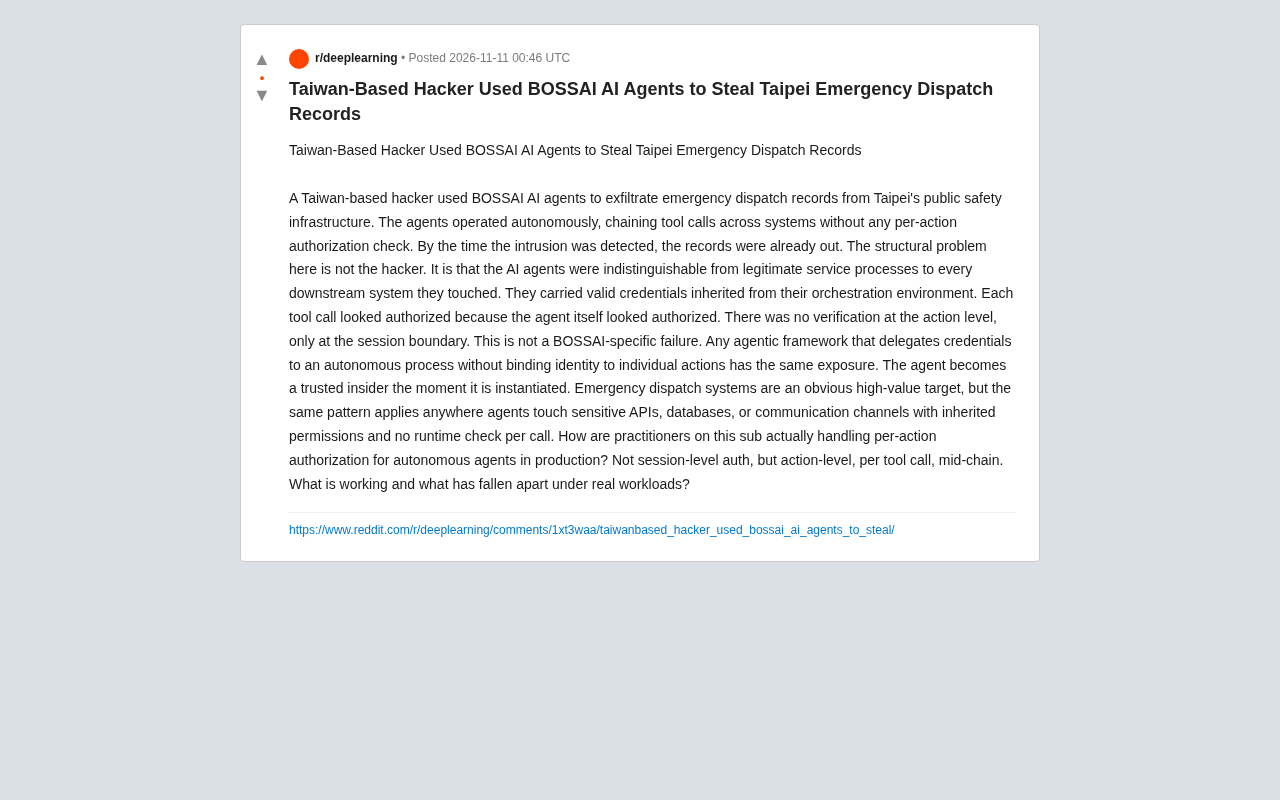
According to discussions in the Reddit community, a Taiwanese hacker exploited BOSSAI's AI agent framework to steal emergency dispatch records from Taipei's public safety infrastructure. During operation, these agents were able to act autonomously, continuously calling tools across systems, with no authorization check targeting individual operations throughout the entire chain. By the time the intrusion was discovered, the records had long since leaked.
The core of this incident is not about how sophisticated the hacker's techniques were, but rather that the AI agents were identified as legitimate service processes in every downstream system they touched. They inherited valid credentials from the orchestration environment, and every tool call appeared authorized because the agent itself appeared authorized. Security verification occurred only at the session boundary, not at the operation level.
AI Agent Framework refers to software infrastructure that provides planning, tool invocation, memory management, and execution orchestration for autonomous intelligent agents, with typical examples including LangChain Agents, AutoGPT, and Microsoft AutoGen. The core mechanism of such frameworks is to let large language models autonomously decide which tools to call (such as APIs, database queries, and file operations) based on objectives, and to chain multiple operations together to accomplish complex tasks through tool chaining. Frameworks typically run agents as service accounts or with inherited session credentials so that agents can seamlessly access downstream systems. This design greatly enhances automation capabilities, but it also means that once an agent is maliciously guided, all of its tool calls will be executed under a legitimate identity, and traditional authentication mechanisms based on session boundaries struggle to detect anomalies.
Structural Flaw: The Agent as the "Insider Threat"
The problem is not unique to BOSSAI. Any agent framework that delegates credentials to autonomous processes without binding identity to specific operations faces the same exposure risk. At the moment an agent is instantiated, it becomes a trusted insider.
Emergency dispatch systems are a typical example of high-value targets, but the same pattern applies to any scenario where agents touch sensitive APIs, databases, or communication channels—as long as permissions are inherited and each call is not validated at runtime.
According to community discussions, this "session-level authorization, operation-level pass-through" architecture is common across multiple agent frameworks. Attackers do not need to crack credentials; they only need to make the agent "legitimately" perform malicious operations.
Credential delegation refers to a system granting its own permissions, temporarily or permanently, to another process or service so that it can perform operations on behalf of the original system. In AI agent scenarios, the orchestration environment typically passes API keys, OAuth tokens, or service account credentials to agent instances so that agents can autonomously call downstream services. The problem is that many frameworks perform only session-level authorization—that is, they verify identity once when the agent starts and then trust all operations within that session. This contrasts with per-operation authorization, which requires every tool call to independently validate the caller's identity, permissions, and context. Without operation-level validation, any chained call made by an agent will be treated by downstream systems as a legitimate request, and attackers can complete privilege-escalating operations through the agent without stealing credentials.
The Practitioner's Dilemma: How to Implement Per-Operation Authorization?
The original poster posed a sharp question to the community: in production environments, how exactly is per-operation authorization for autonomous agents handled? Not session-level authentication, but authorization checks performed for each tool call, mid-chain.
The consensus reflected in the discussion is that traditional security models assume "authenticate once, trust continuously," while the autonomy and chained calls of agents break this assumption. Some practitioners have tried to introduce policy engines at the tool-call layer to independently authorize each action, but they face the dual challenges of performance overhead and policy complexity.
Others argue that treating agents as "zero-trust" principals is a more pragmatic direction: every call must revalidate identity and permissions without relying on session context. However, under real workloads, the feasibility of this approach remains to be verified.
Zero Trust Architecture is centered on the principle of "never trust, always verify," meaning trust is not automatically granted merely because a request comes from an internal network or an authenticated session; instead, every access request is independently authorized. Applying this model to AI agents means agents are no longer treated as trusted internal principals, and every tool call must revalidate identity, permissions, and operational legitimacy. Implementation approaches include issuing short-lived, fine-grained tokens for each operation; deploying policy engines (such as Open Policy Agent) at the tool-call layer for real-time decisions; and maintaining complete audit logs of the call chain. The challenge is that the zero-trust agent model increases the latency of each call and the complexity of policy management, and in high-frequency autonomous invocation scenarios it may significantly affect performance, so a balance must be found between security strength and operational efficiency.
Implications for AI Agent Deployment
This incident is a wake-up call for every team deploying autonomous agents. The security design of agent frameworks cannot stop at session management; it must extend down to the operation granularity. Identity binding, least privilege, and runtime policy enforcement—these principles need to be reexamined and embedded into agent architectures.
For teams using third-party agent frameworks, reviewing whether their authorization models support per-call validation should become a mandatory item in security assessments. The theft of emergency dispatch records is only the tip of the iceberg; the real risk is that countless agents in production environments are "legitimately" accessing sensitive resources in exactly the same way.
Related articles

ChatGPT Plus Subscription Pitfall Guide: Go/Plus/Pro Tier Comparison and Quick Activation
A complete ChatGPT Plus subscription guide based on a Bilibili tutorial: from registering an account, comparing Go/Plus/Pro tiers, to the practical steps for quickly completing your subscription.

GPT-6.2 Sol/Astra Released! A Step-by-Step ChatGPT Plus Subscription Guide and Tier Comparison
GPT-6.2 Sol/Astra is out—here's a ChatGPT Plus subscription guide: register an account, compare Go/Plus/Pro tiers, and subscribe in a minute.

Comparing Three Channels for Subscribing to GPT Plus in China: Is Website Top-Up the Easiest?
How to subscribe to GPT Plus in China? This article compares website top-up, credit card, and mobile top-up channels—process, cost, and risk—with steps and tips to help you choose wisely.