Botric: Making Brands Visible in AI Search
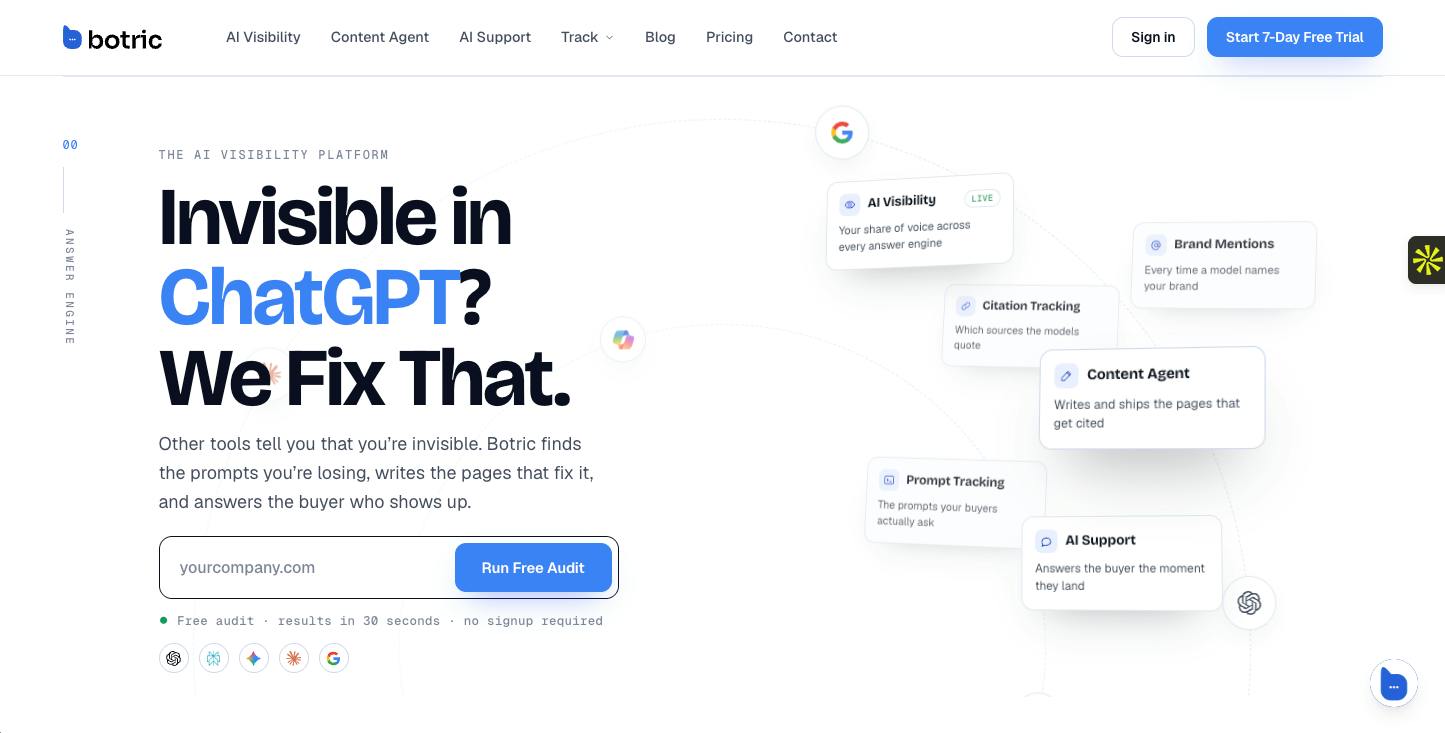
Botric monitors brand mentions and citations in AI search to facilitate GEO optimization.
Botric is a new tool for the AI search era that helps brands track mentions and citations across ChatGPT, Gemini, Claude, Google AI Overviews, and other platforms, while monitoring competitor performance. The article notes that AI search's answer generation differs from traditional SEO, making model adoption a new battleground. Botric offers monitoring and optimization modules, with the latter using content agents to generate optimized content and boost recommendation probability. This falls under the emerging GEO field, which lacks definitive methodology; Botric positions itself as data-driven experimentation for marketing and SEO teams, though the product is still early-stage with limited community traction.
AI search is reshaping how users find information. When users ask ChatGPT, Gemini, or Google AI Overviews a question, whether a brand gets recommended or cited directly affects traffic and conversions. Botric, a new product on Product Hunt, targets exactly this pain point—helping brands track and improve their visibility in AI search.
Why AI Search Visibility Is the New Battleground
Traditional SEO focuses on a webpage's ranking in search engine results pages, but AI search's answer generation mechanism is entirely different: the model synthesizes multiple sources, generates a natural language response, and may include citation links. This means that even if your webpage ranks high in traditional search, it may not be selected by AI as an answer source. A brand's "presence" in AI answers depends on whether the model mentions, cites, and how it evaluates your brand.
Botric's positioning is precisely to fill this gap. According to its Product Hunt page description, the tool can monitor brand mentions and citations across ChatGPT, Gemini, Claude, Google AI Overviews, and other platforms, while also tracking competitor performance. This cross-platform monitoring capability has practical appeal for marketing teams looking to stay competitive in the AI era.
AI Overviews is an AI summary module that Google generates directly at the top of search results pages, powered by the Gemini model. It synthesizes multiple web sources to generate an answer with citation links. It appears alongside traditional blue link lists but occupies the most prominent position, and users often get answers without needing to click. This means that even a webpage ranking first may lose clicks because it wasn't cited by AI Overviews. For brands, being cited by AI Overviews is equivalent to gaining exposure in a "zero-click" scenario, making it a new optimization target.
Retrieval-Augmented Generation (RAG) is the underlying mechanism of current mainstream AI search: the model first retrieves relevant webpage snippets before generating an answer based on those snippets. This explains why "being retrieved" doesn't equal "being cited"—the model filters, compresses, and reorganizes source content, and only pages with high semantic relevance, high information density, and clear structure are more likely to be adopted. Understanding RAG helps brands understand that the essence of GEO is increasing the probability of content being retrieved and cited, rather than simply stuffing keywords.
Breaking Down Botric's Core Features
Based on the product description, Botric offers two major capability modules: monitoring and optimization.
On the monitoring side, Botric helps brands understand their exposure across various AI searches, including mention frequency, citation context, and relative competitor performance. This is similar to ranking tracking tools in traditional SEO, but the subject becomes AI-generated answers.
On the optimization side, Botric introduces the concept of "content agents." These agents can generate optimized content to increase the probability of brands being recommended by AI. The essence of this approach is to influence model output by producing content that better aligns with AI model preferences.
Interestingly, Botric doesn't guarantee that brands will definitely be recommended by AI, but rather increases that possibility through data feedback and content optimization. This pragmatic positioning reflects the current actual state of AI search optimization—no definitive methodology has been established yet, but gradual improvement is possible through experimentation and data-driven approaches.
Content agents typically refer to automated content production workflows built on large models: given brand information, target keywords, and platform preferences, agents can batch-generate or rewrite articles, FAQs, product descriptions, and other content, adjusting structure according to GEO research recommendations (such as adding bullet lists, data citations, authoritative source links). The logic is "using AI to influence AI"—making content better align with retrieval and citation preferences. However, note that batch-generated content without fact-checking and quality control may be judged by models as low-quality sources, potentially damaging brand credibility. Therefore, content agents are better suited as auxiliary experimental tools rather than complete replacements for human planning.
The Rise and Controversy of Generative Engine Optimization (GEO)
What Botric represents is an emerging field called "Generative Engine Optimization" (GEO). Unlike traditional SEO, GEO's goal is not to rank webpages higher in search results, but to have brand information adopted and presented to users by AI models.
This field is still in its early stages and has considerable controversy. On one hand, AI model outputs are uncertain and dynamic—the same question may yield different answers at different times and on different platforms, posing challenges for tracking and optimization. On the other hand, there is no recognized best practice for how to "optimize" content to influence AI output, and the effectiveness of different tools and methods is difficult to compare horizontally.
Botric's product approach is: establish a baseline through continuous monitoring, then observe changes through content experiments, forming a feedback loop. This data-driven approach is a reasonable exploration path in an environment lacking definitive rules.
The GEO concept was first systematically proposed by Princeton University and other institutions in the 2023 paper "Generative Engine Optimization." Research showed that by adjusting content structure, citing authoritative sources, and adding statistical data, content visibility in generative engines can be improved by up to approximately 40%. This research provides an academic foundation for GEO, but there is a gap between experimental environments and real commercial search, and effectiveness varies by model and query type.
Related to GEO are terms such as AEO (Answer Engine Optimization) and LLMO (Large Language Model Optimization), with slightly different emphases: GEO emphasizes generative engines as a whole, AEO focuses on Q&A-style results, and LLMO focuses on large models themselves. The industry has not yet unified terminology, and tool vendors often use them interchangeably. When evaluating tools, brands should focus on the actual platform coverage and metric definitions rather than just conceptual packaging.
Who Needs Botric
From its product positioning, Botric primarily targets marketing and SEO teams, especially brands that have already recognized the importance of AI search traffic. For businesses relying on organic traffic for customer acquisition, visibility in AI search may directly affect potential customers' awareness and decisions.
However, Botric is still an early-stage product. The data of 15 votes and 5 comments on Product Hunt indicates that its community traction is still in its infancy. For teams interested in trying it, it's recommended to first clarify monitoring objectives—such as which AI platforms and keyword scenarios to focus on—then use Botric's data feedback for small-step experiments.
The rules of AI search are still evolving rapidly. The value of tools like Botric lies more in providing an observation window and experimental leverage than in being a one-time solution. Brands need to maintain continuous attention to AI search dynamics and flexibly adjust strategies based on data feedback.
One-line Summary
Botric monitors brand mentions and citations in AI search, facilitating GEO optimization.
Paragraph Summary
Botric is a new tool for the AI search era, helping brands track mentions and citations across ChatGPT, Gemini, Claude, Google AI Overviews, and other platforms, while monitoring competitor performance. The article points out that AI search's answer generation mechanism differs from traditional SEO, and whether brands are adopted by models has become a new battleground. Botric offers two major modules: monitoring and optimization, the latter generating optimized content through "content agents" to increase the probability of being recommended. This falls under the emerging field of Generative Engine Optimization (GEO), which currently lacks definitive methodology. Botric positions itself as data-driven experimentation, suitable for marketing and SEO teams to try in small steps, but the product is still early-stage with limited community traction.
Related articles

A 19-Year-Old's Rental Horror Story: Ceiling Collapse, Bug Infestation, and the Lessons It Taught Me
At 19, my first off-campus rental brought bug infestations, no heat, a collapsed ceiling, and a ruined laptop with no renter's insurance. Here are the hard-won lessons for first-time student renters.

Veda Nurse's Cranial Nerve Exam: Why ASMR Role-Play Is Going Viral
Bilibili creator Veda's cranial nerve exam ASMR video goes viral, blending humor and sensory triggers through nurse role-play. This article analyzes its unique appeal and the audience psychology behind ASMR role-play.

LG Cinebeam AI Review: 120-Inch Giant Screen + 3000 Lumens, a New Choice for the Living Room Theater
LG Cinebeam AI projector review: 3000 ANSI lumens, 4K, 100 inches from about 8 cm and 120 inches from about 18 cm. Built-in webOS, AI Concierge voice recommendations, AI Sound Pro 11.1.2 virtual surround, and Game Optimizer—positioned for fixed living room installation, complementing the portable Cinebeam S.