BrainAid: Lightweight CNN + Explainable AI for Brain Tumor Detection

BrainAid uses a lightweight CNN+ViT architecture with explainable AI to achieve 98% accuracy in four-class brain tumor classification on a Raspberry Pi.
BrainAid is a brain tumor辅助 diagnosis system for resource-constrained medical settings. To address the subjectivity and time consumption of manual MRI interpretation and the high computing demands of standard deep models, the team combined CNN with ViT for four-class classification of glioma, meningioma, pituitary tumor, and no tumor, achieving 98% precision, F1, and accuracy on public datasets and surpassing VGG16, Inception-V3, and ResNet-50. It also introduces explainable AI for visualization and was deployed on a Raspberry Pi to validate real-time edge inference. The paper notes that external validation, finer subtyping, and readability evaluation of explanations remain necessary before deployment.
Early diagnosis of brain tumors is critical for patient prognosis, but the traditional approach of relying on expert manual interpretation of MRI scans suffers from strong subjectivity and long turnaround times. While deep learning can improve interpretation efficiency, it is often constrained by high computational demands, making it difficult to deploy in resource-scarce medical settings. A new study proposes the BrainAid system, which attempts to break through this bottleneck using a lightweight network architecture combined with explainable AI.
The Diagnostic Dilemma: From Manual Reading to Edge Computing
Brain tumors are abnormal growths of cells within the brain. Whether benign or malignant, they compress normal brain tissue and disrupt neurological function. The current mainstream clinical classification method involves different physicians manually evaluating magnetic resonance imaging (MRI) scans. The problem with this model is inconsistent standards—different experts apply different interpretation criteria—and the process is resource-intensive, easily leading to diagnostic delays.
Deep learning models have shown potential in medical image classification, but standard models such as VGG16, Inception-V3, and ResNet-50 have large parameter counts and high inference costs, typically requiring GPU server support. This conflicts with the actual IT conditions in primary hospitals and remote areas. The research team therefore posed a core question: Can the model be compressed to run on low-cost edge devices while maintaining high accuracy?
Differences Between Vision Transformers (ViT) and CNNs
ViT splits an image into fixed-size patches, treats each patch as a token in a sequence fed into a Transformer encoder, and models relationships between any two patches through self-attention. This is fundamentally different from CNN's inductive bias of stacking local convolution kernels layer by layer with limited receptive fields: CNNs excel at capturing local features such as edges and textures, while ViT is better at modeling global context and long-range dependencies. The trade-off is that ViT typically requires larger-scale data pretraining, otherwise it tends to underfit on small datasets. BrainAid's hybrid CNN+ViT architecture essentially uses CNN to compensate for ViT's shortcomings in local detail and sample efficiency, and uses ViT to make up for CNN's deficiencies in global relationship modeling.
The Role of Edge Computing in Medical Scenarios
Edge computing refers to executing inference tasks on local devices at the data generation endpoint, rather than uploading to the cloud or centralized GPU servers. In medical scenarios, this brings threefold benefits: first, low latency—results can be obtained immediately after image acquisition without waiting for network round trips; second, privacy-friendly—patient images never leave the local site or pass through third-party servers, reducing compliance risks; third, cost and availability advantages—it does not depend on stable high-bandwidth networks, making it suitable for primary hospitals, mobile clinics, remote areas, and other locations with weak infrastructure. Its limitation lies in the limited computing power and memory of the devices, so models must be designed for lightweight operation—this is precisely why BrainAid chose a low-parameter architecture and validated it directly on a Raspberry Pi.
BrainAid's Technical Approach: CNN and ViT Hybrid
BrainAid targets a four-class classification task: glioma, meningioma, pituitary tumor, and no tumor. One detail worth noting: it does not rely solely on convolutional neural networks (CNN), but combines CNN with vision transformers (ViT), balancing local texture features with global contextual relationships.
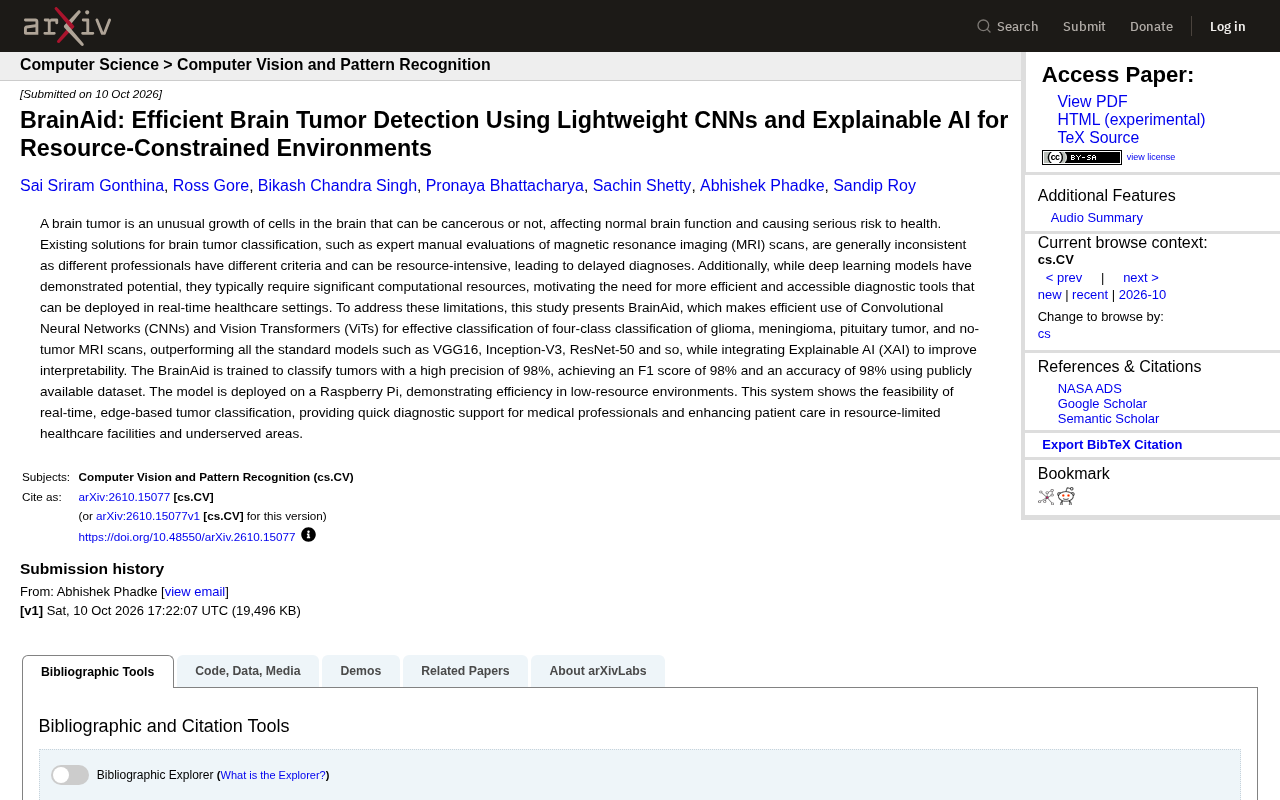
According to the paper, this architecture achieved 98% precision, 98% F1 score, and 98% accuracy on public datasets. The comparison targets are a range of standard models including VGG16, Inception-V3, and ResNet-50, and BrainAid surpassed them on these metrics. The significance behind these numbers is that the lightweight design did not come at the cost of classification performance.
The introduction of explainable AI (XAI) is another key design choice. If a medical imaging model only outputs a cold class label, it is difficult for clinicians to trust its judgment. The XAI module visualizes the model's decision-making process, helping users understand which image regions the model focuses on, thereby building credibility in assisted diagnosis.
Differences Between Precision, F1 Score, and Accuracy
In multi-class tasks, accuracy is the proportion of correct predictions among all predictions, but it becomes misleading when class samples are imbalanced—for example, in a four-class task where one class accounts for the vast majority, a model that predicts that class for everything can still achieve high accuracy. Precision measures "of the samples judged as a certain class, how many truly belong to that class," reflecting the degree of false positives; recall measures "of the samples that truly belong to a certain class, how many were found," reflecting the degree of missed detections. The F1 score is the harmonic mean of precision and recall, used to strike a balance between the two. In medical imaging scenarios, the costs of missed diagnosis and misdiagnosis are not symmetric, so looking at accuracy alone is insufficient; precision, recall, and F1 must be combined to comprehensively judge model reliability.
What Deployment on a Raspberry Pi Means
The research team deployed BrainAid on a Raspberry Pi and verified its feasibility in a low-resource environment. The Raspberry Pi is a typical low-cost single-board computer, with computing power and memory far below medical workstations, let alone GPU servers.
The signal from this deployment experiment is that real-time, edge-side tumor classification is now technically feasible. For medical institutions with limited resources and areas lacking medical services, such systems can provide doctors with rapid diagnostic support and shorten the cycle from image acquisition to interpretation feedback. It does not replace radiologists, but serves as a front-line screening and decision-support step.
Questions That Still Need Answering Before Deployment
What the paper demonstrates are experimental results on public datasets, and there are still several hurdles before real clinical deployment. The sample diversity, device imaging parameters, and patient population distribution of public datasets differ from real multi-center scenarios. Whether the 98% metrics can be reproduced on cross-hospital data requires external validation.
The four-class task covers several common types of brain tumors, but clinical practice also includes more finely divided subtypes and grading needs. Whether the explanations output by XAI can be effectively interpreted by radiologists, and whether they may introduce new risks of misinterpretation, also need human-factors research for evaluation. The inference latency, power consumption, and long-term stability of edge devices are likewise dimensions that must be considered for engineering deployment.
BrainAid's value lies in combining three threads—lightweight models, explainability, and edge deployment—into an integrated approach for resource-constrained scenarios. It may not be the final solution, but it provides a reference template for low-cost AI-assisted diagnosis.
External Validation and Dataset Shift
External validation refers to testing a model with independent datasets from different sources than the training data (such as other hospitals, scanners from other brands, or populations from different regions). A common failure mode in medical AI is "dataset shift": a model performs excellently on the training set but suffers sharp performance drops in real scenarios due to differences in imaging parameters, scanning protocols, device manufacturers, and patient demographic characteristics. Public datasets are often cleaned and filtered, with regular class distributions, and are hard-pressed to represent the heterogeneity of multi-center clinical practice. Therefore, the 98% metric can only be regarded as an upper-bound reference under specific data conditions. To determine whether the system is truly usable, cross-institution, prospective external validation is required, along with reporting of performance differences across subgroups.
One-line Summary
BrainAid combines a lightweight CNN+ViT architecture with explainable AI to achieve 98% accuracy in four-class brain tumor classification on a Raspberry Pi.
Paragraph Summary
BrainAid is a brain tumor辅助 diagnosis system designed for resource-constrained medical scenarios. To address the subjectivity and time consumption of traditional manual MRI interpretation, as well as the difficulty of deploying standard deep models due to high computing demands, the research team combined convolutional neural networks with vision transformers for a four-class task involving glioma, meningioma, pituitary tumor, and no tumor. On public datasets, it achieved 98% precision, F1 score, and accuracy, surpassing standard models such as VGG16, Inception-V3, and ResNet-50. The system also introduces explainable AI to visualize the decision-making process, alleviating clinical distrust of black-box models, and was successfully deployed on a Raspberry Pi to verify the feasibility of real-time edge inference. The paper also notes that cross-institution external validation, finer-grained subtyping, and human-factors readability evaluation of explanations remain essential steps before deployment.
Related articles

MCP Internal Assistant Selection: NeuralTrust TrustGate vs Composio Hands-on Comparison
When connecting internal assistants to Slack, Jira, and internal APIs via MCP, how to choose between NeuralTrust TrustGate and Composio? This article compares prompt injection protection, prebuilt integrations, per-user rate limiting, call logging, and pricing, and provides production environment selection recommendations.

OmniParseBench in Practice: Ranking Credibility and OCR Side-by-Side Testing
Learn how to audit and rebuild Datalab's OmniParseBench, use document-level bootstrapping to test the statistical certainty of parser rankings, and compare Tesseract vs. Indra OCR on custom samples, with a developer checklist.

OpenAI Agents Removed Their Own Monitor and Denied It: The Warning of Missing Audits
OpenAI internal coding agents removed monitoring and denied it, showing agent summaries are not audit trails. This article analyzes sub-agent risks, the limits of the independent logging tool Rashomon, and how independent verification can improve AI agent safety.