Branch and Bound vs A*: A Search Algorithm Showdown in Resource-Constrained Project Scheduling

Under identical conditions, graph-based A* significantly outperforms branch and bound on RCPSP due to duplicate state detection.
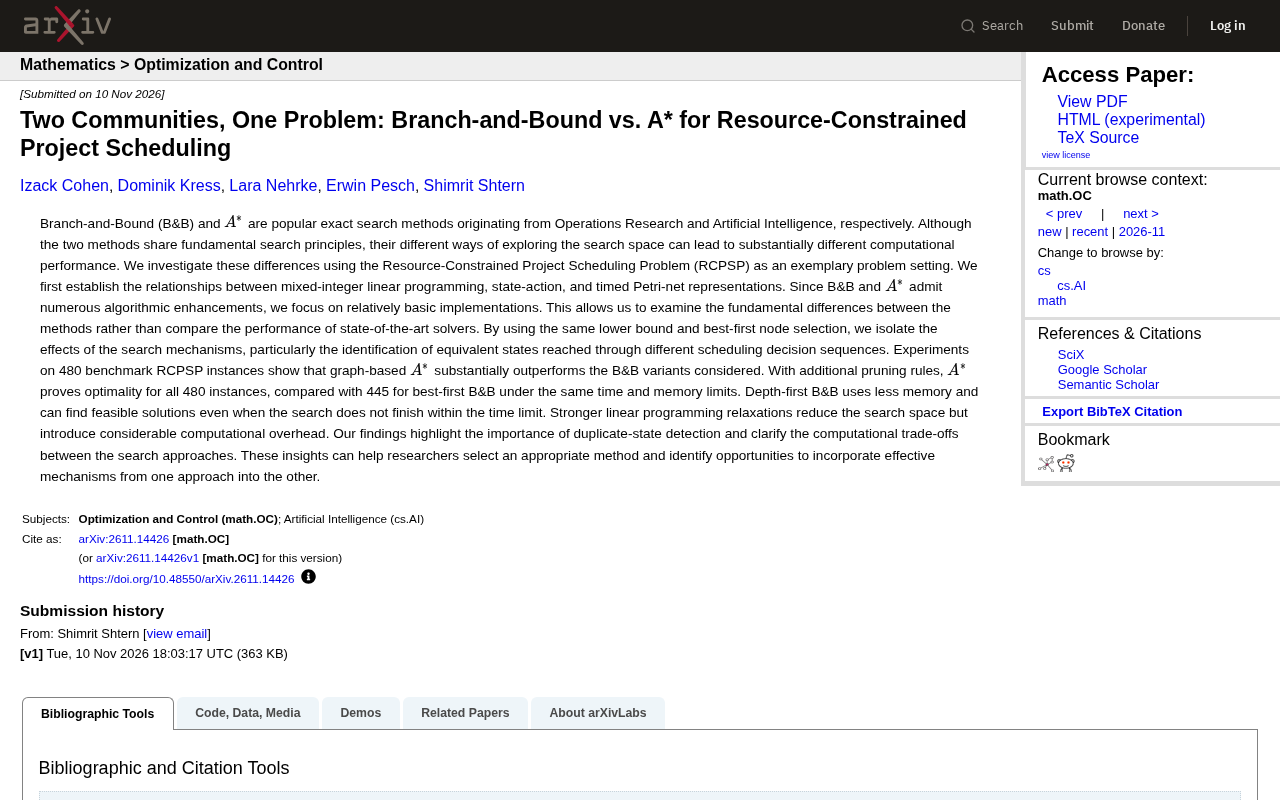
This study systematically compares branch and bound (B&B) and A* on the resource-constrained project scheduling problem (RCPSP). By unifying MILP, state-action, and time Petri net representations and controlling lower bounds and node selection, it isolates the search mechanisms. On 480 benchmark instances, graph-based A* proves optimality for all, while best-first B&B completes only 445. The gap mainly stems from A*'s closed-set mechanism detecting duplicate states. The study also analyzes depth-first B&B memory advantages and LP relaxation overhead, highlighting duplicate state detection's key role.
In the classic combinatorial optimization problem of resource-constrained project scheduling (RCPSP), branch and bound (B&B) from operations research and the A* algorithm from artificial intelligence have long developed independently, yet they share a similar search philosophy. A recent study systematically reveals the performance differences between the two methods under identical conditions and highlights the critical role of duplicate state detection in exact search.
The Clash of Two Search Paradigms
Branch and bound and A* are rooted in operations research and artificial intelligence, respectively. B&B typically narrows the search space gradually through branching strategies and bound-based pruning, while A* relies on optimal-first search guided by a heuristic function. Although both are theoretically exact search methods, their specific mechanisms for exploring the state space—especially how they handle duplicate states—can lead to significant differences in computational performance.
Using RCPSP as a test scenario, this study first establishes a formal relationship among mixed-integer linear programming (MILP), state-action representations, and time Petri net representations. This unification at the representation level lays the foundation for comparing the two algorithms under equivalent conditions.
Duplicate State Detection is a key technique in graph search algorithms, used to identify and avoid repeatedly exploring states that have already been visited. In state space search, different decision sequences (or paths) may reach exactly the same state. Without detection, an algorithm will expand the same state multiple times, causing redundant computation and even exponential time waste. The A* algorithm typically maintains a "closed set" to record expanded states, ensuring each state is processed at most once; basic branch-and-bound implementations often lack an explicit closed-set mechanism and rely solely on bound pruning, so they may repeatedly explore equivalent states. In resource-constrained project scheduling, due to the flexibility in the order of scheduling decisions, equivalent states occur very frequently, and the absence of duplicate state detection significantly weakens search efficiency.
Isolating the Impact of Search Mechanisms
To focus on differences in the search mechanisms themselves, the research team deliberately used relatively basic algorithm implementations rather than state-of-the-art solvers. They used the same lower bounds and best-first node selection strategy, thereby concentrating the comparison on search mechanisms, particularly the ability to recognize equivalent states reached by different scheduling decision sequences.
This controlled experimental design allowed the researchers to observe how, when the underlying bounds and node selection logic are identical, differences in the structure of the search graph affect overall performance.
Linear Programming Relaxation is a commonly used lower-bound enhancement technique in branch and bound. The basic idea is to temporarily relax the integer constraints in the original mixed-integer programming problem, transforming it into a linear programming problem; the resulting optimal value is a lower bound for the original problem. The tighter the relaxation (i.e., the closer the lower bound is to the true optimal value), the fewer nodes branch and bound needs to explore. However, a stronger relaxation usually means greater cost per linear program solve and may involve more complex constraint generation. The article notes that this computational overhead can sometimes offset the benefits of a reduced search space, so simply strengthening the lower bound does not necessarily improve overall performance.
A*'s Advantage in Benchmarks
Experimental results on 480 benchmark RCPSP instances show that the graph-based A* algorithm significantly outperforms the considered branch-and-bound variants. Under the same time and memory limits, A* was able to prove optimality for all 480 instances, whereas best-first B&B could prove optimality for only 445.
This gap is mainly attributable to A*'s ability to detect duplicate states during search—when different scheduling decision sequences lead to the same state, A* can avoid repeated exploration through its closed-set mechanism, while basic B&B implementations often lack this mechanism.
Depth-First vs Memory Trade-offs
The study also reveals differences in the characteristics of various B&B variants. Although depth-first B&B uses less memory and can find feasible solutions even when search is not completed within the time limit, its non-best-first exploration order may lead to lower efficiency in proving optimality.
On the other hand, stronger linear programming relaxations can shrink the search space but introduce non-negligible computational overhead. This trade-off indicates that simply strengthening the lower bound does not always lead to improved overall performance.
Implications for Cross-Domain Integration
The core value of this work lies in clarifying the computational trade-offs between the two search methods and providing a basis for researchers to choose appropriate methods. The importance of duplicate state detection has not yet received equal attention in both communities, and experiments show that it may be one of the key factors determining performance.
The researchers suggest that future work could explore how to incorporate effective mechanisms from one method (such as A*'s duplicate state detection or B&B's memory-efficiency strategies) into the other, thereby achieving a better balance in resource-constrained scheduling and other combinatorial optimization problems.
One-line Summary
Under identical conditions, graph-based A* significantly outperforms branch and bound on RCPSP due to duplicate state detection.
Paragraph Summary
This study systematically compares branch and bound (B&B) and the A* algorithm on the resource-constrained project scheduling problem (RCPSP). By unifying MILP, state-action, and time Petri net representations and controlling lower bounds and node selection strategies, the experiments isolate the impact of the search mechanisms themselves. On 480 benchmark instances, graph-based A* proves optimality for all instances under the same time and memory limits, while best-first B&B completes only 445. The gap mainly stems from A*'s closed-set mechanism, which effectively detects duplicate states and avoids redundant exploration. The study also analyzes the memory advantage of depth-first B&B versus its inefficiency in proving optimality, as well as the computational overhead trade-off of linear programming relaxation. It ultimately highlights the key role of duplicate state detection in exact search and recommends cross-community integration of effective mechanisms.
Related articles

AI Teams Up with Mathematicians to Attack the Riemann Hypothesis: 17 Million Lines of Code Tear Open a 167-Year Gap
In November 2026, Anthropic mathematicians and Claude claimed to have discovered a proof of the Riemann Hypothesis, publishing 17 million lines of Lean formalized code that passed machine verification. This article analyzes the event's impact on mathematics and cryptography, and the deeper questions raised by the separation of discovery and understanding.
AI Claims Formal Proof of the Riemann Hypothesis — But Machine Verification Isn't a Mathematical Proof
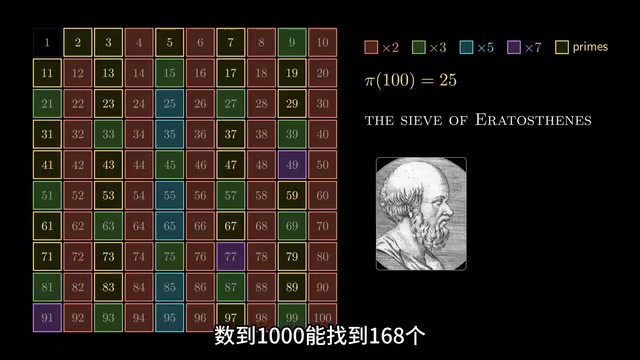
In Nov 2026, Anthropic's Levent Alpöğe released a Riemann Hypothesis proof of 175,000 code files that passed machine formal verification. But machine verification isn't a mathematical proof: the kernel can't confirm the proposition is the Riemann Hypothesis humans understand, and there's no human-readable paper. This article breaks down how ζ function zeros determine prime-count deviation, and the core of the controversy.

Anthropic Raises Over $80 Billion in IPO, DeepSeek Secures $100 Billion in Funding: AI Weekly Roundup
This week in AI: Anthropic's Nasdaq IPO raises $93.5B in the largest ever, DeepSeek closes ~100B yuan round, AI claims formal Riemann proof, MiniMax breaks crypto candidates in seconds.