Breaking Down a 30K-Star Open Source Project: How AI Agents Work in Database Management

AI Agents reshape database management tools via tool calling and natural language, with a clear skill path for full-stack engineers.
This article dissects a high-star open source database management project to reveal how AI Agents are deployed at the tooling layer. The core shift: traditional SQL execution (Navicat/DBeaver) is being replaced by natural language + tool calling, where AI senses real schema via List Table and Get Columns before generating verifiable SQL. At the broader pipeline level, the article covers D2C/T2UI concepts — using MCP to expose component libraries to models for end-to-end code generation. It closes with an FDE framework that maps AI full-stack skills into three tiers: tooling integration, AI-ifying existing products, and owning a complete data operations product loop.
AI Enters Database Management — A New Paradigm
AI Agents are redefining what database management tools look like. Tools like Navicat and DBeaver have long been the standard — connect to a database, browse table structures, execute SQL. But as a new wave of open source projects with over 30,000 GitHub stars has emerged, a new product paradigm is taking shape: deeply coupling database management interfaces with AI conversational capabilities, letting natural language directly drive data queries, SQL generation, and intelligent diagnostics.
What makes these projects worth dissecting isn't any single tool in isolation — it's the architectural thinking they collectively embody for deploying AI at the tooling layer. From solution design and technical architecture to complete business workflows, they offer a referenceable engineering paradigm. For frontend, full-stack, and FDE (Frontier Deployment Engineer) roles alike, understanding this pipeline is practically a prerequisite for entering the AI Agent application layer.
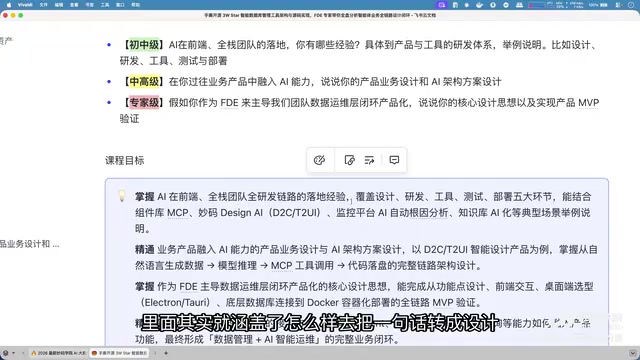
From Traditional Database Tools to Intelligent Interaction
The product demonstrated is straightforward: on the left is a standard database management panel connected to a specific database instance (a PG database in this example), with tables, fields, and lists expanded below — nothing different from traditional tools so far. The real difference lies in the interaction model.
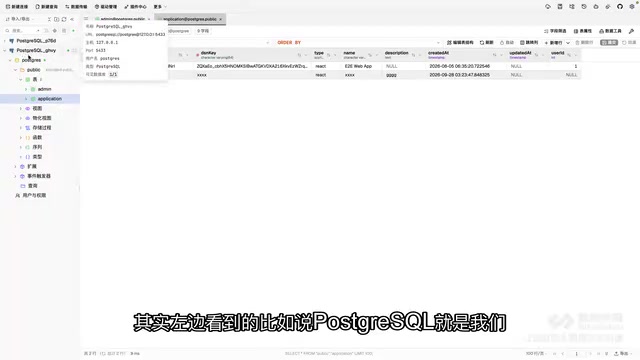
Users can "add" a specific table (say, the Application table) "to AI," and a chat panel on the right opens with that table as context. You can issue natural language commands like "query all data in the Application table" or "count the total number of Applications," with models like Doubao or Volcano Engine handling the inference on the backend. Going further, you can also select content and trigger operations like "generate SQL," "explain SQL," or "optimize SQL" — essentially packaging a database DBA's common tasks into a conversational flow.
Tool Calling Is the Core of Intelligent Queries
When a user asks to "count data under the Admin group," the system doesn't just output a result directly. It first verifies whether that group exists, then triggers a series of tool calls: List Table to see how many tables exist, Get Columns to examine field structures, then aggregates by email, group, or admin dimensions. This clearly illustrates the typical AI Agent workflow — using tool calls to progressively understand the database schema, then generating executable SQL based on real structure, rather than guessing blindly.
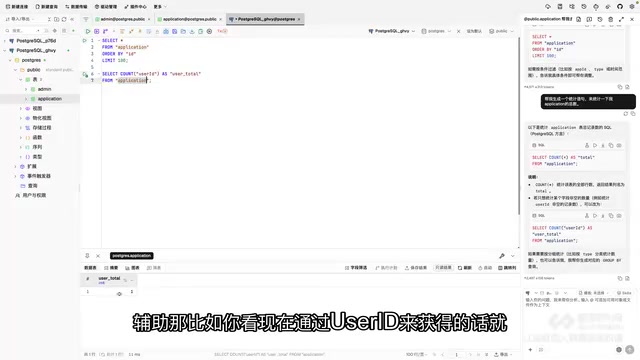
This design ensures query accuracy and makes AI a reliable assistant for learning and debugging — every step it returns is traceable, and users can pull out the generated SQL to run and verify directly.
Tool calling is a standard capability in today's mainstream AI Agent frameworks. At its core, it enables large language models to call external functions or APIs during reasoning — not just generate text. In implementations from OpenAI, Anthropic, and others, developers pre-declare a set of tools with names, parameters, and descriptions. The model can then "decide" which tool to call and with what parameters during a response, folding the tool's return value into the next round of reasoning. In a database context, tools like List Table and Get Columns are wrappers around database metadata interfaces — they let the model perceive the real schema structure, avoiding "hallucinated" table names or field names. This "sense first, then generate" pattern is the core engineering characteristic that distinguishes AI Agents from pure Q&A models, and it's the key mechanism ensuring generated SQL is executable and results are verifiable.
The Complete Pipeline from Natural Language to Code
The bigger capability behind these products is the generative development pipeline represented by "D2C / T2UI": turning a sentence (text) into a design mockup, then converting that mockup into code. "Miaomadesign AI" mentioned in the demo is a prime example — it exposes a team's existing component library to AI via MCP (Model Context Protocol), so the generated code directly reuses existing components rather than producing a pile of boilerplate that can't be deployed.
The full pipeline can be summarized as: natural language → data generation → model inference → MCP tool calls → code written to disk. This chain genuinely threads AI capabilities into a frontend/full-stack team's development workflow, with the component library MCP serving as the critical engineering integration point. Putting this kind of hands-on experience in a resume will stand out noticeably in interviews.
How an AI Assistant Integrates Into an Existing Product
A lighter-weight example is the AI transformation of a document-type product. In a Feishu-style collaborative document project, an AI assistant panel is added on the right — users input a prompt to refine and polish content, then insert the generated version back into the left editing area with one click. This represents the simplest path for integrating AI into an existing product: without touching the core data model, simply overlay an intelligent assistant at the interaction layer.

By contrast, the intelligent database management product demonstrated earlier represents a more complete deployment — corresponding to something like an "enterprise-internal Supabase" in scope: Feishu-style collaborative table capabilities on one side, full database management functionality integrated on the other, and Agent capabilities like intelligent diagnostics and natural language queries layered on top.
MCP (Model Context Protocol) is an open protocol proposed and championed by Anthropic in late 2024, aimed at standardizing how AI models connect to external tools and data sources. Its core idea is to wrap various resources (database schemas, component libraries, file systems, APIs, etc.) into uniformly formatted "MCP Servers," so any compatible model client can invoke them through the same protocol — like a USB interface for the AI world. In a frontend development pipeline, wrapping a component library as an MCP Server means AI can directly "see" the attributes and usage of existing Button, Form, Table, and other components when generating code, producing output that references those components directly rather than reinventing the wheel. Compared to the fragmented Function Calling implementations of earlier tools, MCP's standardization reduces integration costs and allows the same tool ecosystem to be reused across models.
Three Tiers of Capability Growth from an FDE Perspective
The source material breaks AI-integrated full-stack development into three progressively advanced questions, roughly benchmarked against different salary levels — a useful self-assessment framework:
- Entry level (~¥15K): How does AI fit into the development pipeline for frontend/backend/full-stack teams? The focus is on the research and tooling ecosystem — D2C/T2UI practices like turning a sentence into a design and a design into code, and transforming legacy monitoring platforms into AI-powered auto-analysis systems.
- Mid-to-senior level (~¥25K): How do you integrate AI into existing business products? This tests product design thinking and AI architecture — the full pipeline from natural language to data generation, model inference, MCP calls, and code written to disk.
- Expert level (~¥35K): As an FDE, leading a closed-loop productization of the data operations layer. This requires thinking holistically across feature design, frontend interaction, desktop client, data management platform, and Agent development (intelligent diagnostics, natural language queries), and completing MVP validation end-to-end.
This framework clearly reveals a trend: AI application-layer capabilities are becoming a core competitive differentiator for frontend and full-stack engineers, and FDE roles capable of owning a complete business loop are commanding even greater value.
FDE (Frontier Deployment Engineer) is a role concept that has emerged in recent years in the context of AI application deployment. It emphasizes combining frontend/full-stack engineering capabilities with AI Agent architecture design skills — and the ability to own the complete pipeline from product design to business closure. What distinguishes this role from a traditional frontend engineer: it's not just about implementing UI interactions. It also involves designing the tool-calling chains for Agents, integrating large model APIs, evaluating model reliability in specific business contexts, and completing end-to-end MVP validation. The article uses salary benchmarks (¥15K / ¥25K / ¥35K) as a rough calibration for three tiers, which fundamentally reflects three cognitive leaps: "able to use AI tools" → "able to integrate AI into a product" → "able to lead AI productization end-to-end" — broadly consistent with how the industry generally stratifies AI engineering capabilities.
Closing Thoughts
From a 30K-star open source project to "enterprise-internal Supabase" product planning, the signal from these practical breakdowns is clear: traditional tool categories like database management and collaborative documents are being restructured by AI Agents through "tool calling + natural language interaction." For developers, the key isn't just knowing how to use these tools — it's understanding the architectural paradigm behind them: how MCP connects component libraries and database schemas, how Agents use tool calling to ensure reliable results, and how to turn this capability into a closed-loop product. Mastering this pipeline is the real entry point for deeply understanding enterprise-grade AI Agent applications.
Related articles

Felix Rieseberg Personal Homepage
Felix Rieseberg's personal homepage sparks attention on Hacker News. This article covers the Slack engineer's technical background, the rise and fall of nativefier, and the value of a developer homepage as a tech calling card.

@ai-sdk/vue 3.0.306 Patch Release Syncs with [email protected] Update
@ai-sdk/vue 3.0.306 released, synced with [email protected]. A routine patch release for the Vercel AI SDK ecosystem with no public API changes; the Vue adapter layer stays version-aligned with the core package.

Gemini 4 Argon API Launches: The Era of Million-Token Output Begins
Google launches Gemini 4 Argon with sparse MoE architecture, up to 1M output tokens, and a 68.90% Vals Index score, available across API, AI Studio, and the Gemini app.