Breaking Down a Complete Python Course for Beginners: A Structured Learning Path from Basics to Practice

A structured breakdown of a 600-episode Python course and what beginners should focus on at each stage.
This article analyzes a 600-episode Python beginner course on Bilibili, breaking down the content logic across its three stages: Fundamentals (syntax, control flow, functions), Intermediate (OOP, regex, exception handling), and Applied Projects (scraping, data analysis, AI, automation). It also flags the core risk of "comprehensive" courses — the illusion that watching equals mastery — and advises beginners to solidify the first two stages before going deep in one or two applied directions.
Inside a 600-Episode Python Course
A Python course recently gained traction on Bilibili, claiming to cover 198 hours of content across core syntax, web scraping, data analysis, AI applications, and office automation. Setting aside the marketing language, the real value of a structured course like this lies in the learning path it maps out — for beginners, knowing what to learn first and what to learn next often matters more than the course itself.
The curriculum is divided into three stages: Fundamentals, Intermediate, and Applied Projects. This is the most widely adopted structure in mainstream programming education, and it follows a natural progression from syntactic understanding to engineering capability. Let's break down the focus of each stage and highlight some practical considerations along the way.
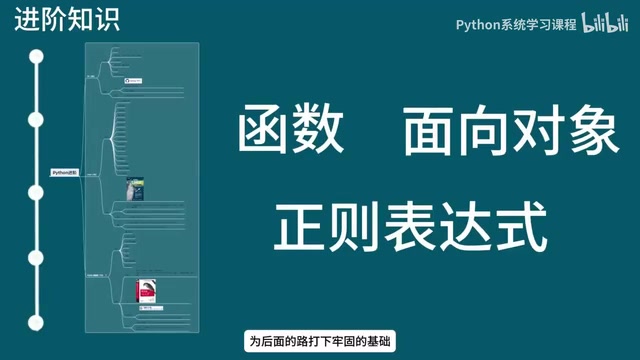
Fundamentals: Building a Solid Syntax Foundation
The fundamentals stage starts with environment setup and works through Python installation, variables and data types, operators, loops, strings, tuples, and other core concepts — then extends into control flow, function definitions, and working with modules and packages.
This stage is the foundation everything else rests on. A common mistake among beginners is rushing toward web scraping or project work while repeatedly stumbling over fundamentals like variable scope, loop logic, and data structures. In practice, mastering control flow (if/for/while) and how functions are organized determines the readability and maintainability of everything you write later.
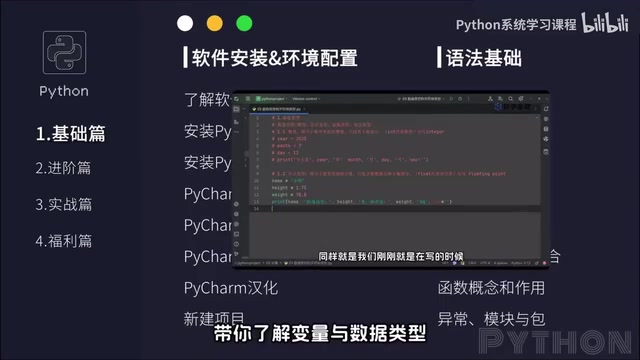
The recommendation at this stage: write code actively instead of just watching videos. The concept of modules and packages deserves particular attention — it's what allows you to organize scattered code into a reusable project, and it marks the dividing line between "writing scripts" and "writing software."
Intermediate: From Syntax to Engineering Thinking
The intermediate stage is the pivotal bridge in the entire curriculum, covering object-oriented programming (inheritance and polymorphism), regular expressions (matching and substitution), file I/O, and exception handling.
Object-oriented programming is the core challenge at this level. Classes, objects, inheritance, and polymorphism aren't immediately intuitive for complete beginners, but they're prerequisites for understanding how most Python third-party libraries are designed. Regular expressions, meanwhile, are an indispensable tool for processing text data — they show up almost everywhere in web scraping and data cleaning.
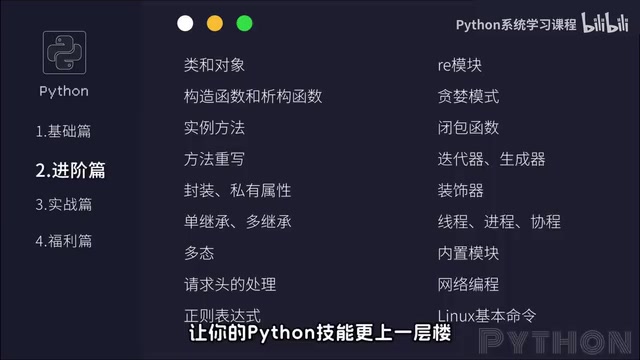
Exception handling and file I/O may seem basic, but they're among the most error-prone areas in real-world projects. A robust program must account for edge cases like missing files, network timeouts, and malformed data. Covering these topics systematically in the intermediate stage is what prevents projects from grinding to a halt every time an error appears.
Regular expressions (regex) are essentially a mini-language for describing string patterns, built from ordinary characters and special metacharacters. For example, \d+ means "one or more digits" and [a-zA-Z]+ means "one or more letters." Python's built-in re module provides functions like search, match, findall, and sub for finding, matching, extracting, and replacing text. A common beginner mistake is treating regex like formulas to memorize — a more effective approach is to write and test simultaneously. Tools like regex101.com let you validate patterns in real time and develop an intuitive feel for what each metacharacter does. The learning curve is steep, but once you get it, tasks like log parsing, HTML extraction, and data cleaning become dramatically more efficient.
Applied Projects: Turning Skills into Capability
The applied projects stage is positioned as the "practical payoff" of the course, with real project development across four directions: web scraping, data analysis, artificial intelligence, and office automation — from downloading images and videos off the web to writing automation scripts, to storing and mining data.
These four directions represent Python's most mainstream use cases today:
- Web Scraping: The entry-level data collection scenario — quick to get started with, immediate feedback, great for building early momentum;
- Data Analysis: Using libraries like pandas and numpy, this is a hard skill for data-related roles;
- AI Applications: From calling models to building simple intelligent apps, this is currently the hottest extension of Python skills;
- Office Automation: Batch-processing Excel files, documents, and emails — arguably the highest ROI skill for professionals in any industry.
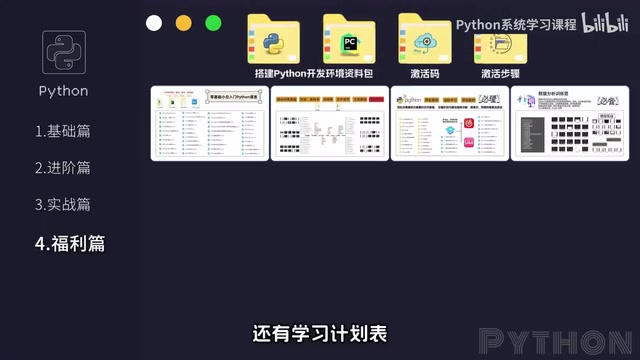
One important caveat: the "comprehensive coverage" of the applied stage typically means each direction only gets surface-level treatment. Real engineering capability requires going deep in one area, not skimming across all of them. The development environment packs, study schedules, e-books, and course materials bundled with the curriculum can serve as useful references for pacing your learning.
The pandas and numpy libraries mentioned in the data analysis track are two cornerstones of Python's scientific computing ecosystem. numpy provides high-performance multidimensional array objects (ndarray) and vectorized operations, avoiding the inefficiency of pure Python loops. pandas builds on top of it with the DataFrame — its core data structure — which loads two-dimensional tabular data (similar to Excel) into memory and supports filtering, aggregation, merging, and pivoting. Both are typically paired with matplotlib or seaborn for visualization. For anyone pursuing a data analysis career, proficiency in these three libraries directly determines how competitive your resume is. The strong recommendation: find a real public dataset (such as a beginner competition on Kaggle) and analyze it hands-on, rather than only following the sample data in the course.
Practical Advice for Beginners
The biggest strength of a "complete course" like this is its comprehensive structure. The biggest risk is that it can create the illusion that watching equals learning. Six hundred episodes represents an enormous time investment, and without a plan, it's very easy to quit halfway.
A more practical approach: work through the Fundamentals and Intermediate stages thoroughly with hands-on practice, then use the Applied Projects stage to go deep in one or two directions based on your own goals — whether that's career development, a side income, or personal interest. That's exactly what the study schedule is for: breaking 198 hours of content into executable daily tasks so the sheer volume of the course doesn't overwhelm you.
Ultimately, video tutorials are just a map. Real capability comes from every line of code you type yourself and every error you debug on your own.
Related articles

From Photons to Production: An Open-Source Computer Vision Engineering Reading Path
Reddit user open-sources a computer vision engineering reading path with 16 chapters from image formation to production deployment, emphasizing primary sources, dependency order, and reproducible benchmarks to help engineers understand why models fail and build reliable vision systems.

Prompt Failures? The Truth About Why AI Agents Struggle in Production—and How to Fix It
A Reddit developer built Agents with Copilot and Gemini but faced unstable behavior. This article analyzes three gaps in prompt engineering for Agent scenarios and offers three practical paths to reliable Agent deployment, including structured prompts, workflow-first approaches, and building an evaluation loop.

Tesla Robotaxi to Open Private Vehicle Access Next Year: Promise or Pipe Dream?
At its Q3 earnings call, Tesla said owners can add their cars to the Robotaxi fleet next year. We analyze the technical basis, Musk's missed deadlines, business logic, and competition.