Breaking Into LLM Application Development from Scratch: A Complete 5-Stage Learning Roadmap

A 5-stage roadmap to break into LLM app development: start applying once you can run a RAG or Agent pipeline.
This article lays out a 5-stage learning path for developers transitioning into LLM application development: L1 fundamentals and prompt engineering, L2 RAG-centered engineering pipelines, L3 Agents and multimodal apps, L4 fine-tuning and private deployment, and L5 continuous learning of frontier tech like GraphRAG and MCP. The core argument: you don't need to master everything before applying — start once you can run a RAG or Agent pipeline, and refine based on interview feedback. Real value lies in debugging skills, bad-case analysis, a public GitHub project, and the ability to translate business needs into technical architecture.
What's the biggest misconception about transitioning into LLM application development? Many people think they need to finish learning Python, RAG, Agents, and LLM fundamentals before they're qualified to apply for jobs. In reality, job descriptions reflect an ideal candidate profile — what companies actually care about in interviews is whether you have baseline development skills, whether you can get an AI application pipeline running end-to-end, and whether you have a systematic approach to debugging problems.
This article is based on a structured LLM learning roadmap and distills a growth path that more closely matches real hiring requirements — designed to help Python and Java developers, as well as complete beginners, find their direction.
Job-Hunting Mindset: Start Applying Once You Clear the Basics
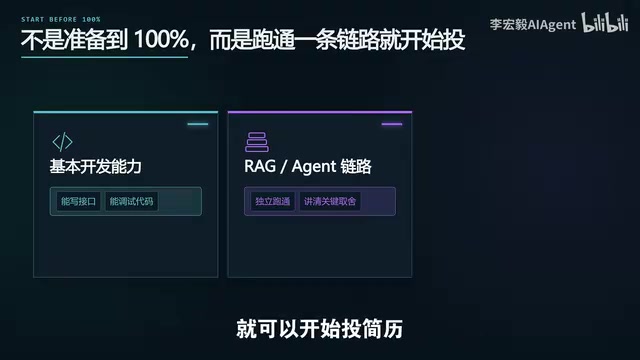
You don't need to be 100% ready before submitting your first application. Once you have basic development skills and can independently run a RAG or Agent pipeline, start applying — then fill in the gaps based on interview feedback.
Getting into real interview environments and improving from there is almost always more efficient than months of isolated self-study. Interviewers don't want to hear "I used RAG" — they want to hear "when retrieval accuracy dropped, here's how I diagnosed and fixed the problem." That troubleshooting ability is what companies actually value most.
L1 Launch: Foundational Knowledge + Prompt Engineering
The first stage is about building your Python and basic engineering skills. You should be comfortable with HTTP, JSON, and Git, and be able to independently write API endpoints, process data, and debug code in Python.
On the conceptual side, you need to understand what LLMs are, their core principles, and the evolution from AI 1.0 to AI 2.0 — including the relationship between Artificial General Intelligence (AGI) and large language models. You should also familiarize yourself with the major models and ecosystems, including DeepSeekAd, Qwen, Llama, GPT, Claude, and Gemini.
This stage also introduces Prompt Engineering. Its value here is practical: even without strong programming skills, you can make basic LLM calls by crafting prompts — building small projects like a 24-point puzzle solver or a social media copywriting generator. While prompt engineering's real-world impact is shrinking, it gives L1 learners quick wins and a sense of progress, preventing the trap of getting stuck in pure theory.
L2 Core: RAG-Centered Engineering Pipelines
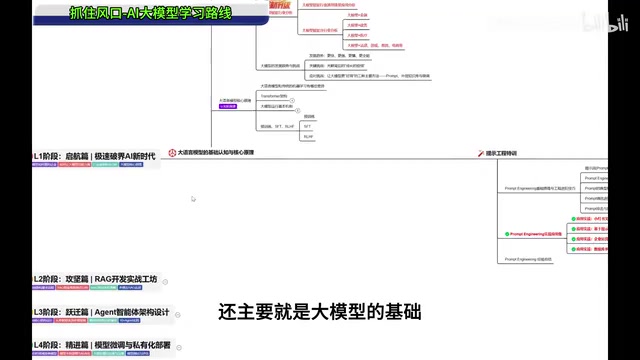
The second stage gets into real LLM development. The core focus is RAG (Retrieval-Augmented Generation), which exists specifically to address two inherent weaknesses of LLMs: hallucinations and knowledge cutoff dates.
Run a Complete End-to-End Pipeline
The recommended exercise is to build a knowledge base Q&A service: starting from PDF upload, through parsing, chunking, embedding, vector store indexing, TopK retrieval, reranking, and finally generating answers with source citations. Once you've run this full pipeline, you'll actually have something meaningful to discuss in interviews.
On the engineering side, you should be able to independently build an API service with FastAPI, build Docker images and run containers, and have deep experience with either LangChain or LlamaIndex. For vector databases, start with tools like Chroma or Qdrant. If you need local model serving, add vLLM — knowing how to launch a model service and monitor concurrency and VRAM usage is sufficient.
What is RAG? RAG (Retrieval-Augmented Generation) works by retrieving the most relevant text passages from an external knowledge base before sending a user's question to the LLM. Those retrieved passages are included as context in the prompt, allowing the model to answer based on real source material rather than relying solely on what it learned during training. This approach addresses two major pain points: LLMs can fabricate non-existent facts ("hallucinations"), and training data has a cutoff date that prevents the model from knowing about recent information.
Embedding is a critical step in the RAG pipeline — it converts text into high-dimensional numerical vectors so that semantically similar text ends up close together in vector space, enabling semantic search rather than simple keyword matching. Chunking refers to splitting long documents into smaller segments before embedding; chunk size directly affects retrieval quality — segments that are too long introduce noise, while segments that are too short lose context. Reranking is the step after initial TopK retrieval where a second, more precise model rescores and reorders candidate passages to improve the quality of context passed to the LLM.
Deliberately Create Bad Cases
Most people consider a project done once the demo can answer questions. But in production, the hard part is handling edge cases. Try intentionally increasing the chunk size and observe why answer quality degrades; swap in a weaker embedding model and watch how recall changes; pass wrong parameters to a tool and see whether the Agent throws an error or retries. Test for hallucinations, API timeouts, tool call failures, and context length overflows.
RAG evaluation is also critical — both manual and automated evaluation, covering metrics like context relevance, precision, recall, and faithfulness. Understanding these metrics is what lets you articulate real pain points around chunking granularity, accuracy, and efficiency.
L3 Advanced: Agents and Multimodal Applications
The third stage ramps up significantly in difficulty. The core focus is Agents. You need to understand what an Agent is and how it operates, including task decomposition, self-reflection, and the key development frameworks.
Key Technical Concepts
- Function Calling: The foundation for Agents to interact with external tools.
- Core Frameworks: Reasoning and execution paradigms like ReAct and Plan-and-Execute.
- LangGraph: A popular state machine framework — covering fundamentals, guides, and real projects.
- Multimodal and Digital Humans: Text-to-image, image-to-image, and text-to-video all fall under multimodal AI.
For beginners with weaker coding skills, you can start with visual platforms like Coze — drag pre-built modules together to create Agents without writing code. But if you already have some programming background, hands-on implementation of Agents, digital human pipelines, and LangGraph projects is strongly recommended.
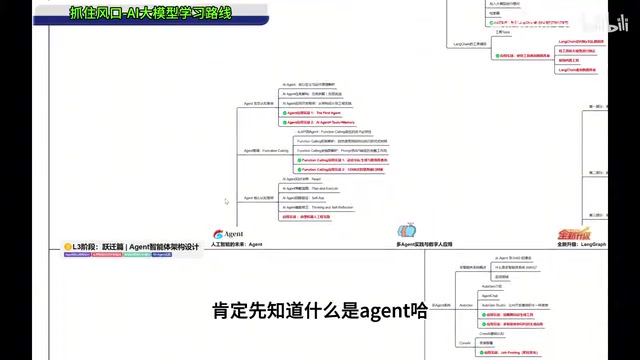
ReAct (Reasoning + Acting) is currently the dominant Agent reasoning paradigm. The core idea is to have the model alternate between "thinking" and "acting" at each step: analyze the current state, decide which tool to call, execute it, observe the result, then continue reasoning — until the task is complete. This loop allows Agents to decompose complex tasks and handle multi-step reasoning. Plan-and-Execute takes this further: a planner first generates a complete task plan upfront, then an executor carries it out step by step. This paradigm suits long workflows with many steps and clear dependencies.
Function Calling is a standardized capability provided by LLM API providers. Developers pre-describe a set of external functions with their names, parameters, and descriptions. When generating a response, the model decides whether to call a function and outputs a structured JSON call request; the application layer executes the call and returns the result to the model to continue generation. This mechanism is the foundation for reliable Agent interaction with external tools like database queries, web search, and code execution.
L4 Expert: Fine-Tuning and Private Deployment
To become a true LLM specialist, you must master model fine-tuning and private deployment.
The case for private deployment comes down to data security: when calling public APIs or web services, your data may be read by the service provider. Deploying models privately ensures that sensitive data never leaves your infrastructure — this is especially critical in verticals like healthcare.
This stage covers local private deployment (e.g., DeepSeek models), instruction fine-tuning to create domain-specific expert models, model quantization and compression, and LLM operations engineering. You'll also go deep into the technical details of DeepSeek V3 and R1 — including multi-head attention mechanisms and Mixture of Experts (MoE) architecture. Understanding these core principles, rather than just "knowing how to use DeepSeek," is what separates casual users from genuine specialists.
If a company wants to deploy an LLM on-premises but nobody knows how to do it, fine-tuning is out of the question entirely. This capability is also the threshold for taking on project management and technical leadership roles in enterprise settings.
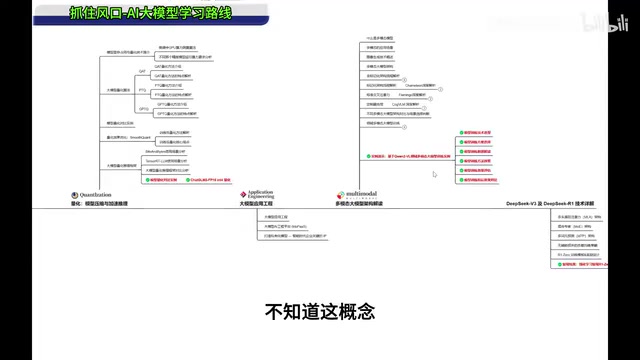
Instruction Fine-Tuning involves taking a pre-trained LLM and continuing to train its parameters on annotated data in an "instruction → response" format, so the model significantly outperforms the general-purpose base model on specific domains or tasks. For example, fine-tuning on medical consultation dialogue data makes the model better at understanding specialized terminology and adhering to proper response formats. Since full fine-tuning is extremely expensive, real projects typically use parameter-efficient methods like LoRA (Low-Rank Adaptation), which trains only a small set of added parameters — drastically reducing VRAM and compute requirements.
Mixture of Experts (MoE) is a core architectural design used in next-generation LLMs like DeepSeek V3. The model contains multiple "expert" sub-networks, and a routing mechanism dynamically activates only a few of them for each input — the rest don't participate in computation. This allows the model to have a very large total parameter count (for capacity) while keeping actual inference compute much lower than a dense model of equivalent size, achieving a better balance between performance and efficiency.
L5 Continuous: Staying Current with Frontier Research
The final stage is an ongoing, continuously updated track covering frontier technologies including LlamaIndex, MCP, A2A, GraphRAG, and more.
Take GraphRAG as an example: it builds knowledge graphs via Neo4j to improve retrieval quality and is gradually displacing traditional RAG in certain use cases. The LLM landscape moves fast — you might be learning RAG today while the market is already shifting toward GraphRAG. Without continuous, systematic learning, it's hard to keep pace.
GraphRAG is a significant upgrade over traditional RAG. Traditional RAG splits documents into independent chunks and retrieves them by vector similarity, losing the relationships between chunks — such as logical connections between entities or causal chains across passages — which leads to poor performance on complex multi-hop questions. GraphRAG addresses this by extracting entities and relationships from text using NLP during knowledge base construction, building a knowledge graph (typically stored in a graph database like Neo4j). At retrieval time, it combines vector similarity with structured graph traversal, enabling answers to questions like "What are the risk exposures of the CEOs of Company A's subsidiaries?" — queries requiring reasoning across multiple graph nodes. MCP (Model Context Protocol) is an open protocol proposed by Anthropic to standardize how LLMs connect to external tools and data sources — think of it as a "USB port" for the AI world, enabling plug-and-play interoperability between models and tools from different vendors.
Practical Advice: Prove Yourself with One Deployable Project
What actually sets people apart is learning methodology, not how many resources they've collected. You don't need dozens of course packages — official documentation, high-quality GitHub projects, DeepLearning.AI courses, and a couple of comprehensive hands-on courses is plenty. The key is writing code to validate each concept right after learning it, rather than bookmarking resources and calling it "studied."
Before job hunting, build at least one small project you can publicly showcase on GitHub. Even something as simple as an internal policy Q&A bot, a contract analysis tool, or an Agent with tool-calling capabilities is more convincing than ten bullet points on your resume saying "familiar with RAG, familiar with LangChain."
Ultimately, LLM application development isn't really about writing code — AI can write code. It's about the ability to translate vague business requirements into technical solutions. When a product manager says they want a "contract review assistant," you need to figure out: what file formats are involved, is OCR needed, how should long documents be chunked, what fields need to be extracted, which sections require source citations, and which risk rules need a knowledge base or rules engine. The ability to decompose a single sentence into data processing, retrieval, model generation, and result validation modules — that's where the real value in AI application development lies.
Related articles

OpenAI Partners with Shield: How the Astra Agent Revolutionizes IT Troubleshooting
OpenAI and Shield launch the Astra agent, which autonomously logs into computers and legacy systems to fix IT issues in real time, 35-40% faster than traditional models, with humans involved only when judgment is needed.

iPhone Duo Battery Life Tested: One Charge a Day Is Unavoidable, and the Large Screen Is the Culprit
iPhone Duo battery test: heavy use needs at least one charge a day, and about 30% remains after 6.5 hours of screen-on time. How often the large screen is unfolded is key; a MagSafe battery pack helps, and long-term degradation is also worth watching.

Kimi K3.1 Pro Open-Sourced: 2.8 Trillion Parameters Close In on Opus
Moonshot releases the open-source MoE model Kimi K3.1 Pro, with 2.8T total parameters and 104B activated, trailing Opus 5.5 by under 1 point on Terminal Bench 4.0.