Breaking the VRAM Bottleneck: ZeRO-3 + LoRA Enables Large-Scale Self-Distillation

LoRA shared backbone + dual adapters make self-distillation with an EMA teacher memory-efficient and runnable on large models.
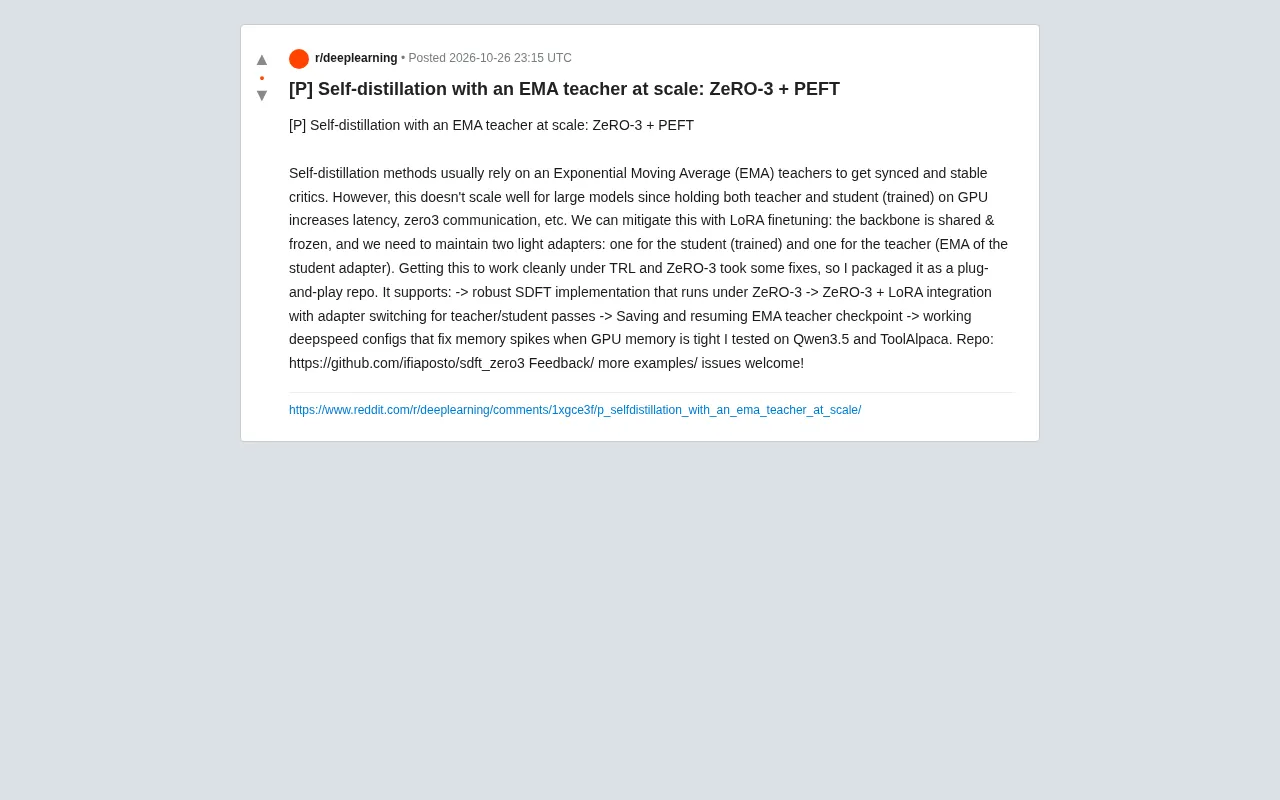
The article introduces an open-source project that uses LoRA fine-tuning to solve the VRAM dilemma caused by the EMA teacher in self-distillation. Traditional self-distillation requires both teacher and student full model copies to reside simultaneously, increasing forward latency and exacerbating ZeRO-3 communication overhead. This scheme freezes and shares the backbone, maintaining only two lightweight adapters for student and teacher, reducing VRAM usage from two full models to one backbone plus two small adapters. The project fixes adapter switching under ZeRO-3, EMA teacher checkpoint saving/restoration, and DeepSpeed memory spikes, and has been validated on Qwen3.5 and ToolAlpaca.
The VRAM Dilemma of Self-Distillation and the LoRA Solution
Self-distillation is a training paradigm that lets a model improve itself. At its core, it uses an exponential moving average (EMA) teacher to provide a stable, synchronized supervision signal. However, as model scale grows, this approach faces serious engineering challenges: two full model copies—teacher and student—must reside on the GPU simultaneously, which not only increases forward-pass latency but also exacerbates ZeRO-3 communication overhead. For large-model training scenarios where VRAM is already tight, this is nearly unbearable.
An open-source project recently shared in the Reddit community offers a clever solution: using LoRA (Low-Rank Adaptation) fine-tuning, the backbone network is shared and frozen, and only two lightweight adapters are maintained—one for the student (continuously trained) and the other as an EMA copy of the teacher. As a result, VRAM usage drops from "two full models" to "one backbone + two small adapters," greatly reducing both memory pressure and communication burden.
EMA Teacher: The Exponential Moving Average (EMA) teacher is a common design in self-distillation. It does not participate in gradient updates; instead, it slowly moving-averages the student model's weights as (\theta_t = \alpha \theta_t + (1-\alpha)\theta_s) ((\alpha) is typically close to or above 0.99). The resulting teacher weights change smoothly and can provide the student with a more stable, less noisy soft-label supervision signal than instantaneous weights, preventing the student from chasing its own rapidly fluctuating outputs and diverging. The cost is that an extra copy of teacher parameters must be stored—one of the root causes of the VRAM dilemma described in this article.
ZeRO-3: ZeRO (Zero Redundancy Optimizer) is a memory optimization technique proposed by DeepSpeed that partitions optimizer states, gradients, and parameters across three stages. ZeRO-3 goes further by partitioning the model parameters themselves layer by layer across GPUs, temporarily reassembling them via all-gather during forward/backward passes. It enables training of very large models under limited VRAM, but at the cost of introducing frequent collective communication—hence the article's emphasis that the teacher forward pass "exacerbates ZeRO-3 communication overhead."
LoRA (Low-Rank Adaptation): LoRA freezes the pretrained weights and injects a pair of low-rank matrices (A) and (B) alongside specific linear layers as trainable adapters, expressing the weight update as (\Delta W = BA). Since the rank (r) is much smaller than the original dimension, the number of new parameters is typically only a few thousandths of the original model. Adapters can be independently loaded, unloaded, merged, or switched—this property is precisely the technical premise that makes the "shared backbone + dual adapters" scheme in this article feasible.
Engineering Implementation: Running SDFT Under TRL and ZeRO-3
Putting the above idea into practice is not simple. The project author points out that running self-distillation cleanly under the TRL (Transformer Reinforcement Learning) framework and the ZeRO-3 distributed strategy requires a series of fixes. The final packaged plug-and-play repository supports the following key features:
- Robust SDFT implementation: Stable self-distillation training under ZeRO-3.
- ZeRO-3 + LoRA integration: Seamless switching between teacher and student forward passes via an adapter-switching mechanism, avoiding extra model copies.
- EMA teacher checkpoint saving and restoration: Supports restoring EMA teacher state after training interruptions, ensuring reliability for long training runs.
- Usable DeepSpeed configuration: Fixes memory spikes for scenarios with tight GPU VRAM, making training smoother.
These fixes may seem trivial, but they directly determine whether large-model self-distillation can run on limited hardware. According to the author, the scheme has been tested on Qwen3.5 and ToolAlpaca, validating its feasibility.
Key Details of Adapter Switching
The teacher and student share the same backbone, which means the LoRA adapter must be dynamically switched before each forward pass. This requires the framework to efficiently load and unload adapter weights while ensuring that EMA updates apply only to the teacher adapter. The project encapsulates the adapter-switching logic, making this process transparent to the training loop and reducing integration cost for users.
TRL (Transformer Reinforcement Learning): TRL is an open-source library maintained by Hugging Face that encapsulates post-training pipelines such as SFT, DPO, PPO, and GRPO, with native support for PEFT adapters and DeepSpeed integration. The difficulty of "running cleanly" here lies in the fact that TRL's trainer assumes by default only one active model, whereas self-distillation requires alternating between student and teacher adapters on the same backbone, and EMA updates must bypass the optimizer and gradient accumulation logic—hence patch-style fixes are needed.
SDFT: Here SDFT refers to Self-Distillation Fine-Tuning, i.e., introducing a self-distillation objective during fine-tuning so that the student model fits both task data and teacher soft labels. Unlike traditional offline distillation (fixed teacher, one-way student learning), the teacher and student evolve synchronously, placing it in the category of online self-distillation.
Implementation Mechanism of Adapter Switching: In PEFT, different adapters are mounted on the same layer under namespaces (e.g., "default", "teacher") and can be activated via set_adapter(). During teacher forward passes, the teacher adapter is activated and placed in eval mode with gradients disabled; during student forward passes, it switches back to the student adapter. There are two key constraints: first, EMA updates must directly perform in-place moving averages on the teacher adapter parameters under torch.no_grad(), without going through the optimizer; second, the switching itself must not trigger parameter reallocation or cache invalidation, otherwise it will cause VRAM spikes under ZeRO-3. After encapsulating this logic, the training loop only needs to declare the "current phase" without worrying about low-level switching details.
Empirical Validation and Community Feedback
In the Reddit post, the author explicitly mentions that the repository has been tested on Qwen3.5 and ToolAlpaca. Although the original post does not disclose specific performance metrics or VRAM savings ratios, the description of "fixing memory spikes" suggests that the original scheme experienced noticeable fluctuations under tight VRAM, and the adjusted DeepSpeed configuration alleviated this issue.
The project is released as open source on GitHub (ifiaposto/sdft_zero3), and the author is openly soliciting feedback, more examples, and issues. For researchers and engineers working on large-model distillation and reinforcement-learning fine-tuning, this is a lightweight tool worth watching—it does not reinvent the wheel but combines existing LoRA and ZeRO-3 capabilities to solve the last-mile problem of scaling self-distillation.
Implications for Large-Model Training Practice
This work reflects a broader trend: as model scale grows, innovations in training methods increasingly depend on fine-grained engineering optimization. Self-distillation itself is not a new concept, but making it run stably within the ZeRO-3 and PEFT ecosystems requires systematic polishing of memory management, communication scheduling, and checkpoint mechanisms.
For teams with limited resources, the idea of LoRA shared backbone + dual adapters provides a reusable paradigm: keeping VRAM overhead within an acceptable range without sacrificing teacher stability. In the future, if the community can supplement benchmark data at more model scales, the impact of this scheme is likely to grow further.
One-line Summary
Using a LoRA shared backbone plus dual adapters, self-distillation with an EMA teacher becomes memory-efficient and runnable on large models.
Paragraph Summary
The article introduces an open-source project that uses LoRA fine-tuning to solve the VRAM dilemma caused by the EMA teacher in self-distillation. Traditional self-distillation requires both teacher and student full model copies to reside simultaneously, increasing forward latency and exacerbating ZeRO-3 communication overhead. This scheme freezes and shares the backbone, maintaining only two lightweight adapters for student and teacher, reducing VRAM usage from two full models to one backbone plus two small adapters. Engineering-wise, the project fixes adapter switching under ZeRO-3, EMA teacher checkpoint saving/restoration, and DeepSpeed memory spikes, and has been validated on Qwen3.5 and ToolAlpaca. The article argues this provides a reusable engineering paradigm for large-model self-distillation for resource-constrained teams.
Related articles

How Did Da Vinci Prove the Sun Is Hot? A Neglected Chapter in Science History
How did da Vinci use a concave mirror experiment to overturn Aristotle's cold sun theory? This article traces this neglected chapter in science history, revealing the embryo of scientific thinking in the 15th century and da Vinci's cold observations on solar heat and the nature of life.
SharpLogic: Formalizing Bug Detection for LangGraph Routing Graphs with k-CNF
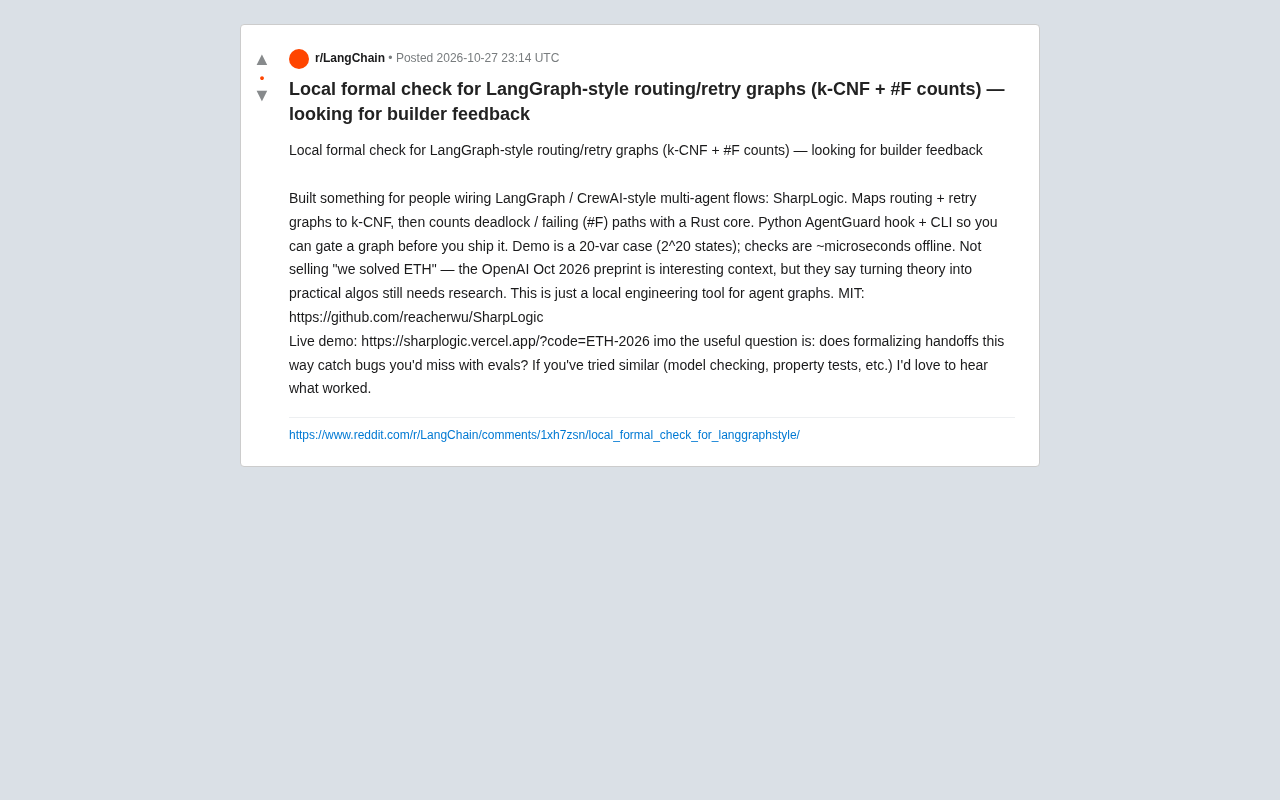
SharpLogic, an open-source project, maps LangGraph-style multi-agent routing and retry graphs to k-CNF, using a Rust kernel to count deadlocks and failing paths (#F counting), offering a Python AgentGuard hook and CLI for pre-release formal gate checks. This article analyzes its principles, its complementary relationship with evals, and the community's concern about modeling costs.
PPO Training of a Franka Robotic Arm for Pick-and-Place: A Reinforcement Learning Starter Project
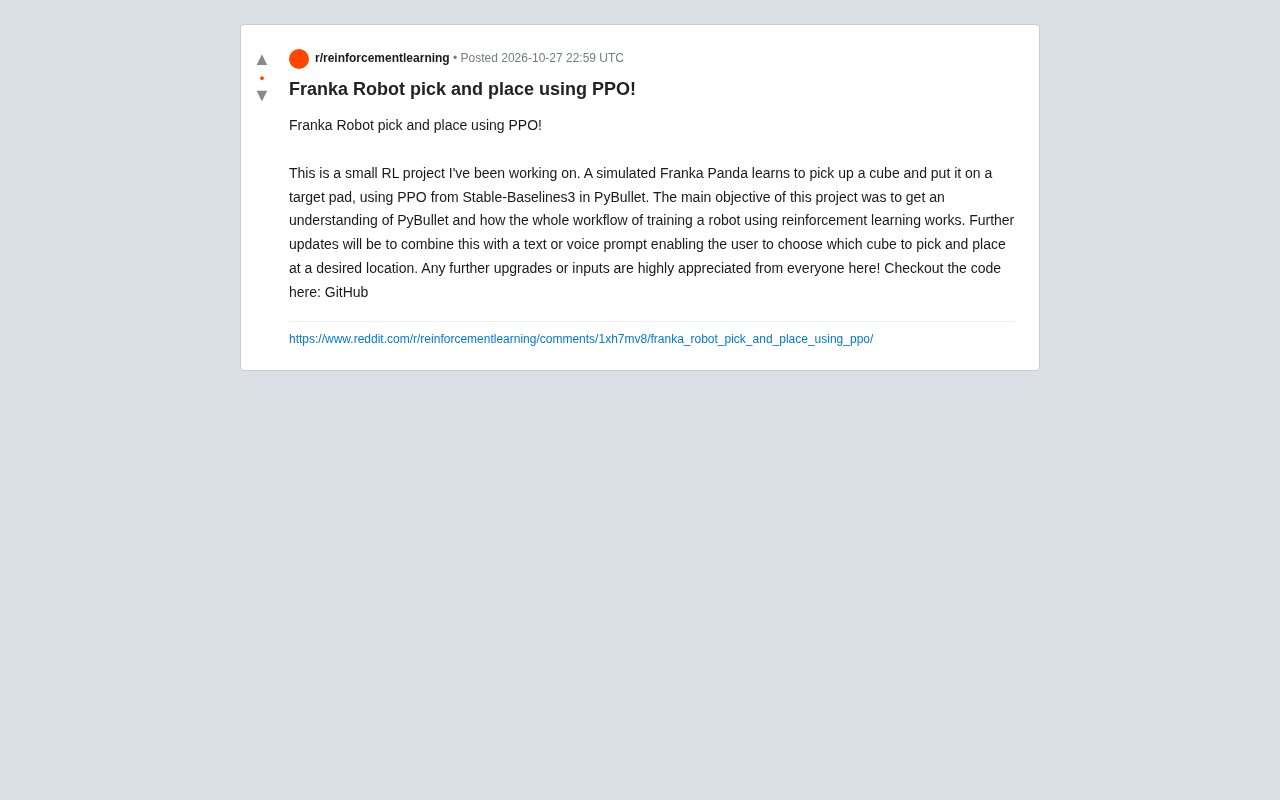
A reinforcement learning project using PPO to train a Franka Panda robotic arm for pick-and-place in PyBullet, covering tech stack choices, task design challenges, and future text/voice command interaction plans—a good reference for beginners.