Bridge: Redefining AI Agent Meetings with an All-in-One Platform to Replace Fragmented Tools

Bridge consolidates the meeting toolchain into an agentic platform where customizable AI agents truly participate in video conferences.
Bridge is a Product Hunt #10 product positioned as "video conferencing for the agentic era." It aims to replace fragmented meeting tools by integrating scheduling, automated meeting prep, video conferencing, real-time intelligence, AI notes, agent workflows, and structured memory into one platform. Its core highlight is letting customizable AI agents join meetings as participants rather than passive note-takers, making meetings an actionable workspace for agents with information continuously invokable afterward. With 76 votes and 5 comments, it ranks in the daily top ten but remains early-stage; the reliability of actual agent participation and team acceptance still need validation.
As AI agents gradually move from demos to real-world collaboration, video conferencing—a high-frequency scenario—is being re-examined. Bridge, a new product ranked #10 on Product Hunt, has put forward an ambitious positioning: a video conferencing platform built for the agentic era. It aims to consolidate a fragmented meeting toolchain into a single platform and, for the first time, let customizable AI agents join meetings as participants.
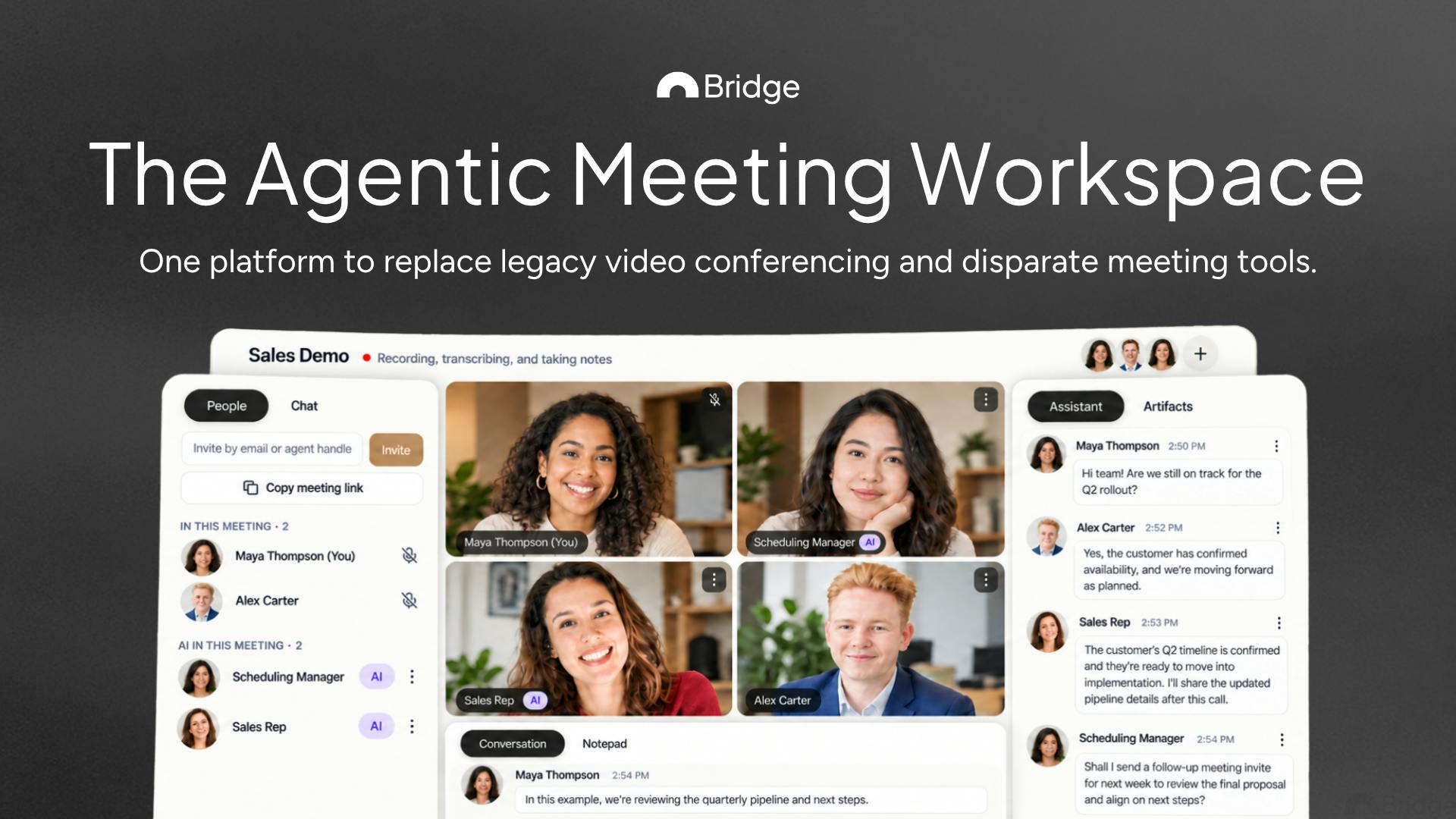
From Fragmentation to All-in-One: What Bridge Aims to Solve
Today, enterprise meetings often span multiple tools: calendar scheduling, pre-meeting prep documents, video calls, real-time notes, and post-meeting task follow-ups—each disconnected from the others. Bridge's core idea is to replace this fragmented meeting tech stack with an agentic meeting platform.
According to its product description, Bridge integrates scheduling pages, automated meeting preparation, video conferencing, real-time intelligence, AI notes, agent workflows, and structured memory into one coherent experience. This means users no longer need to jump between multiple apps, and the meeting-related information flow can form a closed loop in one place.
Letting AI Agents Become Meeting Participants
The core highlight of Bridge's launch is a new type of video conferencing capability—allowing customizable AI agents to join meetings and participate. This is fundamentally different from the common "AI meeting assistants" on the market: the latter mostly play a listening-and-recording role, while Bridge emphasizes the agent's "participation" attribute.
Combined with agent workflows and structured memory, agents can in theory call context, execute tasks, and retain meeting memory during meetings, making the meeting itself an actionable workspace for agents. The company describes it as a meeting format "for the agentic era," which also echoes the current industry trend of AI shifting from passive tools to active collaborators.
AI Agent refers to a software entity that can perceive its environment, make autonomous decisions, and invoke tools to execute tasks. Unlike chatbots that can only respond passively to instructions, it has goal-oriented planning and action capabilities. In meeting scenarios, agentic participation means AI doesn't just transcribe or summarize—it can read context, proactively speak, assign tasks, call external systems (such as calendars, documents, and tickets), and maintain memory state across meetings. This typically relies on mechanisms such as function calling, multi-step reasoning, and persistent memory. The "participation" attribute emphasized by Bridge essentially requires agents to have real-time voice interaction and task execution capabilities, a technical threshold significantly higher than that of listening-based assistants, and it also brings new issues such as reliability, permission control, and meeting order.
Structured Memory: Extending the Value of Meetings
One of the biggest pain points of meetings is that information is quickly lost afterward. The structured memory introduced by Bridge is intended to transform meeting content into structured data that can be continuously invoked by agents and teams, rather than just a text record. Combined with AI notes and real-time intelligence, key decisions and tasks from meetings can be automatically captured for use in subsequent workflows.
The key difference between structured memory and ordinary meeting minutes lies in the data form: text records are unstructured running text, while structured memory extracts decisions, tasks, owners, deadlines, related projects, and more from meetings into entries with fields and relationships, making them easy to retrieve, associate, and invoke by machines. In agent systems, memory is usually divided into short-term context and long-term persistent storage, and long-term memory can be further divided into factual knowledge and episodic experience. Structured memory allows agents to "remember" previous conclusions in subsequent meetings or workflows, avoiding repeated discussion, but it also places high demands on extraction accuracy—incorrectly captured information will be repeatedly amplified, so manual verification and version management mechanisms are needed.
Market Positioning and Observations
On Product Hunt, Bridge received 76 upvotes and 5 comments, placing it in the top ten of the day. Its categories span productivity, meetings, and artificial intelligence, reflecting continued market attention to the "AI + meetings" space. However, the relatively limited number of comments also indicates that the product is still in its early stages, and the actual experience and stability of agent participation in meetings still need validation from more users.
From an industry perspective, Bridge represents a new line of thinking: rather than adding an AI button to traditional meeting software, it redesigns the meeting platform from the starting point of agent collaboration. Whether this path can succeed depends on the reliability of agent participation, the accuracy of structured memory, and whether teams are willing to change their existing meeting habits.
Product Hunt is a global community for launching and discovering new products. Products are ranked by daily, weekly, and monthly leaderboards, and vote counts reflect early attention rather than commercial success. Making the daily top ten usually means gaining some exposure, but products with dozens of votes are still at a very early stage, with a small user base and limited feedback samples. Therefore, 76 votes and 5 comments are better viewed as a signal of "initial market interest" rather than proof of product maturity. For products like AI meetings that depend on network effects and team collaboration habits, real validation often comes from retention and paid conversion after enterprise-level deployment, not from leaderboard rankings on launch day.
One-line Summary
Bridge consolidates the meeting toolchain into an agentic meeting platform, enabling customizable AI agents to truly participate in video conferences.
Paragraph Summary
Bridge is a new product ranked #10 on Product Hunt, positioned as "video conferencing for the agentic era." It aims to integrate scheduling, automated meeting preparation, video conferencing, real-time intelligence, AI notes, agent workflows, and structured memory into a single platform to replace the current fragmented meeting toolchain. Its core highlight is allowing customizable AI agents to join meetings as participants rather than merely listening and taking notes. Combined with agent workflows and structured memory, it makes meetings an actionable workspace for agents and keeps meeting information continuously invokable afterward. The product received 76 votes and 5 comments, ranking in the top ten of the day. It is still early-stage, and the reliability of actual agent participation and team acceptance remain to be validated.
Related articles
 Tech Frontiers
Google Omni 1.2 Flash: 15-Second AI Video at Just $0.07 per Second
Google DeepMind releases Gemini Omni 1.2 Flash: 15-second video, 720p at $0.07/sec (30% cheaper), multi-turn editing without regeneration, draft upscaling to 4K.
 Tech Frontiers
No AI Ghostwriting: Writer's Quarter Reinvents Novel Writing with a Visual Workbench
The Writer's Quarter is an AI-free novel writing and planning tool that unifies character building, story planning, and manuscript writing in one visual workbench. This article analyzes its positioning, target users, and differentiated value amid the rise of AI writing tools.
 Tech Frontiers
Fleeep: A Unified Inspiration Collection Notes App for Creatives
Fleeep is a notes app for creatives that unifies screenshots, bookmarks, saved posts, and inspiration into one calm, cross-device, offline-capable space. This article analyzes its positioning, differentiation, and target users.