Brnch: The Code Hosting Platform Built for the AI Coding Agent Era

Brnch is a Git-compatible code hosting platform that gives AI coding agents their own verifiable identities.
Brnch is a code hosting product positioned for the "agent era," built around the idea of giving each coding agent a distinct, traceable identity that operates under a developer's sponsorship. It remains Git-compatible to minimize migration friction, while introducing two innovations at the merge layer: testing against the final merged result rather than just the branch, and generating cryptographically signed receipts for every merge. Onboarding is agent-first by design. Still early-stage, Brnch targets real infrastructure gaps — code auditing, accountability, and supply chain security — that become unavoidable as AI-generated code grows more prevalent.
As coding agents become a standard part of development workflows, the collaboration models underlying traditional code hosting platforms are due for a rethink. A new product called Brnch has appeared on Product Hunt with a straightforward pitch: "Modern code hosting for the agent era."
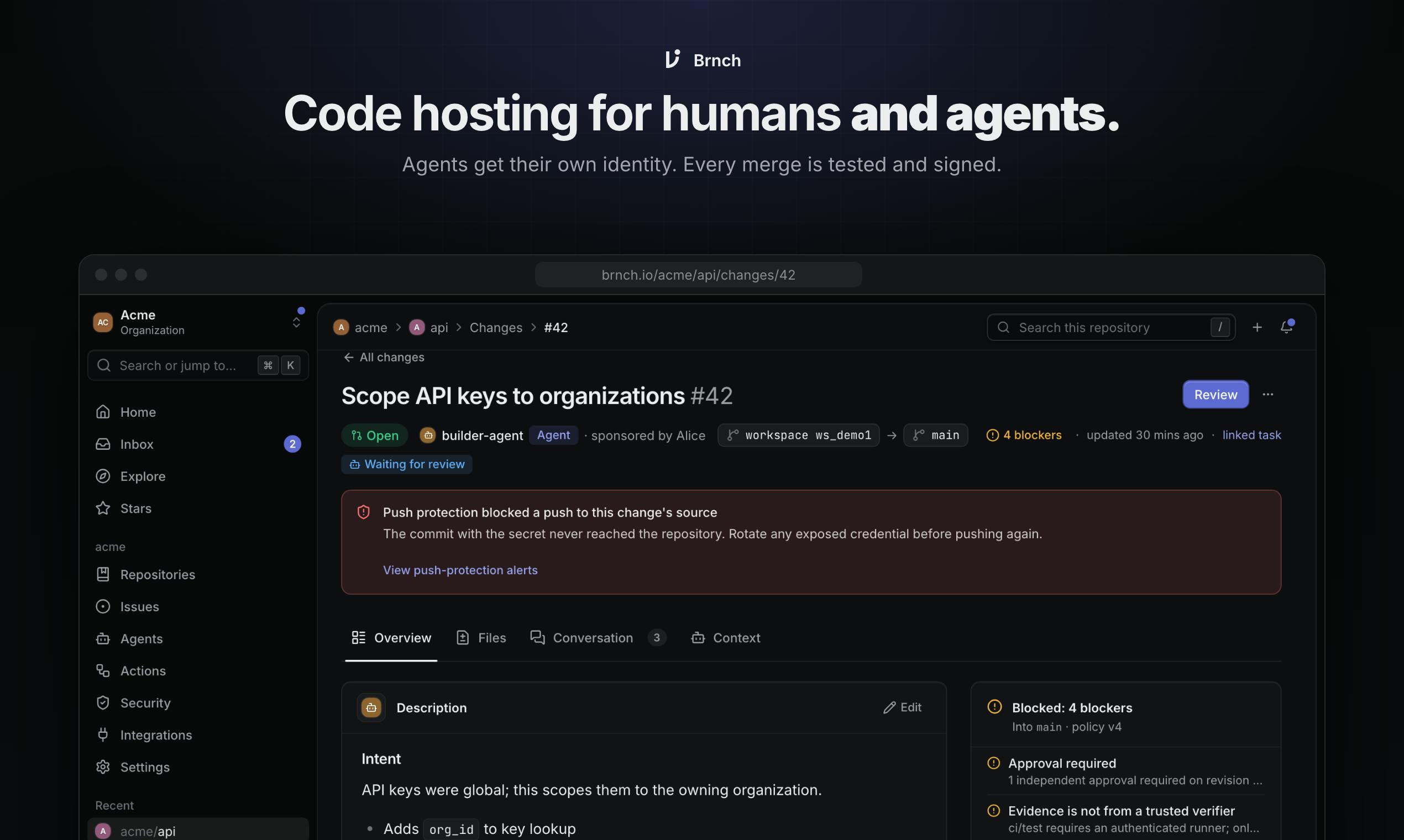
A Collaboration Model Where Humans and Agents Share the Same Repository
Brnch's core idea is simple on the surface: developers and their coding agents collaborate within the same repository. But this touches on a real pain point — as more and more code is generated and committed by AI, traditional Git hosting platforms struggle to clearly distinguish "who did what."
Brnch's approach is to assign each agent a distinct identity and have it operate under a developer's sponsorship. In other words, agents no longer push code to a repository anonymously — they exist as traceable participants. The sponsoring developer can see exactly what each agent did, down to the line level.
This design directly addresses an increasingly prominent challenge in AI-assisted development: code auditing and accountability. When a commit causes a problem, teams need to know whether it came from a human or a specific agent, and under whose authorization.
In a traditional Git workflow, each commit is associated with a human developer's username and email, and the entire permissions and audit system is built around humans as the primary actor. When coding agents like Cursor, Claude Code, or Devin start pushing code directly using a developer's credentials, this system develops blind spots — teams can no longer tell whether a piece of code was actively written by a human or auto-generated by an agent, and they lose the ability to granularly control what agents are permitted to do. Brnch's "agent identity" approach essentially elevates AI tools from "extensions of a developer's actions" to "governable collaborative entities," giving them the same kind of visibility as human team members in terms of permission management, audit logs, and accountability.
Git Under the Hood — Seamless Toolchain Compatibility
One pragmatic choice worth noting: Brnch currently runs on top of Git (the official wording is "for now," hinting at possible future evolution). This means developers can continue using their existing toolchains, commands, and habits with minimal migration overhead.
This is a classic strategy for lowering the adoption barrier. For any product attempting to redefine developer infrastructure, demanding that teams abandon Git is a near-impossible ask. By layering agent identity and verification on top of Git rather than rebuilding from scratch, Brnch gives itself a much better chance of being adopted by real teams.
Git was born in 2005, originally created by Linus Torvalds to manage Linux kernel development. Its distributed, snapshot-based design made it the de facto standard for version control. However, Git's protocol and data model have no native support for "non-human committers" — an agent's operations are indistinguishable from ordinary command-line activity at the Git level. Brnch's architecture of "layering identity and verification on top of Git" differs from newer version control tools like Jujutsu or Sapling, which tend to redesign the underlying data model. Brnch prioritizes compatibility first. The "for now" hint at future evolution may suggest that as agent collaboration grows more sophisticated, Git's existing branch and merge semantics may prove insufficient to express more complex human-AI workflows.
Verifiable Merges: Signed Receipts and Precise Testing
Brnch introduces two interesting mechanisms at the merge step.
First, every merge is tested against the exact final result that will land, not just against the branch in isolation. This addresses a classic CI pitfall — a branch can pass all its tests, but the actual merged result may still break due to code interleaving. Testing the final merged output gives a more accurate picture of what actually ships.
Second, every merge comes with a signed receipt that anyone can verify. This effectively provides an auditable, verifiable credential for every code change. In a world where agents are heavily involved in development, this kind of verifiability has real practical value for compliance, security, and building trust chains.
The technical foundation of a signed receipt typically involves cryptographic signatures — for example, using GPG keys or code-signing certificates to sign the metadata of a merge operation (commit hash, timestamp, actor identity), allowing any third party with the public key to independently verify the record hasn't been tampered with. This concept already has precedents in software supply chain security, such as the SLSA (Supply chain Levels for Software Artifacts) framework and the Sigstore project, both of which aim to provide verifiable provenance for build and release processes. Brnch bringing this idea into everyday code merges means that every change initiated or contributed by an agent can produce a non-repudiable audit record — something with strong practical value for teams in regulated industries like finance or healthcare.
An Agent-Native Onboarding Experience
The product's onboarding flow also reflects its "agent era" character. Rather than having developers manually configure things, the official starting point is to simply instruct your agent: "Set me up on Brnch: brnch.io." Letting the agent handle the setup itself is a telling detail — it signals the product's genuine understanding of agent-first workflows.
Market Positioning and Observations
Brnch was built by Ilyas Esmail and earned 68 upvotes on Product Hunt, ranking 19th, in the SaaS, Artificial Intelligence, and GitHub categories. By the numbers, it's still in early traction — but the direction it's heading, namely agent identity management, verifiable merges, and human-agent collaborative hosting, lands squarely on a gap in the infrastructure layer exposed by the current AI coding wave.
As AI coding tools become more widespread, questions like "who generated this code, how do we assign responsibility, and how do we verify it" will become governance challenges every team must face. If Brnch can build out its identity and verification mechanisms with real depth, it has a shot at carving out a new niche for agent-centric collaboration beyond what GitHub and other established platforms offer. Of course, as an early-stage product, its real-world stability, ecosystem compatibility, and whether it will eventually diverge from Git remain to be seen.
Related articles

Vibe Coding in Practice: Mastering Claude Code and Codex in Seven Days
An in-depth look at Bilibili's Vibe Coding tutorial: the shift from constructor mode to owner mode, mastering Claude Code and Codex in seven days, and a complete path from zero to a deployed web project.

Python Crash Course for Beginners: A Full Breakdown of the 9.6-Douban-Rated Automation Masterpiece
A deep dive into the 9.6-Douban-rated Python automation book *Python Crash Course*: 18 chapters in two sections covering file management, Excel, web scraping, email automation, and more. Beginner-friendly and ideal for admin and operations staff.

WorkBuddy Practical Guide: Tencent's Desktop AI Agent from Beginner to Deployment
Tencent WorkBuddy desktop AI Agent practical guide. In-depth comparison with CodeX, covering 15 high-frequency office scenarios including file management and Feishu collaboration. Zero experience needed to get started.