Brown Sugar Gone Rock Hard? One Slice of Bread Does the Trick — The Kitchen Science Explained

A slice of bread sealed with hardened brown sugar overnight restores it to soft, scoopable texture.
Brown sugar is essentially sucrose crystals coated in molasses — a highly hygroscopic substance that hardens when it loses moisture, cementing the crystals into a solid block. The fix is simple: place the hardened sugar in a sealed container with a slice of bread for 10–12 hours. The bread's moisture slowly releases, the molasses absorbs it and regains fluidity, and the sugar returns to its familiar loose, sand-like texture. The whole process is a neat real-world demonstration of hygroscopicity in action.
Brown sugar that's turned into a rock-solid brick you can barely chip with a spoon — it's a problem almost every home cook has run into. The fix, surprisingly, is as simple as it gets: drop a slice of ordinary bread into a sealed container with the sugar, leave it overnight, and it'll be soft again by morning. The science behind it is genuinely fascinating — a little lesson in what you might call sweet chemistry.
Where Brown Sugar Comes From
Sugar starts as cane juice or beet juice. The process is fairly straightforward: clarify the juice, boil it down, and let the sugar crystals form. But if you want pure sucrose crystals — the white granulated sugar we all know — you have to remove the molasses completely.
Here's the key: if the molasses isn't fully removed, or if some is added back after refining, the result is brown sugar. In other words, brown sugar is essentially sucrose crystals coated in molasses. That coating is what gives brown sugar its distinctive flavor and color — and it's also the reason it hardens over time.
Why Brown Sugar Goes Hard
The very thing that makes brown sugar special — molasses — is also what makes it turn into a brick. Molasses is hygroscopic, meaning it actively absorbs and holds onto moisture. When brown sugar is left in a dry environment, the water in the molasses gradually escapes. As it dries out, the molasses acts like glue, binding the individual sucrose crystals together into a solid mass that's nearly impossible to break apart.
Once you understand this, the solution becomes obvious: the problem isn't the sugar itself — it's the molasses running out of water. Give the molasses enough moisture to flow again, and the hardened block will loosen right up.
What is hygroscopicity? Hygroscopicity refers to a substance's ability to actively attract and absorb water molecules from its surroundings. Molasses is highly hygroscopic because it contains large amounts of fructose, glucose, and various organic acids — molecules with polar functional groups (like hydroxyl groups, -OH) that form hydrogen bonds with water molecules, effectively "grabbing" them. This is a double-edged property: in a humid environment, molasses continuously draws moisture from the air, causing brown sugar to clump into large lumps; in a dry environment, water migrates outward, the molasses shrinks and hardens, and the sucrose crystals become cemented together. This also explains why white sugar doesn't harden the same way under dry conditions — without that molasses coating, pure sucrose crystals have nothing sticky between them and simply stay separate.
The Magic of One Slice of Bread
The solution is surprisingly low-tech: place the hardened brown sugar in a sealed container, add a slice of ordinary bread, put the lid on, and leave it overnight.

The sealed environment is what makes this work. Bread naturally contains moisture, and in an enclosed space, that moisture slowly releases. The hygroscopic molasses then draws that moisture in — just enough to rehydrate and soften it, but not so much that the sugar becomes a soggy mess. No heat required, no stirring needed. Just time.
Why bread is the ideal moisture donor Bread works so well because of its porous, sponge-like structure. The interior of baked bread is made up of a starch-gel network that forms countless tiny air chambers, with water distributed throughout as bound water — it doesn't leak out as liquid and wet the container. In a sealed space, the water activity at the bread's surface is higher than the local humidity around the dried-out sugar, so water molecules migrate slowly along the concentration gradient toward the molasses, until the two reach equilibrium. That equilibrium point is gentle by nature — enough to restore fluidity to the molasses without turning the sugar into syrup. Apple slices or marshmallows can achieve a similar effect by the same principle, but plain bread is the most practical option and won't introduce any extra flavor to the sugar.
What Happens Overnight
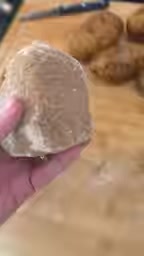
After about 10 to 12 hours, open the container and see for yourself.

Interestingly, the bread looks and feels almost unchanged — still soft and springy, as if nothing happened at all.

But quietly, the bread has transferred a portion of its moisture to the molasses coating the sucrose crystals. The molasses, now rehydrated, is no longer a hard adhesive — it can flow again, wrapping and separating each individual crystal like a lubricant. The brown sugar returns to that familiar texture: loose, slightly damp like wet sand, easy to scoop.
Everyday Chemistry in the Kitchen
The elegance of this trick is how perfectly it illustrates hygroscopicity — a physical chemistry concept — through something completely ordinary. Molasses is both the reason brown sugar can be rescued and the reason it "fails" in the first place. Both stem from the same property: its strong affinity for water. Control the flow of moisture, and you can bring a seemingly ruined brick of sugar back to life.
Next time you find your brown sugar has turned to stone, don't throw it out or struggle to smash it apart. Tuck in a slice of bread, seal the container, go to sleep, and by morning it'll be exactly as it should be. Science is everywhere in the kitchen — and this one might just be the sweetest example of all.
Related articles

From Programmer to AI Architect: The Silent Shift in the Programming Role
AI coding tools like Cursor are transforming software development: developers shift from manual syntax to high-level system architecture. This article analyzes the efficiency gains, technical debt risks, and the trend of architectural judgment becoming the new scarce resource.

ClaudeMD: The Config File That Makes AI Code Assistants Follow Your Rules
ClaudeMD is a project-root config file that lets AI coding assistants like ClaudeCode and Cursor auto-read team conventions—naming rules, test commands, forbidden patterns—at session start, enabling versioned, shareable rules.

One Command Does It All: Connect Relia to Cursor, VS Code, and Other Mainstream AI Coding Tools
The official Relia tutorial shows how one command connects Relia to Cursor, VS Code, Windsurf, Codex, and Gemini CLI, auto-detecting installed tools, writing MCP configs, and supporting project-level setup and connection management.