Build a Visual AI Agent in 30 Minutes: NVIDIA VSS Blueprint in Action

One natural language prompt, 26 minutes, $3: a factory visual AI agent built with NVIDIA VSS Blueprint.
This article breaks down a technical demo in which NVIDIA VSS Blueprint's Build Vision Agent skill lets developers describe requirements in plain language — "Tell me if the juice ends up outside a bottle" — and automatically reads real API contracts, plans an architecture, and deploys on user confirmation. Cosmos VLM monitors camera feeds for anomalies while Nemotron generates event reports. The full build took 26 minutes, ~7.5M tokens, and roughly $3. With models running on local GPUs and no cloud calls, ongoing costs drop to just cents per operation.
When Cameras Can See But Can't Speak
In an orange juice factory, cameras line every production line. They see everything — yet tell you nothing. Spills, leaks, missed fills, overfills — these problems can happen at any moment, but traditional surveillance only records passively. By the time someone reviews the footage, the damage is already done.
This is exactly the core problem that Visual AI Agents are designed to solve. They don't just "see" — they understand what's happening in real time, detect anomalies, and take proactive action. These agents are already transforming operations in factories, warehouses, energy grids, and urban management. This article breaks down a YouTube technical demo showing how to build a working visual AI agent in under 30 minutes for about $3, using NVIDIA VSS Blueprint.
The Core Tool: The Build Vision Agent Skill in VSS Blueprint
The entire build relies on the Build Vision Agent skill within NVIDIA VSS Blueprint. Its design philosophy is to compress a complex deployment process into "one conversation, five steps" — keeping the user in control at all times while the agent handles the underlying engineering pipeline automatically.
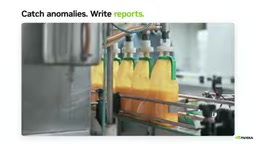
The process starts with a single natural language prompt. You tell it "what you have" and "what you want" — for example, real-time alerts and reports viewable in a web UI. Before writing any code, the agent reads the VSS Blueprint documentation: a straightforward repository containing a microservices catalog and integration contracts. In other words, it designs the solution based on facts, not guesswork. This is especially critical in real-world engineering — many AI-generated architectures fail precisely because they lack understanding of actual interfaces and service constraints.
NVIDIA VSS (Video Search and Summarization) Blueprint is an open-source reference architecture from NVIDIA, purpose-built for video understanding and analysis. It packages multiple microservices — video ingestion, inference engine, event storage, web UI, and more — into a composable blueprint, so developers don't need to design system topology from scratch. The blueprint's core philosophy is composability: each microservice exposes its interface through standardized integration contracts, allowing agents or developers to select and swap components as needed without rewriting the entire data pipeline. This design enables an AI agent, after reading the documentation, to accurately understand which services are available and how to connect them — generating deployable architecture based on real system constraints rather than producing configurations that look good on paper but won't actually run.
Two Models, Two Roles: Cosmos Watches, Nemotron Writes
After reading the documentation, the agent proposes an architecture before touching anything. The proposal centers on two core models:
- Cosmos: NVIDIA's open reasoning-capable Vision-Language Model (VLM), responsible for monitoring the camera feed;
- Nemotron: responsible for writing event reports.
An alert service and VSS web UI round out the stack. Importantly, nothing is deployed at this stage — this is simply a human-readable plan awaiting confirmation.
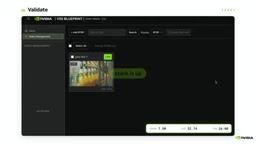
Once the architecture is confirmed, the agent surfaces four key questions: where to build, which GPUs to use, what the host address is, and where the cameras are. Only after those questions are answered and the user gives the go-ahead does it actually begin building. This "plan first, confirm second, execute third" interaction pattern prevents the agent from making unilateral deployment decisions.
Vision-Language Models (VLMs) are multimodal large models capable of processing both images/video and text simultaneously. Unlike pure vision models that only output classification labels or bounding boxes, VLMs can answer open-ended natural language questions about visual content — for example, "Is there liquid outside the bottle?" This capability means the system doesn't need a separately trained detection model for each class of anomaly; switching detection targets is as simple as changing the prompt, dramatically lowering the cost of deploying to new scenarios. Cosmos is NVIDIA's VLM series designed for physical-world reasoning, trained on large amounts of real visual data and specialized in understanding spatial relationships and dynamic scenes. Nemotron is NVIDIA's text generation model optimized for downstream text tasks like structured report writing. Together, they map cleanly onto different stages of the perception–understanding–expression pipeline.
One Prompt, Twenty Services
The single line that actually triggers the whole system is written in plain English:
"Tell me if the juice ends up outside a bottle."

That's it. The agent generates a complete technology stack from this, then handles deployment and verification. The final result: 20 services, 1 live camera stream, completed in 26 minutes, consuming roughly 7.5 million tokens, at a cost of approximately $3. Only once both models, the web UI, and the camera feed are all live and running does the agent truly begin delivering value.
In the background, the VSS agent powered by Cosmos continuously monitors the camera in 10-second segments, repeatedly asking itself the configured question. When a spill suddenly appears on the production line, the event is pushed to the dashboard within seconds.
From Detection to Report: Operational Cost of Just a Few Cents
Detecting the problem is only half the job. The demo presenter wanted to understand what was happening on the production line without scrubbing through footage frame by frame — so they simply typed into the chat box and asked the agent to "generate a report."
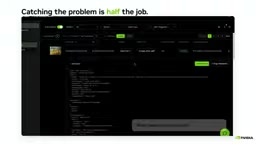
The agent pulled event records from the database, and Nemotron wrote the report on the spot. The whole process took under a minute and cost just a few cents. The key point: no cloud calls, no per-token billing — because Cosmos and Nemotron are both running on local hardware.
The Cost Breakdown: Less Than a Cup of Coffee
Let's do the math:
- Build cost: one coding agent, one skill, one prompt — a one-time spend of roughly $3.50;
- Operational cost: just a few cents per operation, with models running on owned hardware and no ongoing per-token billing.
In other words, a complete visual AI agent capable of real-time anomaly detection and automatic report generation costs less to build than a cup of coffee.
What This Actually Means
What's really worth paying attention to in this demo isn't the "$3" figure itself — it's the workflow shift it represents: moving from "engineers hand-coding microservices" to "describing requirements in natural language while the agent reads real interface contracts and deploys automatically."
For industrial settings, the local deployment model's elimination of per-token billing addresses a long-standing cost concern with visual AI. Continuous video analysis routed through cloud APIs can send bills spiraling out of control. Running inference VLMs and reporting models on owned GPUs is what makes "a few cents per task" economics possible.
Of course, this is fundamentally a product capability demo. Edge cases in real production environments, model false positive rates, and performance at multi-camera scale all require further validation. But it clearly illustrates one pragmatic path for visual AI agents moving from concept to deployable reality.
Edge inference and local deployment carry special significance for industrial visual AI. Camera feeds from factory production lines generate enormous volumes of video data. Streaming that data to cloud APIs for real-time inference not only introduces latency that makes second-level alerting impossible — the continuous token billing also causes costs to scale linearly with the number of cameras. Deploying inference models on local GPU servers within the factory ("edge inference") keeps data on-premises, eliminating network latency bottlenecks and sidestepping data privacy and compliance risks. Operational costs shift from "pay per call" to a one-time hardware investment plus fixed electricity. In industries like manufacturing, energy, and logistics — where both data security and low latency are non-negotiable — this model is rapidly becoming the mainstream path to production visual AI deployment.
Related articles

Amphibious Transforming Drone: Beyond 100x Power Savings, What Are the Real Needs?
Is the amphibious transforming drone just a gimmick? Starting from the 100x power difference of the M4 Morphobot, explore real application scenarios and thesis topic ideas, analyzing boundary conditions where pure drones and pure ground robots both fail.

Warhound Raises $200 Million: Genetically Engineered "War Dogs" Paired with Anduril Gear
Warhound raises $200M, backed by Ben Lamm and Palmer Luckey, to genetically engineer dogs for military and law enforcement use and equip them with Anduril gear. This article analyzes its technology direction, funding logic, and ethical controversy.

Claude API Comes to Google Cloud: IAM Integration and SDK Access Guide
Anthropic hosts the full Claude API on Google Cloud with IAM-controlled permissions and unified billing. This guide covers the Vertex AI and Anthropic-hosted entry points, IAM role configuration, and SDK access.