Build an AI Security Team in 5 Minutes: Grokbot Gives CISOs 11 AI Agents

Grokbot uses templates and MCP to let CISOs assemble an AI security agent team in five minutes.
Grokbot is an AI agent tool that goes live in five minutes, designed to free CISOs from repetitive security execution work. Through a natural language command, the system automatically matches templates and deploys agents, assembling a team of 11 expert agents and 1 coordinator in under five minutes. The coordinator handles task dispatch and result aggregation, while expert agents handle subtasks like vulnerability scanning, log analysis, and incident triage. Its low barrier relies on the template library and MCP server. This architecture mimics human security team division of labor and offers elastic scaling, but responsibility for agent decisions, template quality, and permission boundaries remain challenges. The solution is better suited to repetitive security work with clear task boundaries.
From Going It Alone to Commanding an AI Team
A Chief Information Security Officer's (CISO) daily work is often consumed by policy development, incident response, and vulnerability assessment, leaving little time for actual team collaboration. Grokbot's proposal is straightforward: let AI agents take over these specific tasks. According to a YouTube video, Grokbot is an AI agent tool that goes live "in five minutes," with its core selling point being that it hands repetitive security execution work to customizable intelligent agents, leaving the CISO to play the role of coordinator.
The operational path shown in the video is not complicated: install Grokbot, add a template to create a bot, then connect it to the template library's Grokbot MCP server. Here, MCP (Model Context Protocol) serves as the communication bridge between agents and external tools, allowing different bots to access a unified resource pool.
One Command, 11 Expert Agents Plus 1 Coordinator
The real highlight is "building a team with natural language." The user only needs to type "I am a Chief Information Security Officer, please find and install all relevant bots," and the system automatically matches templates and deploys the corresponding agents. The result demonstrated in the video: in under five minutes, a small team consisting of 11 specialized security agents and 1 coordinator agent is ready.
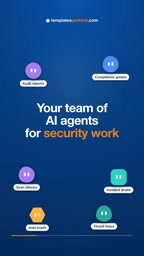
This "coordinator + specialists" structure mimics how human security teams operate. The coordinator agent is responsible for task dispatch and result aggregation, while the expert agents each handle subdomains such as vulnerability scanning, log analysis, and incident triage. For security teams with limited budgets or insufficient staffing, this on-demand agent combination offers an approach to elastic scaling.
A multi-agent system is an architecture in which multiple AI agents with autonomous decision-making capabilities collaborate to complete tasks. Unlike traditional single AI assistants, each agent in a multi-agent system is typically assigned a specific role, tool permissions, and knowledge scope, solving complex problems through division of labor and communication mechanisms. The orchestrator agent is responsible for parsing user intent, decomposing tasks, dispatching them to expert agents, and aggregating results; worker agents focus on specific domains such as vulnerability scanning or log analysis. The advantages of this architecture lie in scalability and modularity: adding a new task type only requires adding the corresponding expert agent, without redesigning the entire system. Common communication methods include shared message buses, direct API calls, or exchanging context through standardized protocols such as MCP. This pattern has been practiced in security operations, customer service, and software development, but permission control among agents, error propagation, and result consistency remain engineering challenges.
MCP and the Template Ecosystem: The Technical Backing Behind the Low Barrier
The entire process can be compressed to five minutes thanks to two designs: the template library and the MCP server. The template library solves the question of "where agents come from"—users don't need to write prompts or workflows from scratch and can simply apply preset roles. The MCP server solves the question of "how agents collaborate," allowing multiple bots to share context and tool permissions and avoid working in isolation.

From an engineering perspective, this combination lowers the barrier to building multi-agent systems. Traditionally, orchestrating multiple AI agents requires handling details such as identity authentication, tool invocation, and state synchronization. MCP abstracts these into standard interfaces, while templates encapsulate the business logic. Together, all the user faces is a single natural language command.
MCP (Model Context Protocol) is an open protocol proposed by Anthropic that aims to standardize how AI models interact with external tools and data sources. It defines the communication specifications between clients (such as AI agents) and servers (services that provide tools or resources), including tool discovery, invocation requests, and context passing. Under the MCP framework, each tool or resource is abstracted as an endpoint on a "server," and agents access it through a unified interface without writing adapter code for each tool separately. This solves the problem of fragmented tool invocation in multi-agent systems, enabling different agents to share the same tool library and permission model. MCP also supports context passing, allowing agents to carry necessary state information when invoking tools. Compared with traditional function calling or custom plugin mechanisms, MCP places greater emphasis on cross-model and cross-platform interoperability, reducing integration costs. However, the permission management and security boundaries of MCP servers still need to be designed by the deploying party; the protocol itself does not provide fine-grained access control.
What It Means for CISOs: Efficiency Gains and Responsibility Boundaries
The core message of the video is a role shift: CISOs no longer need to personally execute every security operation but instead manage AI agents as they would a human team. This can indeed free up time for strategic thinking, but it also raises new questions—who is responsible for judgments made by agents? How is template quality ensured? Are the permission boundaries of the MCP server sufficiently clear?

These questions are not elaborated in the video, yet they are unavoidable in real-world deployment. AI agents can quickly complete initial screening for vulnerability assessment, but final risk decisions still require human oversight. Viewing Grokbot as "driver assistance for a security team" rather than "full self-driving" may be a more prudent positioning.
Applicable Scenarios and Limitations
Judging from the demo, Grokbot is better suited to security work with clear task boundaries and high repetitiveness, such as asset inventory, compliance checklist verification, and alert classification. For complex incidents that require cross-departmental negotiation or involve the leakage of sensitive data, agents are still hard-pressed to replace human judgment. In addition, template quality varies, and users need to determine which templates truly fit their environment.
Overall, Grokbot demonstrates a pragmatic way to deploy AI agents: rather than pursuing general intelligence, it standardizes the workflows of specific roles using templates + MCP. For security teams looking to quickly test the waters of multi-agent collaboration, this is an entry point worth watching.
One-line Summary
Grokbot uses templates and MCP to let CISOs assemble an AI security agent team in five minutes.
Paragraph Summary
Grokbot is an AI agent tool that goes live in five minutes, designed to free CISOs from repetitive security execution work. Through the natural language command "I am a Chief Information Security Officer, please find and install all relevant bots," the system automatically matches templates and deploys agents, assembling a team of 11 expert agents and 1 coordinator agent in under five minutes. The coordinator agent handles task dispatch and result aggregation, while expert agents handle subtasks such as vulnerability scanning, log analysis, and incident triage. Its low barrier relies on the template library and MCP server: the template library encapsulates business logic, and MCP standardizes communication between agents and external tools. This architecture mimics the division of labor in human security teams and offers an approach to elastic scaling, but responsibility for agent decisions, template quality, and permission boundaries remain deployment challenges. The solution is better suited to repetitive security work with clear task boundaries.
Related articles

Workbuddy for Absolute Beginners: How a Desktop AI Agent Fits Into Real Workflows
A beginner's guide to the Workbuddy desktop AI agent: installation, claiming credits, file management, and building automated workflows—compared with CodeX for fit and cost, helping professionals shift from AI question-askers to AI managers.

OpenAI's New Agent Stack: Computer Use, Decisions API, and Ultra-Fast Workflows
OpenAI Dev Day unveiled a new agent stack: Computer Use outperforms humans, Decisions API delivers ultra-low-latency classification via Luna, Agents API opens the same Computer Use capabilities, and GPT-6.1 Sol costs only one-seventh of Astra. Core updates, benchmark data, and developer insights.

Liang Wenfeng Open-Sources DeepInfo Inference Framework, Takes On U.S. Ban
DeepSeek open-sources its DeepInfo inference framework after its models, featuring GPU/CPU cross-pipelining, small-model prediction with large-model verification, and full Huawei Ascend and NVIDIA chip support—facing the U.S. federal ban head-on. This article analyzes its significance for AI deployment and open-source strategy.