Build an AI Trading Bot with Zero Code: A $1,000 Starter's Practical Guide

Zero-code AI trading bot guide: strategy generation, backtesting, incubation, and live trading integration.
A no-code method for building AI trading bots with Claude or ChatGPT, TradingView, TradingKit's MCP Server, and TriggerTrade. Strategies draw on the NNFX template. Since 95% of backtested strategies fail live, a 1-3 month incubation with new data is essential before connecting to brokers via TradingView alerts. Five practical rules emphasize capital preservation.
Build an AI Trading Bot with Zero Code: A $1,000 Starter's Practical Guide
After five years of backtesting strategies and blowing up his account twice, one trader distilled a method for using AI agents to automatically hunt for profitable strategies. No coding required—just conversations with Claude or ChatGPT—and you can build a complete system spanning strategy generation, backtesting, and live trading. Here's the full breakdown.
Toolchain: A Free and Low-Cost Combo
You don't need expensive software subscriptions to build an AI trading bot. The core tools are: Claude or ChatGPT (for generating strategy code and conversational development), TradingView (the free plan offers two alerts, enough to get started), TradingKit's MCP Server (a free community project that has backtested over 1.1 million strategies), and TriggerTrade (free middleware that connects brokers to AI agents).
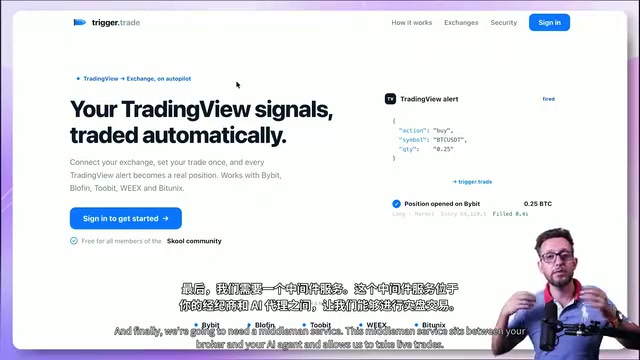
Choosing Claude versus ChatGPT is purely personal preference. The author uses Claude Code rather than the chat interface because it handles code tasks more smoothly. Claude ranges from free to $90 per month, and ChatGPT's free version can also invoke Codex to write bot code. The key point: an AI agent needs a set of tools to execute backtests and live trades, and TradingKit's MCP Server fills exactly that role—copy the code it provides into Claude, and installation completes in about three minutes. After that, authorize via a verification code and the AI agent can backtest strategies on TradingView.
MCP (Model Context Protocol) is an open protocol introduced by Anthropic in late 2024 to standardize how AI models connect to external tools and data sources. Put simply, it lets AI agents like Claude "call" third-party services (such as backtest engines and broker APIs) without writing separate integration code for each service. TradingKit's MCP Server is a bridge built on this protocol—through it, the AI gains the ability to run backtests, read market data, and place trading orders. This is the technical prerequisite that makes "zero code" possible.
Pine Script is TradingView's dedicated strategy scripting language. Its syntax is concise, and it includes a large library of built-in technical indicator functions, making it ideal for quickly expressing trading logic. AI-generated strategy code must ultimately be converted to Pine Script to run and trigger alerts on TradingView. Understanding this helps explain why the entire workflow revolves around TradingView: it serves both as the backtest environment and as the signal emitter for live trading.
Strategy Inspiration Sources and the NNFX Framework
Where do good strategy ideas come from? The author recommends three channels: Quantpedia offers preset backtested strategies across markets, Google Scholar is useful for searching academic research on trading strategies, and TradingView hosts the largest library of open-source indicators. Among these, the NNFX channel has been the author's primary source of profits over the past five years.
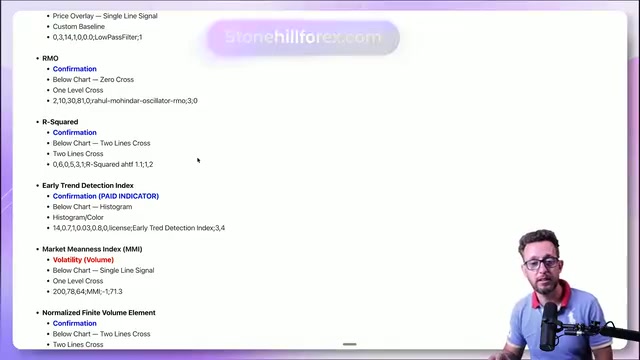
The author distills the NNFX method into a "base template": one trend-direction indicator + two confirmation indicators (such as MACD or RSI) + one volume/volatility indicator (to avoid ranging markets) + one ATR-based stop-loss/take-profit indicator (better adapted to volatility than fixed percentages). This combination performs stably in backtests. Give these rules to the AI and ask it to build a strategy with the same structure, and the AI can automatically generate Pine Script code.
For a small $1,000 account, position management is paramount. The author emphasizes: positions should be much smaller during ranging markets and much larger during explosive trends. This rule must be written into the prompt you give the AI.
NNFX (No Nonsense Forex) is a systematic forex trading methodology proposed by YouTube creator VP. Its core idea is to abandon single-indicator signals in favor of "multi-indicator layered confirmation" to filter out noise. Its standard structure includes: one baseline indicator to determine trend direction, two confirmation indicators to validate signals, one volume indicator to avoid ranging markets, and ATR-based stop-loss/take-profit management. The author champions this framework because its rules are explicit and easy to quantify, making it highly suitable for conversion into prompts an AI can execute.
ATR (Average True Range) is a classic indicator for measuring market volatility, reflecting the average price range over a given period. Setting stop-losses and take-profits using multiples of ATR, rather than fixed percentages, lets a strategy automatically adapt to different instruments and volatility environments—widening stops during high volatility to avoid being stopped out by noise, and tightening them during low volatility to control per-trade risk. This is especially critical for risk control in a small $1,000 account.
Loop Optimization and Incubation: 95% of Strategies Fail
The author designed a detailed prompt that lets the AI run a "loop"—continuously generating, backtesting, and optimizing strategies within a set period (such as 24 hours, 8 hours, or a week) to find the most profitable configurations. All results flow into a locally hosted HTML mission control center displaying equity curves, win rates, profit factors, and other key metrics.
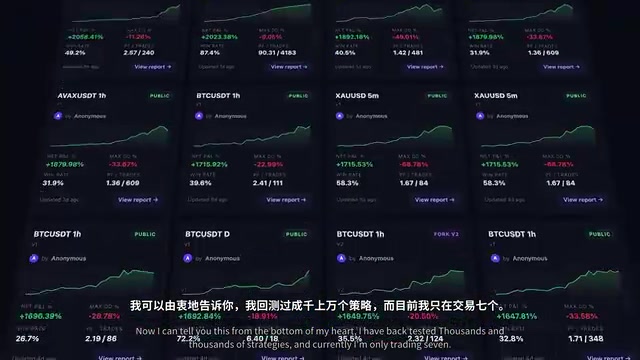
But pretty backtests don't mean real profits. The author admits: 95% of backtested strategies fail completely in live trading. He has backtested hundreds of thousands of settings and currently trades only 7 strategies. Hence the indispensable "incubation" stage—place the strategy in a simulated environment, run it on new, unseen data for one to three months, then have the AI re-backtest it, dividing the data into an incubation segment and a backtest segment, and compare the equity curves. Green represents backtesting, pink represents live performance during incubation. If you learn only one thing from this entire process, the author believes it should be incubation: "absolutely essential to becoming a profitable AI trader."
Equity curve is a chart of an account's net value over time and is the core tool for assessing strategy health. A smooth, upward equity curve usually indicates a robust strategy; sharp drawdowns, prolonged flat periods, or sudden plunges suggest the strategy may be overfitted or has stopped working. During incubation, the author compares the shape of two equity curves—the "backtest segment" and the "incubation segment"—to judge whether a strategy is genuinely effective. If the incubation-period curve deviates significantly from the backtest period, the strategy has merely fitted historical data.
Profit factor is the ratio of total profits to total losses; above 1 means profitable, and above 1.5 is generally considered acceptable. Win rate must be viewed alongside the risk-reward ratio: a strategy with a high win rate but low risk-reward ratio can wipe out many small wins with a single large loss. Together, these metrics form the quantitative basis for judging strategies in the mission control center.
Connecting to Live Trading: From TradingView to Broker
Once a strategy passes incubation, the next step is to hand the signals to TradingView so you don't need your own computer running 24/7. Paste the AI-generated Pine Script code into TradingView, set up the alert system, and signals can be sent to the broker's servers.
Specific process: create an API key on the broker platform (granting only read and trade permissions, not withdrawal permissions), enter the key into middleware like TriggerTrade, and generate a snippet to paste into the message body of a TradingView alert. The middleware acts as a translator, converting TradingView signals into instructions the broker understands; a single message can contain entry, stop-loss, and take-profit simultaneously.
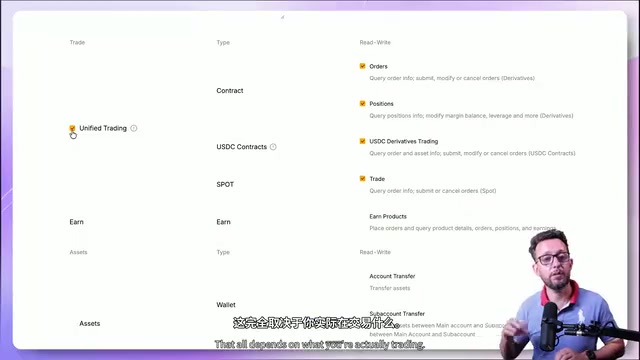
The author notes that API permission settings vary slightly across brokers, but the core principle is the same: give the AI agent trading permissions only, never fund-transfer permissions.
Five Live Trading Rules: Lessons Paid for in Real Money
- Incubation cannot be skipped. Don't put real money into a strategy that hasn't been validated on new data.
- Respect the law of large numbers. Give the bot enough time to prove itself; frequent switching only burns capital.
- Always backtest yourself. Blindly trusting any AI agent or bot was the author's most costly mistake.
- Know when to shut it down. Establish shutdown criteria based on equity curves and standard deviation, and don't become emotionally attached to the bot—no matter how much it has made in the past.
- Community beats going it alone. The author believes finding like-minded partners to exchange strategies with is more valuable than any off-the-shelf AI system.
The core logic of the entire process isn't complicated: use AI to accelerate strategy discovery, use incubation to filter out noise, use middleware to connect to live trading, and use discipline to constrain execution. How many bots can $1,000 run? The author doesn't give a fixed number, but emphasizes that a small account's top priority is capital preservation—position management rules matter more to survival than the strategy itself.
One-line Summary
Build trading bots with AI agents and zero code: a complete methodology from strategy generation, backtesting, and incubation to live trading integration.
Paragraph Summary
The article presents a no-code method for building AI trading bots: using Claude or ChatGPT, TradingView, TradingKit's MCP Server, and TriggerTrade middleware, traders can complete strategy generation, backtesting, and live deployment through conversation. Strategy inspiration comes from Quantpedia, Google Scholar, and TradingView, centered on the NNFX base template (trend indicator + two confirmation indicators + volatility filter + ATR stop-loss/take-profit). The author stresses that 95% of backtested strategies fail in live trading, so a 1–3 month incubation period using new data is essential. In the live phase, brokers' APIs connect to TradingView alerts with trading-only permissions. Finally, five rules paid for in real money, with capital preservation first for small accounts.
Related articles

Random Pruning of the DPO Computation Graph: 1.4x Training Speedup and Lower Peak Memory
DPO training too slow and memory-hungry? This paper proposes a random pruning framework for the DPO computation graph, sampling independently across position, sequence, and branch dimensions; branch pruning achieves a 1.426x step-time speedup and cuts training time by about 30%, with in-depth attribution of memory and time gains.

Why Does JEPA Underperform MLM in Longitudinal EHR Representation Learning?
New study compares JEPA and MLM for longitudinal EHR representation learning on MIMIC-IV: three JEPA variants train stably without collapse but underperform MLM; target size, not heterogeneity, drives prediction error.

Transfer Learning + Visible Light Communication: A New Approach to Energy-Efficient Indoor Positioning
A study proposes a transfer learning-based visible light communication indoor positioning method, achieving 47% accuracy improvement on the BOSCH factory dataset, 67.5% model efficiency under high noise, and introducing the ME composite metric for energy-efficient positioning in energy-constrained industrial IoT scenarios.