Build From Scratch or Just Use sklearn? A Complete ML Engineer Learning Path Guide

A practical guide on when to build ML algorithms from scratch vs. using sklearn for job-focused learners.
The debate between implementing ML algorithms from scratch in NumPy versus using sklearn comes down to timing and career goals. This guide recommends a three-stage approach: start with a curated set of from-scratch implementations to build intuition, then master sklearn and mainstream frameworks, and finally complete end-to-end projects. Skill priorities also vary by company type — startups value full-stack delivery, while top tech firms reward deeper algorithmic understanding.
The Classic Debate That Confuses Countless ML Learners
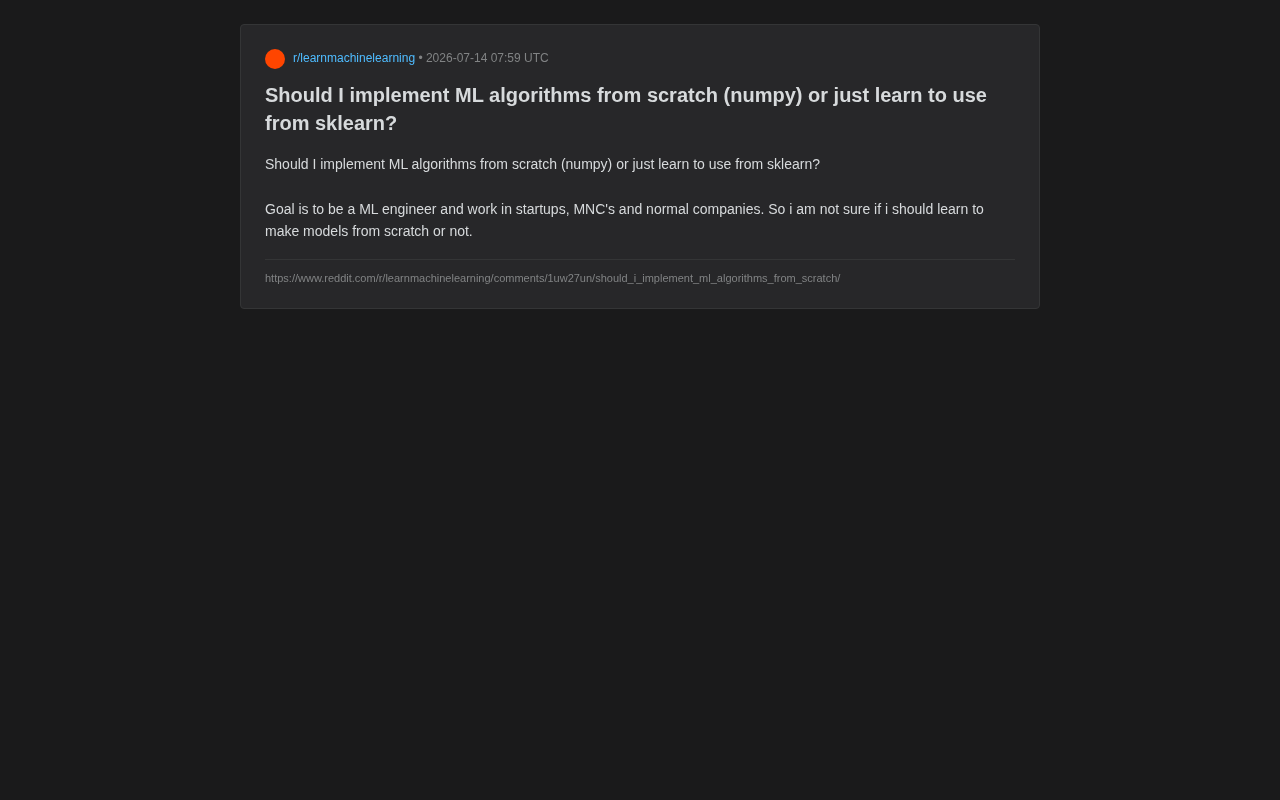
A timeless question keeps surfacing in the machine learning community: Should you implement ML algorithms from scratch with NumPy, or go straight to calling sklearn? For job-focused learners, this isn't just a question of study method — it directly affects the return on your time investment.
This debate cuts to a long-standing tension at the heart of ML education: How do you balance deep understanding of underlying principles against the efficiency of engineering in practice?
The Core Difference Between the Two Paths
Building From Scratch: Understanding the "Why"
Handwriting linear regression, logistic regression, or even neural network backpropagation in NumPy isn't really about the code itself — it's about forcing you to truly understand the mathematical mechanics of the algorithm.
NumPy (Numerical Python) is the foundational library for scientific computing in Python, providing high-performance multi-dimensional array objects and linear algebra operations. Writing ML algorithms from scratch in NumPy means touching the mathematical skeleton of an algorithm directly at the matrix operation level. Take the parameter update formula for linear regression: θ = θ - α∇J(θ). Manually deriving and implementing the gradient matrix calculation turns an abstract formula into something concrete.
When you implement gradient descent by hand, you viscerally feel what happens when the learning rate is too large and parameters diverge, or when features aren't normalized and convergence stalls. Gradient descent iteratively updates parameters in the direction opposite to the loss function's gradient to approach the optimum — a learning rate that's too large causes the parameters to oscillate wildly or diverge. That firsthand experience of hitting these pitfalls becomes the direct foundation for later understanding why adaptive optimizers like Adam and RMSprop were designed the way they are. When you hand-code information gain for a decision tree, you intuitively grasp why certain features get prioritized for splitting. These "learning-by-breaking" experiences simply cannot be replicated by calling an API.
The key benefits of building from scratch include:
- Debugging ability: When a model behaves unexpectedly, you can pinpoint the issue at the principled level rather than blindly tuning hyperparameters
- Interview competitiveness: Many technical roles ask candidates to derive formulas or implement simplified versions of algorithms
- Learning transfer: Once you understand the underlying logic, picking up new algorithms or frameworks becomes far easier
Using sklearn: Focusing on the "How"
In real industrial environments, almost no one writes algorithms from scratch. Mature tools like sklearn, XGBoost, and PyTorch are highly optimized and far exceed any personal implementation in performance, stability, and maintainability.
scikit-learn, primarily developed by France's INRIA research institute, has become the de facto standard for Python ML since its 2007 release. Its Pipeline mechanism lets you chain data preprocessing, feature engineering, and model training into reusable workflows, effectively preventing common engineering mistakes like data leakage. GridSearchCV automates hyperparameter search using K-fold cross-validation, systematically replacing what used to be a tedious manual process — these engineering-minded designs significantly reduce the risk of human error in production.
For ML engineers focused on landing a job, day-to-day work typically involves:
- Data cleaning and feature engineering
- Model selection and hyperparameter tuning
- Building training and inference pipelines
- Model deployment, monitoring, and continuous iteration
In these areas, being fluent with sklearn's Pipeline, GridSearchCV, cross_val_score, and similar tools is far more practically valuable than being able to hand-code an SVM.
Practical Advice for Job Seekers
Move Past the False Dichotomy
For learners targeting a role at a startup or a major tech company, the most rational answer is: do both, but know the priorities and the timing.
This isn't fence-sitting — it's a judgment grounded in career reality. ML engineers need to interface with business stakeholders and deliver models quickly (which requires tooling) while also having the diagnostic ability to troubleshoot when systems break down (which requires foundational understanding). Both capabilities are essential; the difference is just the order in which you develop them.
A Suggested Three-Stage Learning Sequence
Stage 1: Implement a curated set of core algorithms from scratch
There's no need to handwrite every algorithm — the return on investment is too low. Focus on these most representative examples:
- Linear Regression / Logistic Regression (understand loss functions and gradient descent)
- A simple neural network (understand forward pass and backpropagation)
- K-Means or Decision Trees (understand core logic behind unsupervised / tree-based models)
Implementing these algorithms will cover roughly 80% of the core ideas in machine learning.
Stage 2: Shift fully to sklearn and mainstream frameworks
Once your foundational understanding is solid, invest the majority of your energy in getting fluent with sklearn, pandas, XGBoost/LightGBM, and deep learning frameworks. Focus on practicing complete project workflows rather than repeatedly reimplementing individual algorithms.
Stage 3: Complete real end-to-end projects
What hiring managers care about most is whether you can solve real problems. A true end-to-end project covers the full lifecycle — data collection, feature engineering, model training, evaluation, deployment, and production monitoring. This aligns closely with the MLOps (Machine Learning Operations) philosophy that has gained traction in recent years, which borrows continuous integration concepts from DevOps and emphasizes reproducibility and maintainability of ML systems. It's worth noting that in industrial ML projects, data engineering and deployment operations often account for more than 80% of total effort, far outweighing model training itself — which is exactly why hiring managers place such high value on end-to-end experience. Building a complete project using public datasets, from data acquisition and cleaning through modeling to deployment, packaged into a portfolio, will impress interviewers far more than any standalone algorithm implementation.
Skill Priorities by Company Type
Different types of companies have noticeably different expectations for ML engineers. Understanding this helps you allocate your study time strategically:
- Startups: Value "full-stack" capabilities and fast delivery. Being able to use off-the-shelf tools effectively and independently complete end-to-end projects is your core competitive advantage.
- Large tech companies / multinationals: Interviews tend to be more academic, potentially testing derivation of algorithm principles. Experience building from scratch becomes a meaningful differentiator.
- Traditional enterprises: Typically care whether a model can be reliably deployed to generate business value. Engineering skills and business acumen carry more weight.
If your target includes top-tier tech companies, investing time in from-scratch implementations pays off more. If you're leaning toward startups or traditional enterprises, shift your focus earlier toward tooling and project experience.
Understanding and Efficiency Were Never Opposites
Coming back to the original question — "build from scratch or just use sklearn" — experienced ML engineers never treat these as opposing choices. Building from scratch is about developing solid intuition for underlying principles; mastering tools is about creating value efficiently in real-world projects.
For learners focused on employment, the optimal strategy is: use a targeted amount of from-scratch implementation to build a solid foundation, then invest the bulk of your time in engineering practice and project experience. Understanding "what's happening under the hood" will make you a better engineer — but what ultimately determines how far you go in your career is whether you can use the tools at your disposal to genuinely solve real problems.
Key Takeaways
Related articles

Roamux: Run AI Agents Locally, Control Them From Anywhere
Roamux is an open-source project that runs AI agents locally while enabling remote control from anywhere. Explore its architecture, use cases, and security considerations.

Researchers Claim AI Agents Being Tested by OpenAI Were Involved in a Cyberattack
Security researchers allege OpenAI-tested AI agents were involved in a cyberattack. We analyze the security risks, accountability gaps, and safeguards the industry needs.

James Webb Telescope Reveals: Extreme Star-Forming Galaxies Masquerading as Faint Quasars
JWST finds some objects mistaken for faint quasars are actually extreme star-forming galaxies, potentially revising estimates of early-universe supermassive black holes.