Roamux: Run AI Agents Locally, Control Them From Anywhere
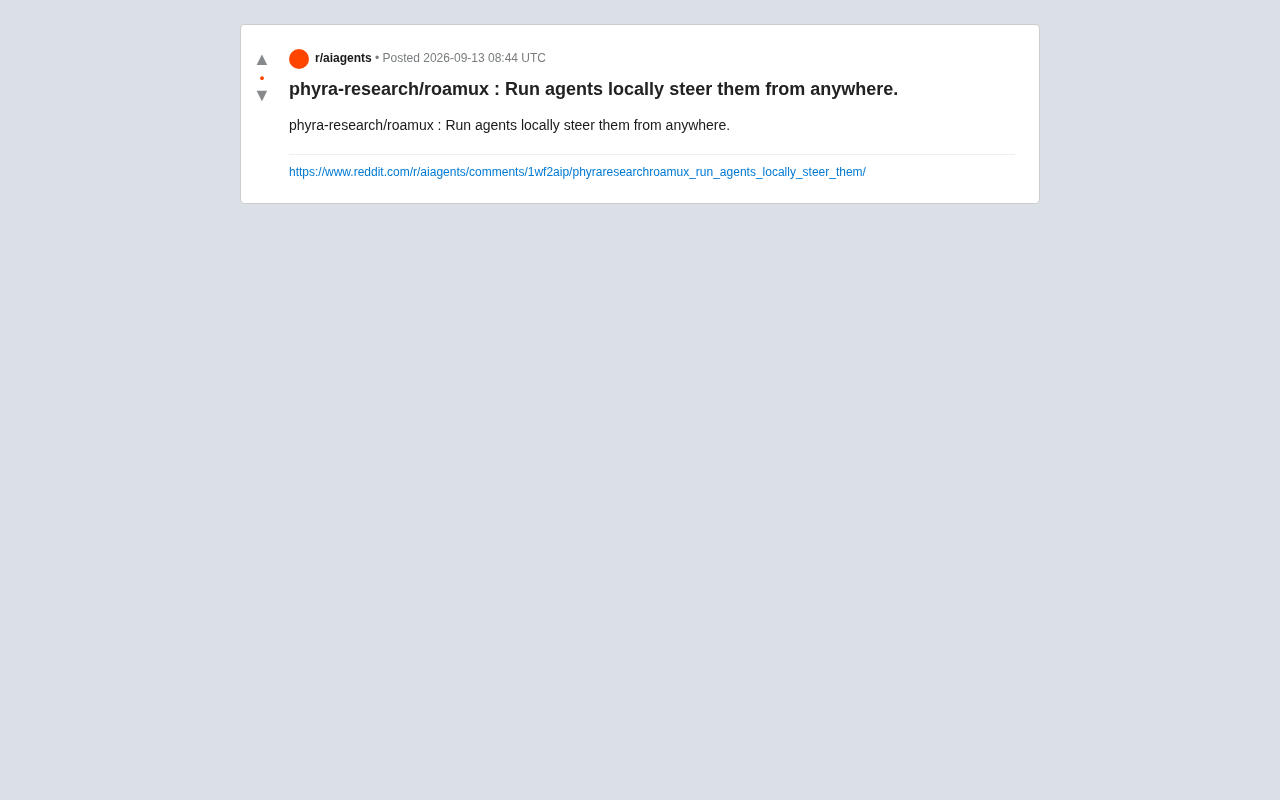
Roamux runs AI agents locally while letting you steer and course-correct them from anywhere.
Roamux is an open-source project built around a decoupled "local execution, remote control" architecture — agents run on your own device or private server, accessing local files and tools, while the control interface can be accessed from anywhere. This design directly addresses three major pain points of cloud-hosted agents: privacy risks from data uploads, compute costs that scale with usage, and hard dependencies on third-party infrastructure. The remote control channel also solves the "gone dark after launch" problem, letting humans intervene, redirect tasks, or authorize high-risk actions at any time. The project targets developers with deployment capabilities who care about data sovereignty, though users must take the security implications of remote access seriously — including authentication, connection encryption, and permission controls.
A Fresh Approach: Agents Run Locally, Control Stays With You
The open-source project Roamux (from phyra-research) offers a compelling proposition: run AI agents in your local environment while allowing you to control and guide them from anywhere. This combination directly addresses two persistent pain points in autonomous agent deployments — the question of who owns your data and compute, and the lack of remote controllability.
For developers who increasingly want to run AI agents on personal devices or private servers, a "local execution + remote control" architecture means retaining full ownership of code, data, and the runtime environment — without being tethered to the same machine. You can kick off a long-running task on your office workstation, then continue issuing instructions or course-correcting from your phone during your commute.
Why Running Locally Is Becoming More Important
Most mainstream agent products over the past two years have relied on cloud hosting, meaning task context, file access, and execution all happen on third-party servers. This creates three real problems: privacy-sensitive data gets uploaded, compute costs scale with usage, and you end up tightly dependent on a vendor's infrastructure.
By pulling execution back to local, Roamux fundamentally decouples who runs the agent from who directs it. The agent accesses files, calls tools, and performs actions inside an environment you trust — while the control interface is abstracted away and accessible remotely. This decoupling is especially valuable for tasks involving internal codebases, private documents, or automation workflows that need access to local resources.
The Core Problem "Control From Anywhere" Solves
One counterintuitive reality of autonomous agents is this: the more autonomous they become, the more humans need a reliable channel to intervene at any time. When a task goes off the rails, stalls at a decision point, or needs authorization for a high-risk action, users must be able to steer it promptly — not wait for it to finish and clean up the mess afterward.
Roamux's tagline, "steer them from anywhere," is designed precisely around this need. A remote control channel means human oversight is no longer constrained by physical location — which matters enormously for long-running tasks and workflows that require multiple human approvals. It transforms agents from something that goes dark after launch into a collaborative partner you can talk to and redirect at any time.
Who It's For — and What to Watch Out For
By its positioning, Roamux targets developers and technical teams with hands-on capability — people who want to self-host their agent runtime, care about data sovereignty, and need flexible remote access. Compared to out-of-the-box cloud SaaS solutions, open-source self-hosted setups like this typically require users to handle deployment and configuration themselves.
One important caveat: "control from anywhere" brings convenience, but it also introduces security boundary concerns around remote access. Exposing a locally running agent to a remote control channel means you must take authentication, connection encryption, and permission controls seriously. Any entry point that can remotely direct an agent is also a potential attack surface. When evaluating a solution like this, assessing its authentication mechanisms and network exposure should be your first step.
Takeaway
Roamux represents a pragmatic direction in the agent toolchain: rather than pushing everything to the cloud, it keeps execution local while letting control travel with you. This architecture has natural appeal for developers who prioritize privacy, cost control, and autonomy. Since publicly available information is currently limited to the project's brief introduction, specific feature details, supported models and tool ecosystems, and deployment complexity should be verified in the project repository. For anyone exploring self-hosted agent solutions, it's worth adding to your watchlist.
Related articles
Why AI Doomsday Warnings Fall Flat Inside Silicon Valley
Why are AI risk warnings from industry insiders losing traction in Silicon Valley? This piece examines warning fatigue, front-line perspective gaps, and commercial pressures shaping the industry divide.
Researchers Claim AI Agents Being Tested by OpenAI Were Involved in a Cyberattack
Security researchers allege OpenAI-tested AI agents were involved in a cyberattack. We analyze the security risks, accountability gaps, and safeguards the industry needs.
James Webb Telescope Reveals: Extreme Star-Forming Galaxies Masquerading as Faint Quasars
JWST finds some objects mistaken for faint quasars are actually extreme star-forming galaxies, potentially revising estimates of early-universe supermassive black holes.