Build Your Own Personal Assistant Agent or Buy Off-the-Shelf? A Developer's Practical Decision Guide

The core value of building a personal assistant agent is data sovereignty and fine-grained human confirmation—not saving money.
The article revolves around a developer who wants to build a personal assistant agent spanning work and family contexts, analyzing his requirements (data ownership, model swappability, confirmation before high-risk operations, resumable long tasks, security) and providing a decision framework. It notes that when data sovereignty and model swappability are hard constraints, pure SaaS falls short—the strongest case for self-building—but self-building carries long-term operational costs like API changes, tool failures, audit logging, and security patches. LangGraph fits the orchestration layer with stateful, interruptible workflows but doesn't address hosting, security, or permission approval. Fine-grained human confirmation nodes are the core payoff, and starting with a minimal viable version on a single domain is recommended.
Why More and More People Want to Build Their Own Personal Assistant Agent
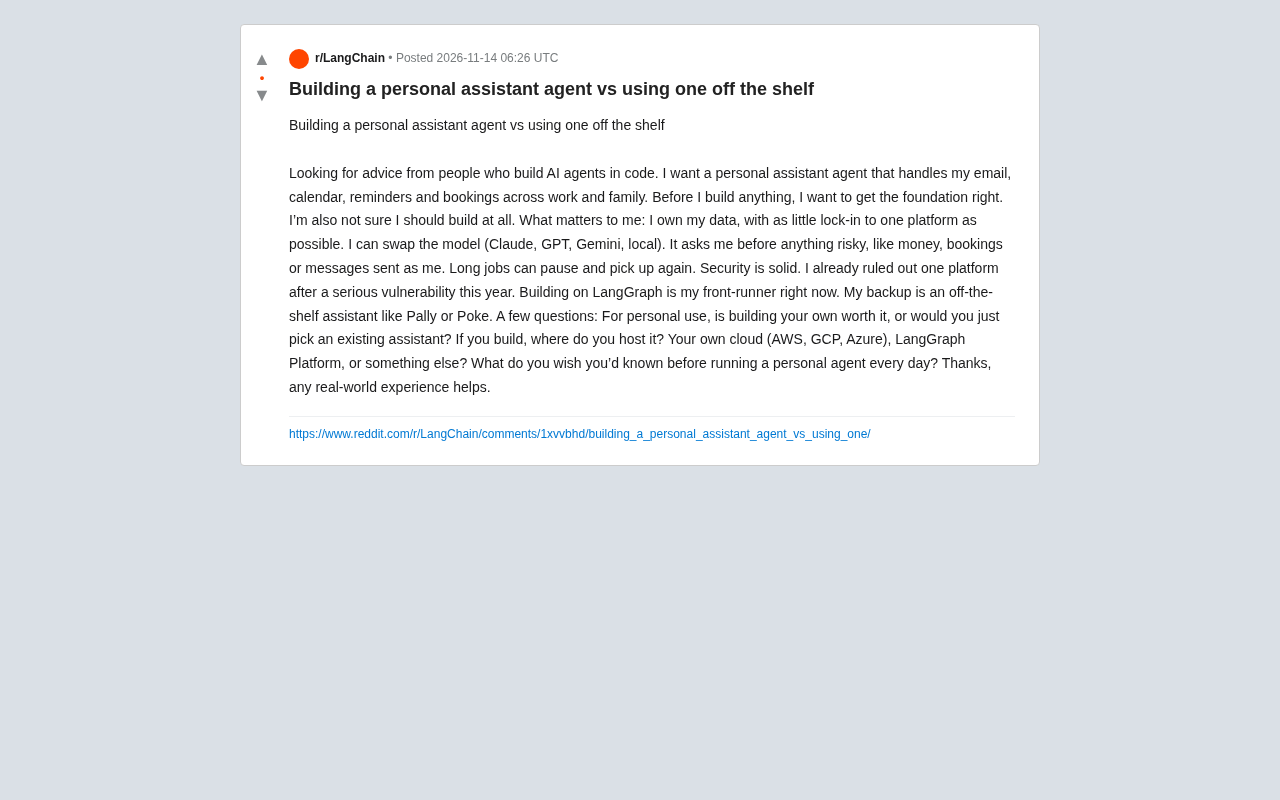
A developer posted on Reddit describing a fairly representative dilemma: he wanted a personal assistant agent that could handle email, calendar, reminders, and bookings across both work and family contexts, but before getting started, he wanted to first figure out how to architect the infrastructure—and whether it was even worth building himself.
His requirements list was specific: data ownership staying with him, minimal platform lock-in, swappable models (Claude, GPT, Gemini, or even local models), mandatory confirmation before high-risk operations involving money/bookings/sending messages on his behalf, the ability to pause long-running tasks and resume later, and solid security. He also mentioned that he had already ruled out an existing platform this year due to a serious vulnerability.
This requirements list actually answers half the question: when "data sovereignty" and "model swappability" become hard constraints, pure SaaS solutions are inherently hard-pressed to satisfy them. The business model of off-the-shelf assistant products tends to be built on data hosting and model binding.
Build vs. Buy: Do the Math on Three Things First
First: The Control Account
The advantage of off-the-shelf assistants (Pally and Poke mentioned in the post) is that they work out of the box, but the cost is that your data lives on someone else's servers, the model is decided by the vendor, and the risk-approval logic is also preset by the vendor. For users who just want "something to remind me about meetings," this is entirely sufficient.
But the poster's needs go beyond that: he wants to span both work and family domains, to be able to send messages and make bookings on his behalf—this is already approaching the realm of a "digital twin." Once an agent has the ability to act in your name, you must control the permission boundaries and data flows yourself. This is the most defensible reason for building your own.
Second: The Maintenance Cost Account
Building your own doesn't end when you finish writing the code. Running a personal agent day to day means dealing with model API changes, broken tool integrations, prompt iteration, logging and auditing, and security patches. The poster asked "what do you wish you'd known before running a personal agent every day"—the question itself hints that operational burden is the part self-builders most easily underestimate.
Third: The Security Account
The poster explicitly said he had already abandoned a platform due to a serious vulnerability. This is not an isolated case—agent products, because they need to hold a large number of credentials (email, calendar, payments), have a much larger blast radius than ordinary applications when something goes wrong. The benefit of building your own is that you know your own attack surface; the downside is that the security responsibility falls entirely on you.
What "digital twin"-level permission risk means: when an agent only does read-only operations (checking calendars, reading email summaries), the cost of errors is basically at the information level; but once it gains write permissions—sending emails, creating bookings, modifying schedules, calling payments—it leaves irreversible traces in external systems under your identity. Such agents typically need to hold OAuth tokens or API keys, which amounts to concentrating long-lived credentials for multiple accounts in a single process, creating a single point of compromise risk. This is also why "least privilege," "short-lived tokens," and "secondary confirmation for high-risk operations" are not optional but essential in personal agent scenarios: a vulnerability in an ordinary application might leak data, but a vulnerability in an agent could directly lead to financial loss or erroneous messages sent in your name.
LangGraph as the Top Choice: Is This Reasonable?
The poster listed LangGraph as his current top choice, with off-the-shelf assistants as the alternative. From a technical perspective, this choice makes sense: LangGraph natively supports stateful, interruptible, resumable workflows, which maps exactly to his need for "long tasks that can be paused and resumed." On model swappability, LangGraph itself doesn't bind to a specific model provider—switching between Claude, GPT, Gemini, or local models is feasible at the architecture level.
But one needs to be clear-eyed: LangGraph solves problems at the orchestration layer, not at the runtime layer—hosting, security, permission approval. The poster asked "where to host—own cloud (AWS/GCP/Azure), LangGraph Platform, or something else," which shows he already recognizes these are two separate layers.
Common community experience is: for personal-scale usage, self-hosting on a small cloud VM is often more flexible and cost-controllable than platform hosting, but you're responsible for backups, monitoring, and upgrades yourself. If you choose a managed service like LangGraph Platform, you're making a trade-off between convenience and lock-in risk—which is precisely in tension with the poster's original intent of "minimal lock-in."
The relationship between LangGraph and LangChain: LangGraph is a low-level orchestration framework released by the LangChain team, which can be understood as the layer in the LangChain ecosystem focused on "stateful multi-step workflows." Early LangChain centered on chain-based invocation (Chain) as its core abstraction, suited for linear call sequences; LangGraph models workflows as graphs (Graph)—nodes are processing steps, edges are state transition conditions, and it explicitly maintains a state object that can be passed between nodes and persisted. It's precisely this state machine/graph model that gives it native support for loops, branching, pausing, and resuming. The "interrupt mechanism" mentioned in the article corresponds to LangGraph's interrupt capability: a workflow can proactively suspend at a certain node, snapshot the current state to disk, and then continue execution from the breakpoint after external input (e.g., human approval) is provided.
Confirmation Mechanism Before High-Risk Operations: This Is the Core Value of Building Your Own
Among the requirements the poster listed, the one most worth calling out separately is this: before operations involving money, bookings, or sending messages in his own name, the agent must ask first.
This seems like a small feature, but it's actually the watershed for whether a personal agent can run credibly over the long term. Off-the-shelf products typically offer "global switch"-style permission control with coarse granularity; building your own allows for fine-grained human confirmation nodes—for example, only ask when a booking amount exceeds a certain threshold, always draft outbound messages first, only confirm calendar changes on conflict. LangGraph's interrupt mechanism happens to be well-suited for implementing these kinds of "human-in-the-loop" approval points.
In other words, the biggest payoff of building your own isn't saving money—it's being able to design approval logic according to your own risk preferences.
Decision Recommendations
Synthesizing the poster's requirements, a phased judgment framework can be offered:
If your needs are just reminders and simple schedule management, an off-the-shelf assistant is sufficient—building your own is over-engineering.
If your needs include sending messages on your behalf, making bookings, and operating across multiple accounts, and you have hard requirements for data sovereignty, building your own is more reasonable—but be prepared for long-term maintenance.
The pragmatic path is to build a minimum viable version first: connect only one domain (e.g., calendar), get the "read—suggest—confirm—execute" loop working end to end, then expand gradually. The poster planned directly for four major domains—email, calendar, reminders, and bookings—which is a rather large scope and easily drains your energy during the integration phase.
As for hosting, in personal-use scenarios, self-hosting on a small cloud instance is the choice of most practitioners, but you need to plan key management, log auditing, and backup strategy in advance.
One last word for the poster: you've already thought through your requirements more clearly than most people. What's left isn't more research—it's cutting the scope to the minimum and then starting to run.
On implementation patterns for "human-in-the-loop": in agent architectures, human confirmation typically has three implementation approaches. The first is pre-approval, i.e., intercepting before a tool call executes, presenting the pending action (including parameters) to the user, and only actually calling after the user approves; the second is draft mode, where the agent only generates content to be sent without sending it directly, and the user manually confirms or forwards; the third is threshold rules, setting conditions on amount, recipient domain, or operation type, triggering confirmation only when boundaries are crossed. In practice, all three are often combined: low-risk operations execute directly with audit logging, medium-risk goes through drafts, and high-risk enforces pre-approval. When designing, pay special attention to the usability of the confirmation step itself—if dozens of confirmations pop up every day, users will habitually click "agree," and the approval mechanism becomes a mere formality.
One-line Summary
The core value of building a personal assistant agent lies in data sovereignty and fine-grained human confirmation—not saving money.
Paragraph Summary
The article centers on a developer who wants to build a personal assistant agent spanning work and family contexts, analyzing his requirements list (data ownership, model swappability, confirmation before high-risk operations, resumable long tasks, security) and offering a decision framework. The author points out that when data sovereignty and model swappability become hard constraints, pure SaaS solutions struggle to satisfy them, which is the most defensible reason for building your own; but self-building entails long-term operational costs such as model API changes, tool failures, log auditing, and security patches. LangGraph suits the orchestration layer because it supports stateful, interruptible, resumable workflows, but it doesn't solve runtime-layer problems like hosting, security, and permission approval. The article emphasizes that fine-grained human confirmation nodes (amount thresholds, drafting outbound messages first) are the core payoff of building your own, and recommends building a minimum viable version first, getting the loop working on a single domain before expanding.
Related articles

English Version of 'Thank You for Your Love' Gains Traction on Bilibili: A Cross-Cultural Rendition of a Classic Love Song
The English version of 'Thank You for Your Love,' titled 'I'll give you all my love,' trends on Bilibili with rewritten lyrics about giving all your love. This article analyzes its emotional expression, cross-cultural adaptation strategy, and differences from the Chinese original.

Claude Code vs Cursor vs GitHub Copilot: How to Choose Among the Three Major AI Coding Tools
A clear explanation of Claude Code, Cursor, and GitHub Copilot through the lens of 'degree of delegation': Copilot embeds in your editor for autocomplete, Cursor is an AI-first full editor with multi-file batch editing, and Claude Code executes tasks end-to-end in the terminal. Includes selection advice.

Behind the Viral Dynamic Comic Commentary: Deconstructing the Narrative of Family Finance and Emotional Conflict
Deconstructing a Bilibili dynamic comic episode on family financial conflict: how dense dialogue and emotional hooks retain viewers, and where AI script generation falls short in narrative coherence.