Building a Mechanical Gear Train Watch Face for a Gearless Smartwatch
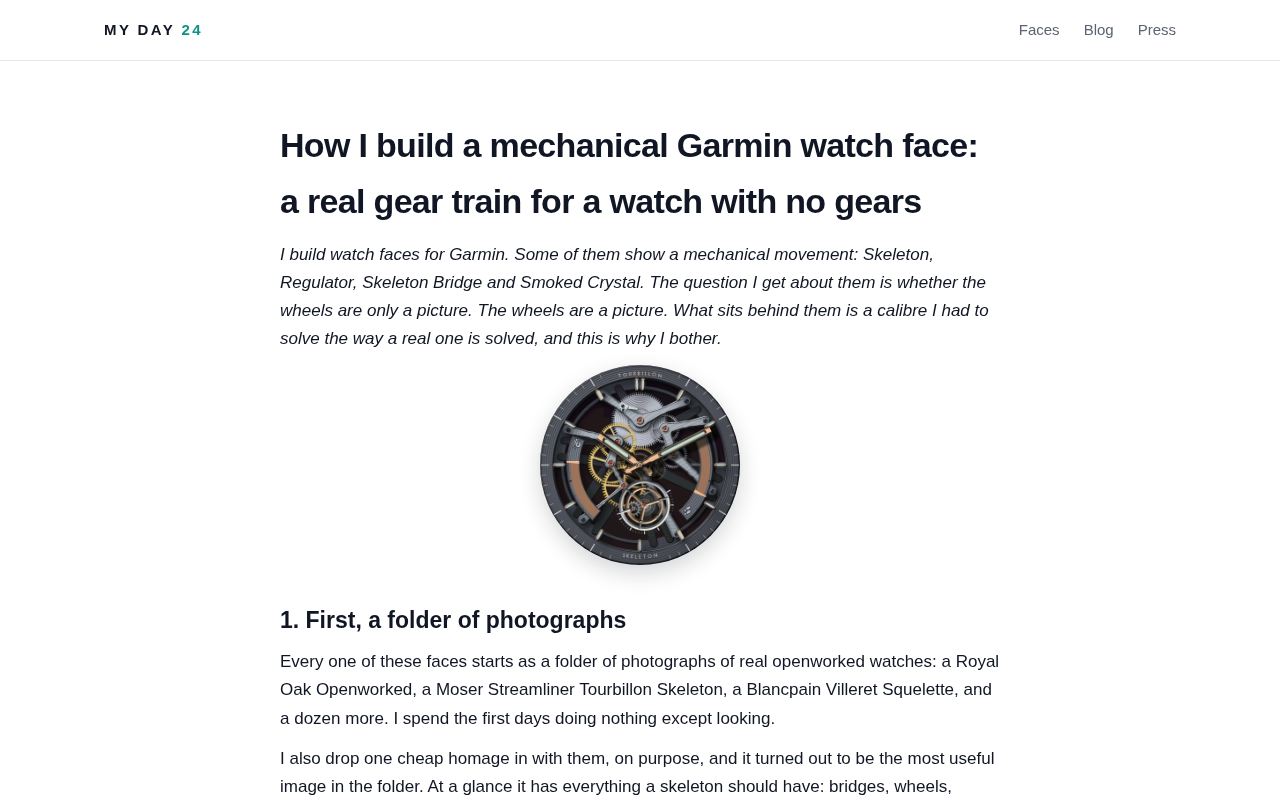
A developer recreated a real mechanical gear train watch face entirely in software for a gearless smartwatch.
A developer shared on Hacker News a distinctly geek-spirited project: using software to faithfully replicate the complete gear train logic of a mechanical watch — including gear ratios, meshing relationships, and phase constraints — on an electronic watch with no physical gears. Rather than mere visual imitation, the work strictly follows the mathematical rules of mechanical transmission. It represents one of the more hardcore explorations in the growing trend of mechanically realistic digital watch faces, hiding engineering precision beneath a seemingly decorative interface. Despite low initial engagement, the project holds genuine technical reference value for the community.
A Counter-Intuitive Idea
A developer shared a project on Hacker News: designing a mechanically accurate "gear train" watch face for a watch with no physical gears whatsoever. The project title itself carries a clever paradox — "a real gear train for a watch with no gears."
In other words, the author used software to simulate the full internal gear train of a mechanical timepiece, rendering it as the watch's visual face. It's a digital watch face paying homage to mechanical aesthetics — an intriguing intersection of software engineering and traditional watchmaking craft.
The Engineering Behind a Gear Train
A traditional mechanical watch relies on a precisely calibrated gear train to transfer energy from the mainspring to the hour, minute, and second hands at exact ratios. Every gear's tooth count is meticulously calculated to ensure the hands rotate at the correct speeds.
Rebuilding this system in software — on a watch with no physical gears — means the developer had to replicate the meshing relationships, gear ratios, and phase relationships between each stage of the train entirely in code. This is far more than just drawing a few spinning circles. To make it look genuinely real, the simulation must obey the physical constraints of mechanical transmission. Any watch enthusiast would immediately spot the inconsistency if it didn't.
This obsession with accuracy is precisely what makes these kinds of geek projects so compelling: they hide engineering rigor beneath a watch face that might appear, at first glance, to be purely decorative.
The Trend Toward Digital-Mechanical Fusion
In recent years, smartwatch face design has increasingly pursued mechanical realism. From smoothly sweeping analog hands to animated tourbillon reproductions, both manufacturers and independent developers have been exploring how to recreate mechanical beauty in pixels.
This project sits at the harder-core end of that spectrum — not content with visual imitation alone, it attempts to reconstruct the underlying operational logic. For tech enthusiasts who also love horology, it's a piece that offers both aesthetic appeal and genuine technical depth.
The Value of Niche Projects
Based on its reception on Hacker News at time of posting (just 5 upvotes and 0 comments), this is a decidedly niche share. But niche doesn't mean without value. Projects driven by personal passion like this often spark fresh thinking about a specialized domain within the community and offer other developers a concrete reference for implementation.
Given the limited information available, specific technical details — such as the development framework used, target hardware platform, or gear modeling approach — remain unclear. Interested readers can follow the original author for more complete coverage of the implementation process.
Related articles
Session-Based Home Server: Running a Low-Power Homelab on an Old Laptop
A Reddit user runs Plex, qBittorrent, and Watcharr on a 10-year-old laptop for just 10–12 hrs/day, using only 305MB RAM idle. Exploring session-based vs. 24/7 Homelab trade-offs.

OpenAI Launches ChatGPT for Financial Services: Built-in Financial Data + GPT-6 Reasoning
OpenAI launches ChatGPT for Financial Services, combining built-in financial data with GPT-6 Astra reasoning to support research, financial modeling, and client materials for financial institutions.
When AI Controls Your Credit Card: The Hidden Risks of Autonomous Payments
When AI agents gain credit card access, hidden dangers emerge: vague authorization, prompt injection attacks, and unclear liability. Learn the real risks and how to stay protected.