Building a Production-Grade AI Agent from Scratch: A Practical Guide to MCP and LangChain

A practical breakdown of AI Agent development using LangChain, MCP, and RAG for everyday developers.
This article argues that AI Agent application development is the most accessible AI career path for general developers, with lower barriers than hardware or algorithm roles. It explains the ReAct loop (Think-Act-Observe) as the core of Agent architecture, demonstrates an agent autonomously creating Vue 2/3 projects by reading terminal output, and breaks down the full tech stack: LLMs (Bailian/Claude/Ollama), LangChain, LangGraph, MCP, RAG, and LangSmith. The course targets Python/Node.js developers looking to transition into Agent development, though "7-day mastery" claims are flagged as marketing hype.
Why Developers Should Bet on AI Agents
In an era of rapid AI advancement, AI Agents are emerging as one of the most compelling directions in the field — and for good reason. Microsoft CEO Satya Nadella introduced the concepts of an "agent network" and "agent economy" at Build, predicting that 95% of all code will eventually be generated by agents. General-purpose AI Agent startups have closed $75 million funding rounds just two months after launch, with valuations growing nearly fivefold in a matter of months — cases like these are rapidly validating market enthusiasm for Agents.
Baidu founder Robin Li has also publicly stated that Agents are the AI application direction he's most bullish on. According to consulting firm research, the AI Agent market is worth approximately $5 billion, with a compound annual growth rate of 44.8%. Signals from capital markets, platforms, and industry leaders all point in the same direction: this is a track with long-term growth potential.
For developers, this opportunity is especially significant. AI Agents have driven demand in both hardware and algorithms, but hardware roles are scarce, and algorithm positions often require a master's degree from a top-tier university — neither path is particularly accessible for most developers. By contrast, Agent application development is far more open to general-purpose engineers — requirements are broad, the space is still relatively blue ocean, and demand is growing quickly on platforms like BOSS Zhipin and Pig8 (猪八戒网).
The Essence of AI Agents: Perception, Decision-Making, and Action
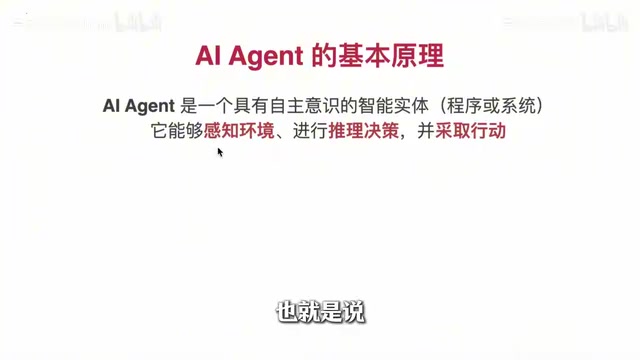
Stripping away the marketing language and getting back to technical fundamentals: what exactly is an AI Agent? Simply put, it's a program or system — but unlike ordinary programs, it has the ability to perceive its environment, reason through decisions, and take action.
An analogy makes this more intuitive. Think of an agent like a person: it needs "eyes" to observe the real world and feed that information back; a "brain" (the large language model) to reason and make decisions; and "hands" to take action. This logic mirrors exactly how humans observe, think, and act.
The operational flow of an AI Agent therefore breaks down into three stages: Think → Act → Observe, then loop back to thinking and repeat until the task is complete. This ReAct-style loop is the core of understanding how Agents work — and what distinguishes them from a one-shot LLM call.
ReAct (Reasoning + Acting) is the theoretical foundation of mainstream Agent architectures, proposed by a Google Research team in 2022. Its core idea is to interleave the LLM's reasoning process (Thought) with external tool calls (Action), observing environmental feedback (Observation) after each action before entering the next reasoning cycle. The advantage of this design is that the model no longer generates a one-shot answer — instead, like a human solving a problem, it can dynamically adjust its strategy based on intermediate results, handling complex tasks that require multi-step, cross-tool collaboration. This contrasts with single-pass inference (e.g., direct Q&A), which cannot sense external state changes or self-correct during execution. Understanding the ReAct loop is the starting point for learning Agent development; frameworks like LangChain are fundamentally engineering wrappers around this loop.
Hands-On Demo: An Agent Autonomously Creating a Vue Project
The course demonstrates the Agent's complete workflow with a concrete project: having the agent autonomously create a Vue 3 project on a local machine. The entire process requires no human intervention — just a single instruction to kick things off.
The agent's first step is to query a knowledge base (Alibaba Cloud Bailian in this case) to retrieve two types of information: terminal operation conventions (macOS uses Terminal, Windows uses PowerShell) and Vue-related knowledge. After retrieving this information, it follows the conventions to close and reopen the terminal, navigate to the target directory, and run the vue create command.
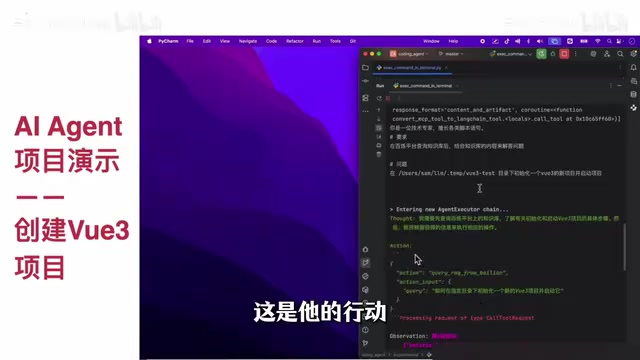
The key insight is that the agent never assumes success after each step — instead, it uses tools like get terminal full text to read the terminal's return value and determine the next action based on the current result. For example, it reasons that it needs to confirm the project should be generated in the current directory, so it simulates pressing Enter; after reading the updated output, it selects the Vue 3 preset, and ultimately runs npm run serve to start the project.
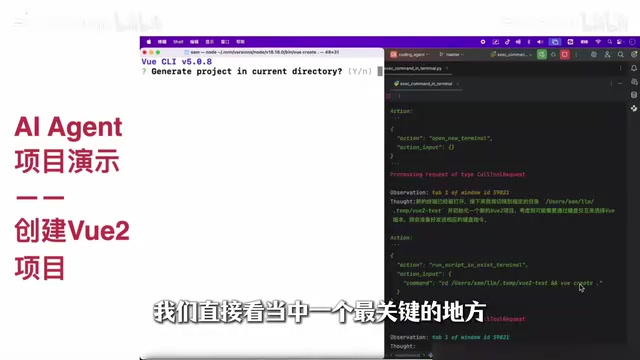
The Vue 2 project comparison is even more interesting. When creating Vue 3, the default option just requires pressing Enter — but selecting Vue 2 requires the agent to decide to move the cursor down before confirming. In the demo, you can see the agent read the terminal content, determine it needs to select downward, then press the down arrow key and Enter to successfully create the Vue 2 project. This detail vividly illustrates the agent's autonomous decision-making ability — it works exactly like a person: "do one thing, check the result, then do the next thing."
The application boundary of this capability extends far beyond project creation. Since the agent can directly operate the system, it can fix bugs, conduct code reviews, handle deployments, operate browsers, control apps like DingTalk, Feishu, and WeChat, and generate Word/Excel/PPT documents — replacing a significant portion of repetitive work.
Core Technology Stack Breakdown
Building an agent like this requires a complete technology stack. From the bottom up:
LLM Layer
Three deployment options are provided, covering different budgets and use cases:
- Cloud option: Call Alibaba Cloud Bailian large models
- International option: Use well-known models like Claude or GPT
- Local free option: Deploy a local LLM via Ollama
AI Framework Layer
LangChain and LangGraph serve as the core development frameworks, responsible for orchestrating the agent's Think-Act-Observe loop. For observability, LangSmith and Langfuse are used for tracing and debugging.
Tool Layer
The agent's ability to act depends on tool integration. This includes custom-built tools (terminal controller, browser controller), LangChain built-in tools (database operations, Python code execution, file operations, etc.), and ecosystem expansion through MCP (Model Context Protocol). The knowledge base integrates with Alibaba Cloud Bailian.
Development Environment
Cursor is recommended, along with Trae — an open-source IDE from ByteDance — as AI-assisted coding tools.
MCP (Model Context Protocol) is a standardized protocol proposed and open-sourced by Anthropic in late 2024, designed to unify the interface specification between large language models and external tools and data sources. Before MCP, every Agent framework had its own tool integration approach, requiring developers to write adapter code repeatedly for different platforms. MCP's core value is "build once, reuse everywhere" — tool providers expose interfaces following the MCP spec (called MCP Servers), and any MCP-compatible Agent framework (MCP Client) can call them directly without additional adaptation. This is analogous to how the USB standard unified the hardware ecosystem. There are now a large number of MCP Server implementations for file systems, databases, browsers, GitHub, and more, dramatically reducing the cost of tool integration for Agents. For application-layer developers, mastering MCP means being able to rapidly expand an agent's capability boundaries without diving into low-level implementations.
RAG (Retrieval-Augmented Generation) is the mainstream solution to the "knowledge cutoff" and "hallucination" problems of large language models. The way it works: private documents or real-time data are chunked, converted to vectors, and stored in a knowledge base. When a user asks a question, the system first retrieves the most relevant snippets from the knowledge base, then sends those snippets along with the question to the LLM to generate an answer. The "Alibaba Cloud Bailian knowledge base" mentioned in this article is a managed implementation of RAG. In Agent contexts, RAG is commonly used as a "long-term memory" module, enabling agents to consult background materials that exceed the context window limit — it's a core component for building enterprise-grade knowledge Q&A systems and vertical-domain Agents.
Course Positioning and Target Audience
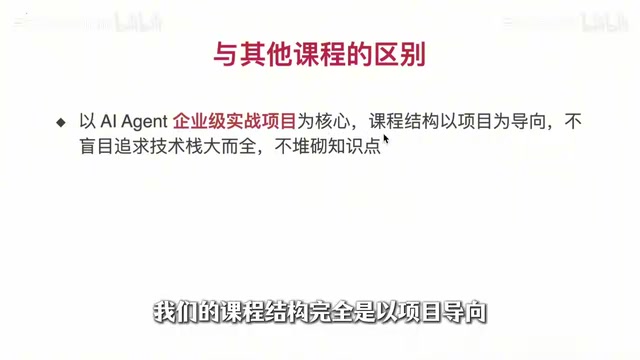
The differentiator of this course is its focus on enterprise-level, hands-on projects, using a project-driven approach rather than stacking knowledge points. All code is written by hand from scratch, keeping the learning curve relatively manageable, with the goal of helping developers make the transition toward AI Agent development.
The primary target audience is developers looking to enter the AI Agent space — including engineers seeking a career pivot and newcomers with ambition to transition. Prerequisites include: experience using large language models, and a basic understanding of Python and Node.js (the course primarily uses Python, with Node.js in certain scenarios).
Overall, this material integrates LLMs, MCP, RAG, and automation technologies to produce a complex Agent application capable of delivering real-world value. For general-purpose developers who want to ride the Agent wave but are blocked by the barriers of hardware and algorithm roles, application-layer development is genuinely a more viable path. That said, it's worth noting that marketing claims like "go from zero to hero in 7 days" are largely hype — truly mastering LangChain, MCP, and Agent architecture still requires solid project practice and meaningful time investment.
Related articles

MCP Protocol in 60 Seconds: A Real Session, Message by Message
Dissecting a real MCP session message by message: how an Agent dynamically discovers tools, forwards call requests, and has an MCP server execute them — all in just 9 JSON messages, with the model and reasoning loop untouched.

n8n 40-Minute Masterclass: Build Your First AI Automation Workflow from Scratch
Distilled from a 40-minute n8n masterclass: the core differences between automation, AI, and AI Agents, a comparison of n8n's four deployment methods, and a complete guide from dashboard to your first workflow.

Why Does a 35GB Quantized Model Blow Up an 80GB GPU? The Truth About KV Cache VRAM
Why does a 35GB 4-bit quantized LLM still blow up an 80GB GPU? This article breaks down the four components of inference VRAM, provides precise KV Cache formulas, compares GQA vs DeepSeek MLA memory, and offers production-grade OOM prevention like FP8 KV Cache.