Building a Sci-Fi UI Collection with Claude Opus: An AI-Assisted Visual Design Chronicle

A developer used Claude to generate a sweeping sci-fi UI collection, probing the limits of AI visual creativity.
A developer shared on Reddit how he built a large sci-fi UI collection using Claude over roughly two and a half weeks of Pro Max 20x usage, with all results freely available at uispace.org. The project deliberately abandoned practicality in favor of high-density, futuristic visual aesthetics — an AI creative experiment targeting pure eye candy. The author compared old and new Claude versions, noting perceptible gains in aesthetic alignment, reduced course correction, and token efficiency. The project also highlights a key pattern in AI creative work: using high-quality prior outputs as iterative foundations creates significant compounding returns. The author stays grounded, noting these are subjective impressions, and that a wide gap still exists between looking good and being truly usable.
A developer shared on Reddit how he used Claude to build a large sci-fi style UI collection over roughly two and a half weeks of intensive use. The project wasn't about practicality — it was a deliberate exploration of AI's limits in visual expression, targeting high information density and a distinctly futuristic aesthetic.
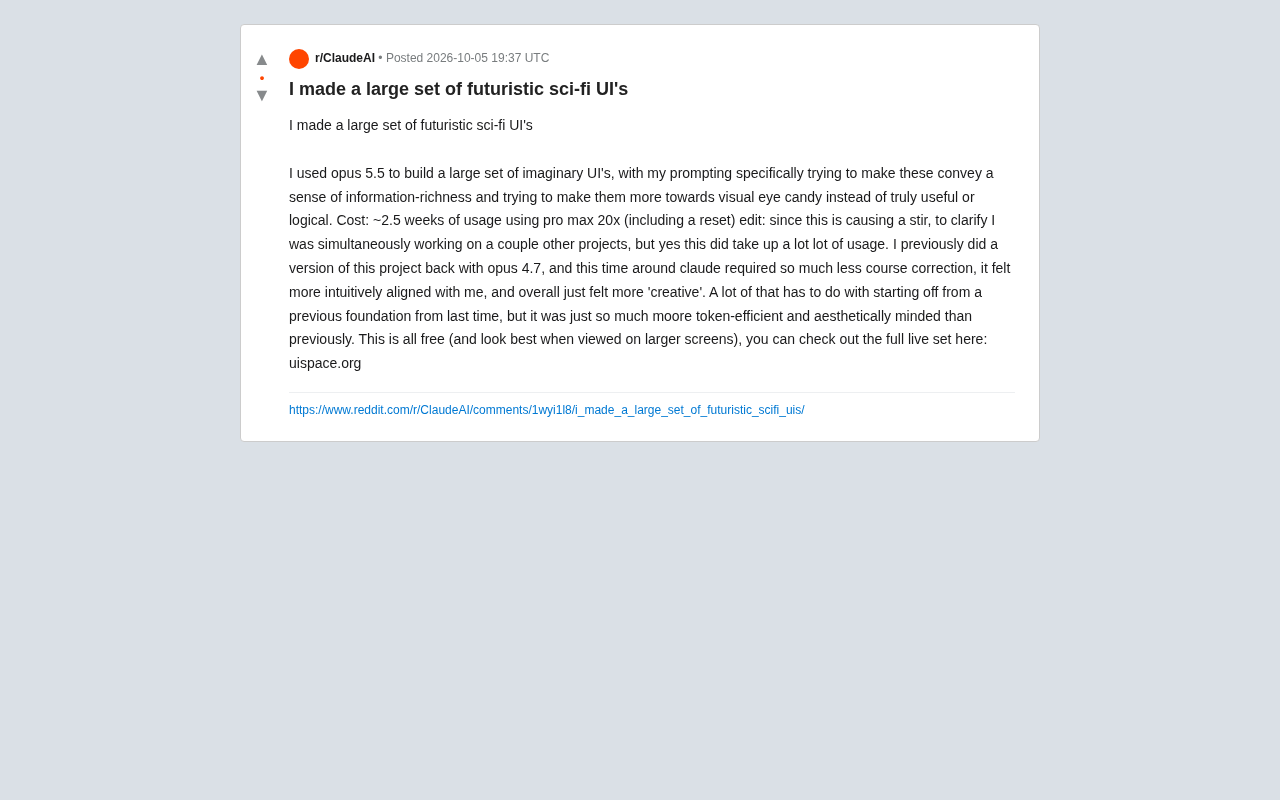
Project Overview: Interfaces Built for Visual Impact
The author made it clear that the design intent behind this UI set was fundamentally different from conventional product design. His prompting deliberately steered the model toward creating an "information-rich" look — pure "eye candy" rather than logically sound or genuinely functional interfaces.
In other words, this was an experiment using AI as a creative tool: generating a large volume of imagined sci-fi interfaces that evoke cinematic tech aesthetics. All the results have been made freely available, and the author recommends viewing them on a large screen for the best experience. The full online collection can be found at uispace.org.
Costs and Commitment
This project didn't come cheap. The author used a Pro Max 20x subscription, consuming roughly two and a half weeks' worth of usage (including one quota reset). He candidly noted that he was running several other projects in parallel, but this UI set consumed a significant share of his token budget. For anyone looking to replicate a similar workflow, this is a useful reference point for resource expectations.
Claude Pro Max 20x is Anthropic's high-tier subscription for power users, offering a much higher message rate limit than the standard Pro plan — roughly 20 times the quota. For creative projects that require intensive iteration, the core value of this tier lies in reducing workflow interruptions caused by hitting rate limits. Token consumption is especially pronounced in UI generation scenarios, since each generation typically involves large blocks of HTML/CSS/JS code, making single-output token volume far higher than ordinary conversation or text summarization tasks.
A Noticeable Leap with Each Model Iteration
Perhaps the most valuable part of this project is the author's direct comparison across model versions. He had previously completed a similar project using an earlier version of Opus, and noticed clear differences when revisiting it this time.
According to the author, the newer version showed improvements across several dimensions:
- Less course correction needed: Compared to the previous attempt, the model required far fewer rounds of corrective prompting, with outputs landing much closer to his intent.
- Stronger intuitive alignment: He described the new model as feeling "more intuitively aligned" with him, making the collaboration feel smoother.
- More creativity: The overall output "felt more creative."
- Better token efficiency: Generating equivalent-quality results consumed fewer tokens, and the model showed a stronger sense of aesthetic awareness.
The author also honestly acknowledged that some of this improvement stems from building on top of the previous version's foundation — having an existing design base as a reference naturally reduces the effort required. But even accounting for that, the model's progress in aesthetic control and token economy was still perceptible.
What This Tells Us About AI-Assisted Design
This project reflects a trend that's taking shape: large language models are gradually evolving from "coding assistants" into "visual creative collaborators." When developers shift their goal from functional correctness to aesthetic expression, the model's creative capability and stylistic consistency become the key evaluation dimensions.
The Model as Paintbrush, Not Compiler
Traditionally, the benchmark for AI-generated interfaces has been "does it run, is the logic correct?" But this project operates from a different framework — one that cares whether the interface feels futuristic enough, whether the information hierarchy is dense enough, and whether the whole thing is sufficiently "cool." This aesthetics-first approach demands a different set of prompting skills: you need to guide the model toward abstract aesthetic intentions, not just concrete functional specs.
Aesthetics-driven prompting typically relies on style prompting and building a frame of reference. Developers use film titles, art movements, specific design works, or even mood words to shape the model's output direction — for example, specifying "reference the information density of the TARS interface from Interstellar" or "Brutalist style with neon accents." This is fundamentally different from functional prompting, which relies on precise technical specifications, whereas aesthetic prompting depends on the indirect transmission of visual concepts. Understanding this distinction is one of the core skills for using AI effectively in creative visual output.
The Compounding Returns of Iterative Foundations
The author repeatedly emphasized the importance of "building on the previous version's foundation," which reveals a key pattern in AI creative work: high-quality prior outputs become assets for future iterations. A model extending within an established style framework is more efficient and more consistent than starting from scratch. This is practical wisdom for anyone looking to use AI for serialized creative output.
In AI-assisted creative work, the "seed artifact" is a practice strategy worth paying attention to: using the most satisfying code snippets or style specifications from the previous round as the initial context for the next conversation can significantly reduce the probability of the model drifting from the established style. This mirrors the logic of human designers maintaining a "design language document" or component library — once a reusable visual baseline is established, the marginal cost of expansion continuously decreases. For serialized creative output (such as brand visuals or game UI kits), this approach can effectively maintain stylistic consistency across sessions.
A Few Caveats and Reflections
It's worth keeping a clear head about this: this is ultimately a single personal account, lacking objective quantitative comparison data. Descriptors like "more creative" or "better aligned" are largely subjective experiences, and different users' prompting habits and project types will all influence their perception.
Additionally, the author's deliberate pursuit of "visual over functional" means this UI set doesn't directly prove that AI has achieved product-level design capability — there remains a vast gap between looking good and being genuinely usable. But as an experiment exploring the upper limits of AI's visual expressiveness, it provides an interesting data point, and leaves us curious about the further evolution of models in the creative domain.
Related articles

Chain of Thought Isn't Just for AI: How Humans Can Use CoT to Improve Thinking Quality
Chain of Thought isn't just a prompt trick for large models. Starting from a Hacker News discussion, this article analyzes why CoT works for human thinking too, breaks down actionable ways to transfer it, and highlights the key differences between human CoT and machine CoT.
Cloudflare Teams Up with OpenAI: Closi…
Cloudflare Teams Up with OpenAI: Closing the Loop from Vulnerability Discovery to Defense with AI
Cloudflare uses OpenAI Daybreak to investigate security vulnerabilities and generate reviewable remediation plans, while developers use Codex to boost coding efficiency and quality.

Orca Multi-Agent Orchestration in Practice: A Guide to Parallel Collaboration with Claude and Codex
Orca is Stable AI's free open-source agent workbench supporting 34 agents like Claude Code and Codex in parallel. Learn its Git worktree isolation, multi-model orchestration, and mobile management.