Building a Text-to-Image Model from Scratch: One Young Developer's Data Challenge
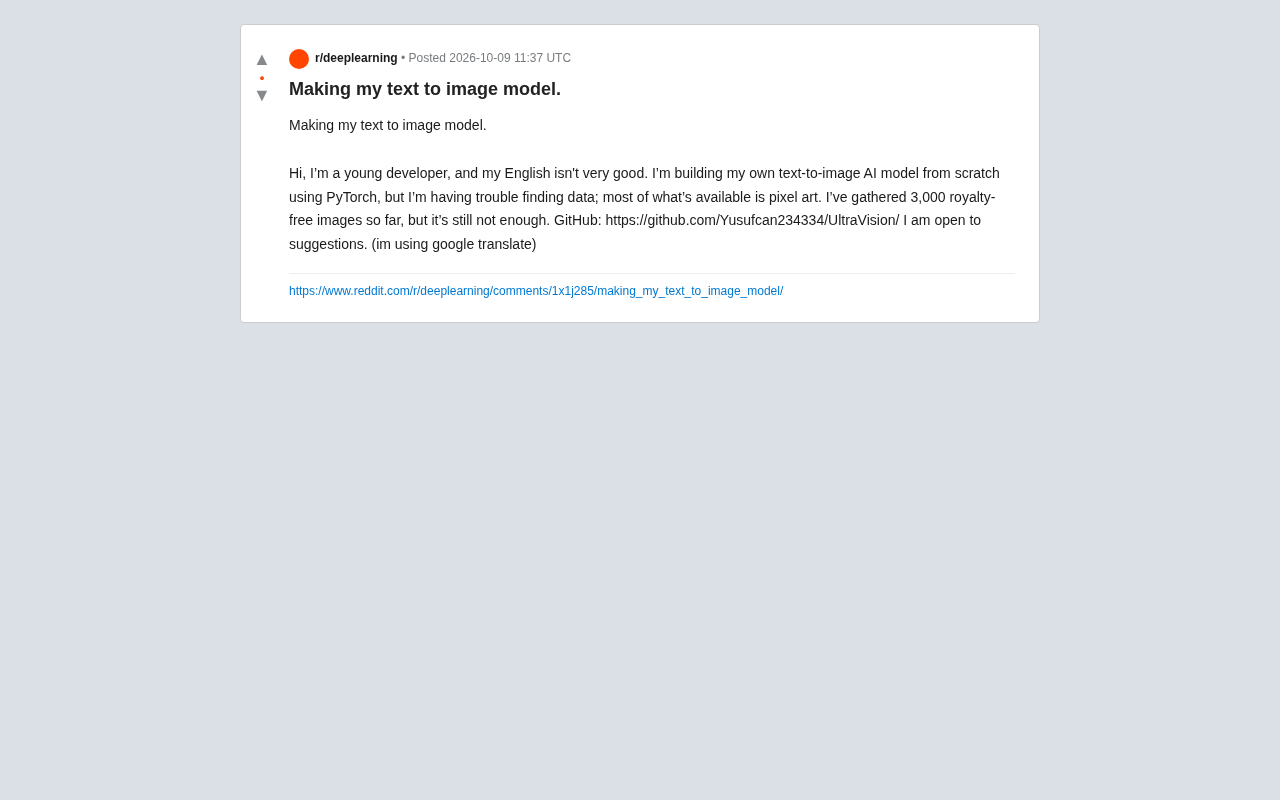
A solo developer building a text-to-image model from scratch hits the classic wall: not enough data.
A young developer shared their from-scratch PyTorch text-to-image project UltraVision on Reddit, but revealed a core challenge: only ~3,000 copyright-free pixel art images — a far cry from the billions of image-text pairs modern models require. The article examines why data scale, diversity, and annotation quality cap model capability, and offers three actionable paths: using open datasets like LAION and COCO, auto-generating captions with BLIP or CLIP Interrogator, and narrowing scope to a domain-specific model. For individual developers, fine-tuning via LoRA is almost always more practical than training from scratch.
A Text-to-Image Project Built from the Ground Up
On Reddit, a young developer — who openly admitted his English wasn't great and relied on Google Translate — shared a personal project: building a text-to-image AI model from scratch using PyTorch. The project is called UltraVision, and the code is hosted on GitHub.
Posts like this aren't uncommon in AI communities, but the problem it highlights is very typical — for individual developers, the biggest obstacle to building a generative model is rarely the algorithm. It's the data. The developer candidly noted that he'd only managed to collect around 3,000 copyright-free images, most of which were pixel art, which falls far short of what's needed to train a general-purpose text-to-image model.
Why Data Is the Biggest Bottleneck
The reason modern text-to-image models (such as diffusion models like Stable Diffusion) can generate high-quality images is that they're trained on massive amounts of image-text paired data. Large-scale public datasets like LAION-5B contain billions of image-text pairs — and 3,000 images doesn't even register as a rounding error.
Even more critical is diversity and annotation quality. If the dataset is concentrated in a narrow style like pixel art, the model will only learn that distribution and fail to generalize to real photographs, illustrations, or other styles. In other words, data skew directly caps what the model can do.
For individual developers, there's a very real tension here: you need scale, compliance (copyright-free or commercially usable), and accompanying text descriptions — all at once. Free resources that check all three boxes are hard to come by.
LAION-5B was released by LAION (Large-scale Artificial Intelligence Open Network), a non-profit organization. It's one of the largest publicly available image-text datasets, containing approximately 5.8 billion image-caption pairs sourced from large-scale web crawls. The original Stable Diffusion was trained primarily on LAION-Aesthetics, a curated subset of LAION-5B. By comparison, a few thousand images collected manually not only differ by six orders of magnitude in scale, but also fall far behind in the breadth of text descriptions and linguistic diversity. This contrast makes it clear why data scale — not model architecture — is the hardest barrier for individual developers trying to replicate text-to-image capabilities.
Practical Approaches to the Data Problem
For the challenge raised in that post, here are a few commonly recommended strategies from the community:
1. Use Existing Open-Source Datasets
Rather than collecting images one by one, it's far more efficient to use established public datasets. Subsets of LAION, COCO Captions, and Conceptual Captions all provide image-text pairs at a scale that dwarfs any individual collection effort. These datasets are already cleaned and annotated, which dramatically reduces upfront work.
2. Automated Captioning and Synthesis
If you already have images but lack text descriptions, you can use existing image captioning models (such as BLIP or CLIP Interrogator) to automatically generate captions, turning a collection of raw images into usable image-text pairs. This is a highly cost-effective way to expand a dataset.
3. Start with a Smaller, Focused Goal
3,000 pixel art images aren't worthless — the problem is the goal. Building a "general-purpose text-to-image model" is nearly impossible for an individual to pull off independently. A more realistic framing is to build a small, domain-specific model — for example, one focused purely on pixel art generation. With a narrow and well-defined task, a few thousand samples combined with fine-tuning an existing pretrained model is actually a very achievable target.
Realistic Advice for Individual Developers
Building a text-to-image model from scratch is an excellent learning exercise — it forces you to genuinely understand how diffusion processes, text encoders, UNets, and other core components work together. But if the goal is something that actually works, fine-tuning a pretrained model (via fine-tuning or LoRA) is almost always more practical than training from scratch.
This developer's project reflects a situation shared by many self-taught developers in the community: plenty of enthusiasm, limited resources, high information barriers — and in this case, even a language barrier. The fact that he chose to open-source his code and ask for help publicly is itself a great example of how developer communities should work. For projects like this, rather than getting stuck on "not enough data," the more encouraging path is to define achievable milestones and get one small end-to-end loop working first.
LoRA (Low-Rank Adaptation) is a parameter-efficient fine-tuning method. The core idea is to add low-rank decomposed delta matrices on top of a pretrained model's weight matrices, training only a small number of new parameters while keeping the original weights frozen. In text-to-image contexts, using LoRA to fine-tune Stable Diffusion for a specific style or concept typically requires only tens to hundreds of images, can be done on consumer-grade GPUs, and produces model files of just a few MB to tens of MB — easy to distribute and reuse. This stands in sharp contrast to training from scratch, which requires billions of data points and hundreds of GPU-hours. As a result, LoRA fine-tuning has become the go-to approach for individual developers doing custom style or character work.
Summary
This is a help post from a single source (Reddit) with limited information, but the problem it raises is universal: data acquisition is the primary obstacle for individuals training generative models. For developers facing similar challenges, the more viable path forward is to prioritize open-source datasets, use automated captioning to expand your samples, and start with fine-tuning rather than training from scratch.
Related articles

Getting Started with Codex: How OpenAI's Coding Agent Differs from ChatGPT
Codex is OpenAI's AI coding agent that autonomously reads, modifies code, and runs tests. Learn how it differs from ChatGPT and why developers need to master it.

Gemini Agent Launches: Argon Model Too Powerful to Release, Weekly AI Roundup
Google launches Gemini Agent for workplace use, supports Gemini 4 Argon and Claude Opus 5.5, but Argon stays unreleased over safety concerns. Weekly AI roundup covering Odyssey 3, OpenAI revenue, and Arena's $200M raise.

Sophos Cuts Threat Response Time by 96% with OpenAI Daybreak
Sophos CTO reveals how OpenAI Daybreak and custom security agents cut MDR average response time from 38 minutes to 89 seconds—a 96% reduction. A look at the plan-execute-observe loop architecture.