Building AI Agents with WorkBuddy+Harness: A Beginner-Friendly Step-by-Step Tutorial

A 17-episode Bilibili course teaches you to go from chat to real work by building AI agent systems with a four-layer framework.
Bilibili creator "Hailang" released a 17-episode open-source course to help learners go from "being able to chat" to "building AI agent systems that actually work." It uses a four-layer framework: large models, Harness (the engineering control layer), agents, and the WorkBuddy platform, stressing that Harness is key to reliable task execution. Ten episodes demo WorkBuddy hands-on for roles like teachers and lawyers; the advanced part covers DeepSeek Harness and the FDE deployment perspective.
AI agents are moving from "answering questions" to "completing tasks," but most people get stuck at the same point: they can hold a conversation, but can't build a system that actually gets work done. Bilibili creator "Hailang" (海浪) has released this 17-episode open-source course to solve that problem with a clear learning path—from foundational concepts to hands-on WorkBuddy practice, then to advanced Harness engineering, and finally to the deployment perspective of an FDE (Forward Deployed Engineer).
The Four-Layer Structure: Your First Map for Understanding AI Agents
The course doesn't start with tools; it starts with a conceptual map. The creator breaks the AI ecosystem into four layers: at the bottom is the large model (such as DeepSeekAd or ChatGPT), responsible for language understanding, logical reasoning, and content generation; above that is Harness—literally "horse tack"—which covers context management, memory, tool calling, task loops, and permission control; above that is the agent, where a large model equipped with a Harness can reliably execute tasks; and at the top are agent platforms like WorkBuddyAd, which integrate many agents to collaboratively tackle complex problems.
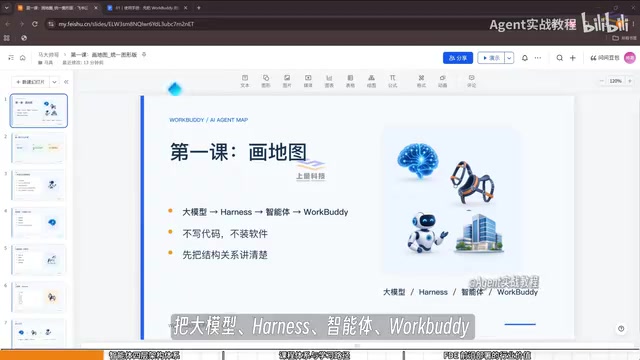
The value of this metaphor is that it isolates the "engineering control layer." Many people assume an agent is just a large model plus plugins, but what really determines whether it can reliably get work done is the Harness layer—the "saddle, reins, and whip." The creator emphasizes in the course that only by getting this layer right can you extract real value from AI.
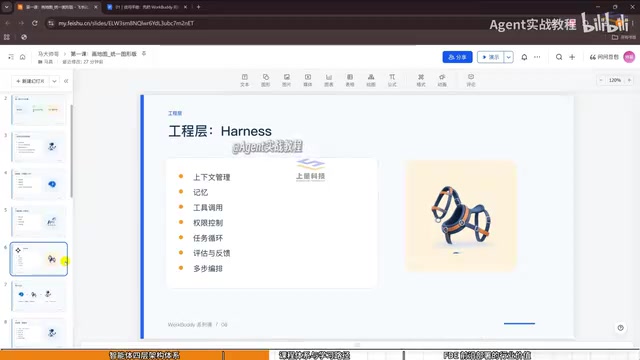
Harness is a term borrowed from equestrianism; in the AI context, it refers to the entire engineering control layer wrapped around a large model. The model itself only handles reasoning and generation, while the Harness manages the context window, maintains memory, schedules tool calls, drives the task loop, and enforces permission control. Without a Harness, a large model is like a horse without reins—it can't be reliably steered to complete multi-step tasks. The industry sometimes uses terms like Agent Runtime or Orchestration Layer for similar concepts, but Harness emphasizes the engineering perspective of "control and constraint." Understanding this layer is the key to distinguishing a "chatbot" from an agent that can actually get work done.
WorkBuddy in Practice: From Installation to Automation
The second part is the main body of the course, with ten episodes centered on WorkBuddy, covering installation, connectors, expert skills, automation, and capabilities like Feishu communication and remote control. The creator's positioning is pragmatic: not every learner needs to become an engineer—the goal is to first learn to use WorkBuddy to solve concrete problems at hand.
His examples span multiple professional scenarios—teachers can use it to make slides, prepare lesson notes, and grade assignments; lawyers can use it to screen for risk points and find legal support. This "customize by scenario" approach makes it easier to get started than talking about features in general terms. The course also notes that after mastering the platform, you can further customize your own Harness to build a personalized agent.
Advanced Harness Engineering: The DeepSeek Harness Example
The third part turns to engineering mechanisms, using DeepSeek Harness as a case study and progressing from basic understanding and environment setup to actual projects. The creator suggests that learners who want to go deeper into Harness and the FDE direction read Cybernetics by a former Soviet scholar, believing the book provides a high-level framework for understanding the control and feedback mechanisms behind agents. This suggestion clearly reflects personal learning experience and is a single-source anecdote, but the direction is worth considering.

The course also introduces the role of FDE (Forward Deployed Engineer). The creator summarizes its responsibility as "bridging the last mile": on one hand, you need to understand technical principles and toolkits; on the other, you need to be able to structure a company's business processes, closing the gaps between large models, Harness, agents, and platforms. He mentions that such positions are in high demand at both big tech companies and mid-sized firms, with salaries reaching hundreds of thousands to over a million yuan—this claim comes from the creator's personal observation without specific data sources, so readers should treat it as a reference rather than a definitive conclusion.
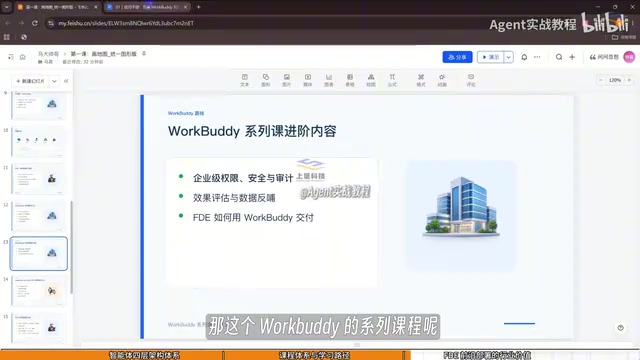
FDE (Forward Deployed Engineer) is a role first popularized at data companies like Palantir, referring to engineers stationed at client sites who understand both technology and business and are responsible for turning a general-purpose platform into concrete solutions. In the AI agent field, an FDE needs two capabilities at once: first, understanding the technical principles and toolchains of large models, Harness, and agent platforms; second, being able to structure a company's business processes into well-defined problems and map them onto agent capabilities. Its core value lies in bridging the "last mile" gap between general AI capabilities and specific enterprise scenarios, which is why demand is growing rapidly amid the wave of large-model deployment.
Course Value and Target Audience
The overall structure follows a three-stage pattern of "cognition—application—engineering": first build the conceptual framework of the four-layer structure, then use WorkBuddy for scenario-based implementation, and finally wrap up with Harness and FDE, along with a preliminary discussion of the commercialization loop. In the video, the creator says accompanying learning materials can be obtained by liking, coining, and favoriting in the comments.
This content suits two types of people: ordinary professionals who want to use AI agents to improve daily work efficiency—the WorkBuddy section has a low barrier to entry; and developers who want to move toward agent engineering—the Harness and FDE sections offer an advanced path. One caveat: the course focuses on conceptual guidance and operational demonstrations, and in-depth engineering details still need to be supplemented with official documentation and real projects.
One-line Summary
A 17-episode open-source Bilibili course that uses a four-layer framework to teach you how to go from conversation to getting work done by building AI agent systems.
Paragraph Summary
Bilibili creator "Hailang" has released a 17-episode open-source course designed to help learners advance from "being able to chat" to "being able to build AI agent systems that actually get work done." The course uses a four-layer cognitive framework: large models, Harness (the engineering control layer), agents, and the WorkBuddy platform, emphasizing that Harness is the key to making AI reliably execute tasks. The main section uses ten episodes to demonstrate WorkBuddy hands-on—installation, connectors, expert skills, automation, and Feishu integration—targeting concrete professional scenarios for teachers, lawyers, and others. The advanced section uses DeepSeek Harness to explain engineering mechanisms and introduces the deployment perspective of an FDE (Forward Deployed Engineer). The course suits both ordinary professionals and advanced developers, though in-depth engineering details still need to be supplemented with official documentation.
Related articles

Amphibious Transforming Drone: Beyond 100x Power Savings, What Are the Real Needs?
Is the amphibious transforming drone just a gimmick? Starting from the 100x power difference of the M4 Morphobot, explore real application scenarios and thesis topic ideas, analyzing boundary conditions where pure drones and pure ground robots both fail.

Warhound Raises $200 Million: Genetically Engineered "War Dogs" Paired with Anduril Gear
Warhound raises $200M, backed by Ben Lamm and Palmer Luckey, to genetically engineer dogs for military and law enforcement use and equip them with Anduril gear. This article analyzes its technology direction, funding logic, and ethical controversy.

Claude API Comes to Google Cloud: IAM Integration and SDK Access Guide
Anthropic hosts the full Claude API on Google Cloud with IAM-controlled permissions and unified billing. This guide covers the Vertex AI and Anthropic-hosted entry points, IAM role configuration, and SDK access.