Building an Agent Skills System from 0 to 1: Five Steps to Reusable AI Capability Modules

Break down the five-step path and core design principles for building an Agent Skills system from 0 to 1.
Based on a Bilibili creator's tutorial, the article explains why some AIs can only chat while others can complete tasks like employees—the key is whether they have a reusable Skill system. It defines a Skill as a standardized capability module including task instructions, execution rules, tool invocations, and even script resources, rather than just a prompt. Around this definition, it outlines a five-step development path: unify the Skill structure as a capability contract; adopt an index-then-load mechanism to control context costs; have the execution engine handle task decomposition, parameter passing, exception handling, and permission control; achieve a multi-Skill collaboration loop through standardized inputs and outputs; and finally drive iteration with metrics such as matching accuracy, completion rate, execution time, token consumption, and exception recovery capability. The article emphasizes that the core value lies in precipitating human experience and workflows into reusable capabilities, and that future competition is the competition of Skills ecosystems.
Why can some AIs only chat with you, while others can act like a real employee—understanding tasks, invoking tools, executing workflows, and even independently completing complex work? According to an analysis by a Bilibili creator, the difference lies in whether it has a truly reusable skill system.
Around this question, the creator organized their experience running multi-agent collaboration systems and building their own Agent Skills into a complete tutorial—from requirements analysis and workflow construction to skill paradigms that connect with external ecosystems—emphasizing that "you can follow along and get it running step by step." The content is designed for beginners. This article, based on the core logic of that tutorial, breaks down the key path for developing an Agent Skills system from 0 to 1.
What Are Agent Skills?
Simply put, an Agent is an intelligent entity responsible for thinking, planning, and executing; a Skill is a specific capability that the agent possesses. For example, asking an Agent to write an industry analysis report may require invoking multiple Skills such as data search, web page parsing, information organization, and report generation.
According to the creator's definition, a Skill can be understood as an Agent's professional skill package—it's not just a prompt, but a standardized capability module that includes task instructions, execution rules, tool invocations, and even scripts and resource files. This definition is crucial: if a Skill is treated merely as a piece of prompt text, the system will quickly degenerate into "prompt stacking," making it hard to reuse and coordinate; only by treating it as a standardized capability module can subsequent loading, execution, and evaluation have a solid foundation.
Multi-Agent Collaboration System refers to an architecture composed of multiple intelligent agents with different roles or capabilities, collaborating through message passing or shared state to complete tasks. Common patterns include supervisor-worker (a dispatch Agent assigns subtasks to execution Agents), debate-style (multiple Agents cross-validate conclusions), and pipeline-style (processing sequentially by stage). Compared to a single Agent, its advantages lie in responsibility isolation and parallel processing, but the cost is a significant increase in engineering complexity such as communication overhead, state consistency, and error propagation control. The Skill system discussed in this article is precisely the infrastructure that gives each Agent clear, reusable capability boundaries during collaboration.
Progressive Disclosure is a design principle for Agent context management: instead of putting all tool descriptions, documentation, or skill details into the prompt at once, it first provides index-level information (name, brief description), and then loads the full content on demand when the model determines it's needed. The motivation is that context windows are limited and costs rise with length, and information overload can dilute the model's attention and reduce tool selection accuracy. Implementation typically involves retrieval (matching by description) or hierarchical file reading. The "index first, load later" approach in Step 2 of this article is exactly this idea implemented in a Skill system.
Step 1: Design the Skills Standard
The starting point for developing the system is not writing code, but defining a unified Skill structure. According to the tutorial requirements, each Skill should at least include: name, function description, usage scenarios, input parameters, execution steps, and output specifications.
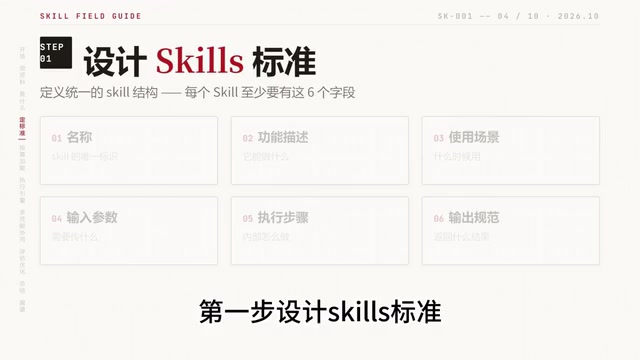
The purpose is to enable the Agent to accurately identify when a particular Skill should be invoked and what result should be obtained after invocation. From an engineering perspective, this structure is essentially a "capability contract": the description determines whether the scheduler can match tasks, and the input/output specifications determine whether multiple Skills can be stitched together into a workflow.
Step 2: Develop the Skill Loading Mechanism
When a user proposes a task, the system cannot stuff all Skill details into the large model at once. A more reasonable approach is to first load the Skill names and descriptions, let the Agent match the corresponding capabilities based on the task, and then read the specific execution instructions on demand.
This two-stage design of "index first, load later" reduces context consumption and improves the efficiency of capability scheduling. It aligns with the progressive disclosure approach common in current Agent engineering: context windows are scarce resources, and keeping all details resident in the prompt often quickly fails as the number of Skills grows.
Step 3: Build the Skill Execution Engine
The execution engine is the core of the entire system. The Agent decomposes tasks based on user needs, determines which Skills are needed, and then invokes the corresponding execution logic. Some Skills can be completed directly through the large model, some require calling APIs, and some require executing Python scripts or accessing external tools.
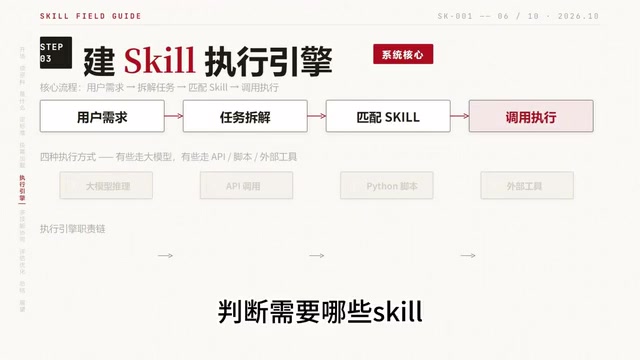
The execution engine is responsible for parameter passing, result reception, exception handling, and necessary permission control. The creator described this in the original text as "permission fear," which actually points to the same thing: when Skills can reach external tools and scripts, permission boundaries must be uniformly managed by the engine; otherwise, the stronger the system's capabilities, the greater the risk surface.
Permission Control and the Principle of Least Privilege: When Skills can call APIs, execute Python scripts, or access external tools, the system is effectively turning model outputs into real-world side-effect operations. In engineering, the principle of least privilege is typically adopted—each Skill is granted only the tool and data access scope necessary to fulfill its responsibilities, with whitelists and approval steps for write operations, network requests, and file system access. The execution engine also needs to log invocations and limit resource usage (timeouts, retry counts, token budgets) to quickly locate and mitigate issues during anomalies or abuse. The creator's "permission fear" is essentially vigilance against the simultaneous growth of capability expansion and risk exposure.
Step 4: Implement Multi-Skill Collaboration
Truly complex tasks often cannot be completed by a single Skill. For example, automatically generating a market research report: the Agent first calls a search Skill to obtain information, then calls a data analysis Skill to process the data, then calls a content generation Skill to produce the report, and finally uses a validation Skill to check the results.
Multiple Skills collaborate through standardized inputs and outputs, ultimately forming a complete task loop. This also explains why Step 1 emphasizes input parameters and output specifications—the reliability of collaboration depends on whether the interface of each link is stable.
Step 5: Establish Evaluation and Optimization Mechanisms
Whether a Skill system can truly be deployed depends not only on whether it can run, but also on whether it is stable, accurate, and safe.

According to the metrics given in the tutorial, attention should be paid to Skill matching accuracy, task completion rate, execution time, token consumption, and exception recovery capability. Through continuous testing and iteration on real tasks, a reliable skill system can gradually be established. These metrics cover three dimensions: effectiveness, cost, and robustness—a practical checklist for beginners to self-assess system maturity.
Core Value: Precipitating Experience into Reusable Capabilities
At the end of the tutorial, the creator raised a noteworthy point: the most important thing in developing Agent Skills is not how many Skills you write, nor how many tools you integrate, but rather precipitating human experience, workflows, and professional methods into standardized capabilities that AI can understand, invoke, execute, and reuse.
According to this judgment, future competition among AI Agents will not just be about model capabilities, but also about tools, workflows, and the Skills ecosystem—whoever can modularize professional capabilities will have a better chance of building AI agents that truly get work done. It should be noted that this judgment comes from the creator's personal analysis and is a single-source view, but it aligns with the overall trend of Agent engineering moving from "single-point prompts" to "capability systematization," and is worth using as a design starting point when building a system.
For developers ready to get started, this five-step path can serve as a minimum viable framework: first define capabilities with a unified standard, then use a loading mechanism to control context costs, use an execution engine to contain tools and scripts, use a collaboration mechanism to connect complex tasks, and finally use evaluation metrics to drive iteration. Compared to piecing together scattered tutorials, following this main line once makes it easier to build a well-structured, sustainably extensible Agent Skills system.
Related articles

Qwen 3.8 Beats Opus at Coding—But Can Your Mac Run It?
Open-source Qwen 3.8 beats Opus 4.6 at coding at just 18GB, but how much Mac memory do you need? 24GB crashes; 32GB is the sweet spot. Full config guide inside.

Claude Code + Agent: Building a Fully Automated AI Testing Loop
Bilibili course breakdown: how test developers can use Claude Code terminal-based Agents to build a fully automated AI testing loop. Compares permission boundaries of terminal vs. device Agents, explains why enterprise projects choose Claude Code over Open Claude-type tools, and outlines the Node.js environment setup and DeepSeek model integration path.

Working with AI Agents Requires Nerves of Steel
The more autonomous AI agents become, the heavier the user's psychological burden. Drawing from a Hacker News discussion, this article analyzes black-box anxiety, behavior drift, and monitoring fatigue in agent collaboration, and offers practical approaches like sandbox isolation, permission control, and task granularity management to reduce cognitive load.