Building an AI Agent Directory With a Single Prompt: A Product Experiment

A directory experiment where a single prompt lists your product or AI Agent — touching on service discovery for the Agent era.
An indie developer shared an early-stage platform on Reddit where users can submit products or AI Agents to a directory using a single prompt — and Agents can even register themselves. While this lowers the barrier to entry and hints at deeper infrastructure needs for multi-Agent collaboration, it also faces classic directory-product challenges: prompt-based submission opens the door to spam, cold-start content accumulation is hard, and differentiation from existing platforms remains unclear. The developer openly admits it's an imperfect early idea, and its greatest value may be the question it raises.
A Product Experiment From Reddit
On Reddit, an indie developer shared a platform concept with an intriguing premise: users can submit their products or AI Agents to a directory using a single, simple prompt. The idea itself isn't particularly complex, but the thinking behind it is worth unpacking — it hands off the act of "listing a product," which traditionally requires filling out forms, to an AI Agent.
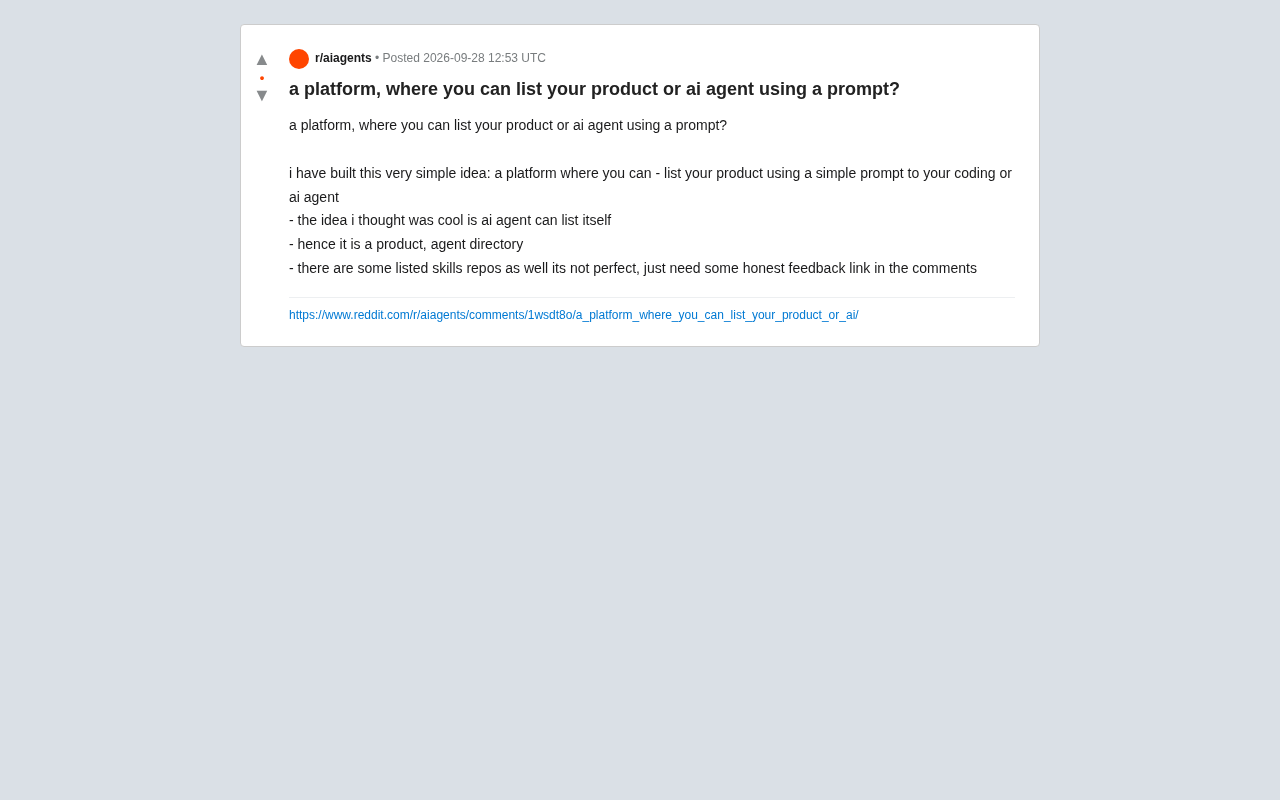
The developer's core vision has a few layers: products can be listed by sending a simple instruction to a coding assistant or AI Agent; and more interestingly, AI Agents themselves can "self-list" — meaning an Agent can proactively register itself into the directory. In other words, this is both a product directory and an Agent directory. The platform also includes some skills repos, though the developer admits this section is still incomplete.
Why "Agent Self-Registration" Is an Interesting Idea
Traditional product directories (like Product Hunt) rely on humans manually filling in information and submitting it for review. The model this developer proposes turns the submission flow into a prompt-driven process: just describe what you want in natural language, and an interactive or coding Agent handles the registration for you. This lowers the barrier to entry and aligns with the broader trend of "everything driven by natural language."
The real novelty lies in the idea that an Agent can list itself. As autonomous AI Agents proliferate, they need ways to discover and invoke each other's capabilities. A directory that Agents can automatically read from and write to could theoretically become the "yellow pages" of the Agent ecosystem — Agents wouldn't just be tools used by humans, but active participants that register themselves and get discovered by others. This "machine-readable, machine-writable" directory format is a piece of potential infrastructure for multi-Agent collaboration scenarios.
At the technical level, this maps directly to the concept of Service Discovery — in microservices architecture, service instances automatically register their addresses and capabilities with a registry (like Consul or Etcd) at startup, and other services query that registry to locate and call them. The AI Agent era faces an analogous problem: as the number of Agents explodes, manually maintaining a list of "which Agent can do what" becomes both inefficient and perpetually out of date. Protocols like MCP (Model Context Protocol) and OpenAI's Function Calling are already attempting to standardize how Agent capabilities are described. A machine-readable, machine-writable directory is essentially building a decentralized Agent registry on top of those protocols. This is why "Agent self-registration" isn't just a product gimmick — it points toward a foundational infrastructure challenge in multi-Agent systems: collaborative scheduling and service discovery.
The Real-World Challenges Behind the Idea
The developer himself is refreshingly honest, stressing that "this is just a very simple idea and far from perfect," and openly inviting genuine feedback. From a product perspective, getting this concept off the ground runs into several unavoidable challenges.
Content Quality and Spam
Lowering the submission barrier with a prompt is a double-edged sword. The lower the friction, the easier it is for low-quality or outright spammy entries to flood in. If Agents can self-register, preventing bulk submissions and fake registrations becomes critical to the directory's credibility.
This problem has well-documented precedents in Web2-era directory platforms (such as DMOZ and the early App Store). Prompt-based submission effectively compresses the cost of submission from "filling out 20 fields" to "saying one sentence" — and when friction disappears, submission volume tends to grow exponentially while the signal-to-noise ratio deteriorates in tandem. For scenarios involving Agents bulk-registering themselves, manual review simply doesn't scale. Viable countermeasures include requiring verifiable links or API endpoints at submission time (so Agents must "prove they actually run"), introducing community rating and reporting mechanisms, and rate-limiting submissions by identity or wallet address. Finding the right balance between an ultra-low barrier and a basic level of trustworthiness is the core design decision that will determine whether this kind of platform survives.
Distribution and Cold Start
The value of a directory-style product comes from network effects — you need enough high-quality listings to attract visitors, and enough visitors to attract submitters. How to accumulate that first batch of quality products and Agents during the cold-start phase is the age-old challenge for this type of platform.
Differentiation From Existing Ecosystems
There are already plenty of product launch platforms and Agent/tool aggregation sites out there. For this project to stand out, it needs to deliver a genuinely differentiated experience around "prompt-based submission" and "Agent self-registration" — not just as concepts, but as felt, real-world features.
Implications for the Developer Community
Early-stage projects like this one, shared on Reddit with an explicit "give me honest feedback" posture, often derive their value not from the finished product but from the question they raise: as AI Agents become increasingly ubiquitous, do we need a registration and discovery mechanism that lets Agents find and call each other?
From that angle, this simple directory experiment touches on a much larger proposition — service discovery for the Agent era. Regardless of whether this specific project succeeds, the underlying ideas — using natural language to drive registration and treating Agents as first-class citizens — point toward a direction worth watching closely. For developers looking to build something similar, the more important question isn't which features to pack in, but rather: who is the real user — humans or Agents? And how do you keep quality standards intact while keeping the submission process open?
Summary
This is an early-stage idea being validated by a solo developer, with limited information available, but the conceptual direction is worth discussing. It combines "prompt-based submission" with "Agent self-registration" to create a unified directory entry point for both products and AI Agents. The real tests lie in content quality control, cold start, and differentiation — challenges that every directory-style product must ultimately face.
Related articles

Chain of Thought Isn't Just for AI: How Humans Can Use CoT to Improve Thinking Quality
Chain of Thought isn't just a prompt trick for large models. Starting from a Hacker News discussion, this article analyzes why CoT works for human thinking too, breaks down actionable ways to transfer it, and highlights the key differences between human CoT and machine CoT.
Cloudflare Teams Up with OpenAI: Closi…
Cloudflare Teams Up with OpenAI: Closing the Loop from Vulnerability Discovery to Defense with AI
Cloudflare uses OpenAI Daybreak to investigate security vulnerabilities and generate reviewable remediation plans, while developers use Codex to boost coding efficiency and quality.

Orca Multi-Agent Orchestration in Practice: A Guide to Parallel Collaboration with Claude and Codex
Orca is Stable AI's free open-source agent workbench supporting 34 agents like Claude Code and Codex in parallel. Learn its Git worktree isolation, multi-model orchestration, and mobile management.