Building an AI Agent Is Cheap — But Have You Calculated the Cost of Running It 10,000 Times?
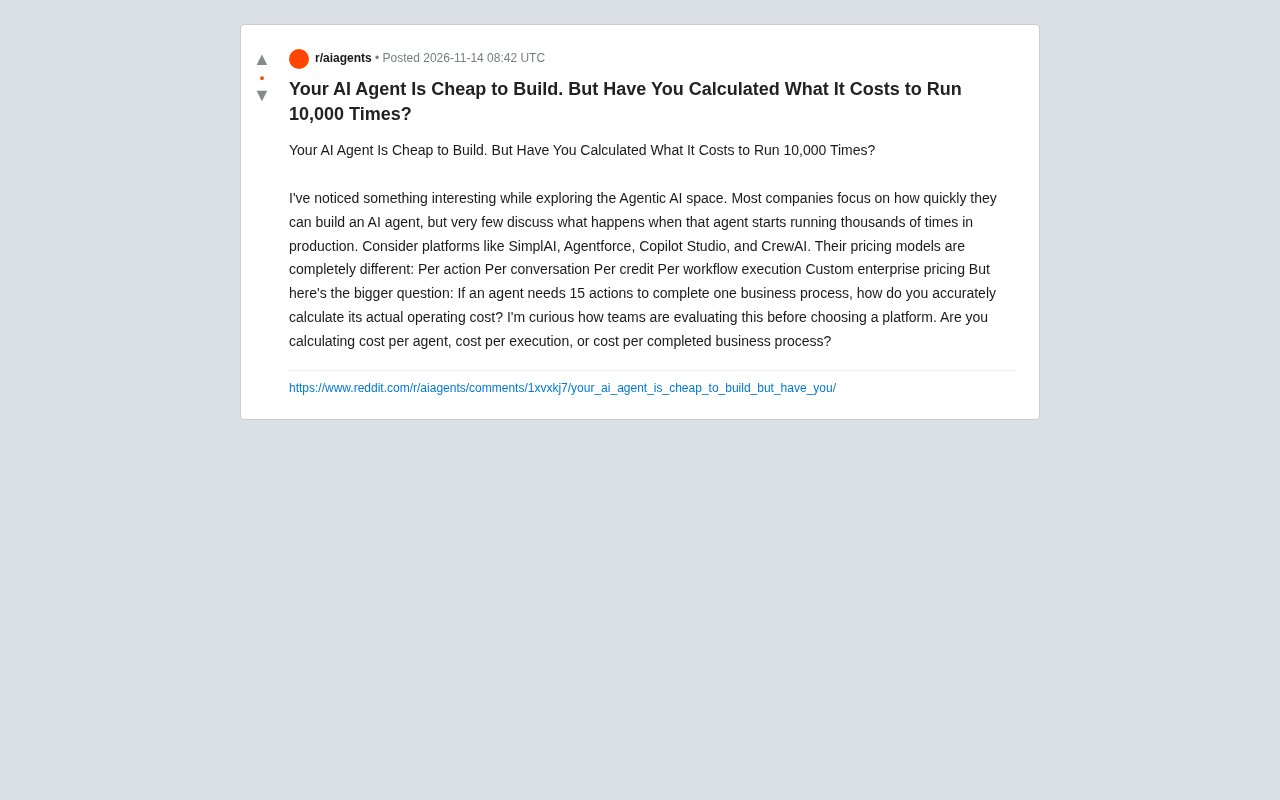
Agentic AI build barriers are dropping, but runtime cost accounting and billing transparency are becoming hard selection criteria.
The article highlights that while the Agentic AI field focuses on rapid building, the real cost of running agents at scale is overlooked. After comparing SimplAI, Agentforce, Copilot Studio, and CrewAI, a Reddit developer found five coexisting pricing models with vastly different billing structures. The article proposes three practical cost evaluation dimensions: measuring by completed end-to-end processes, factoring in failure retries, and separating platform fees from model invocation fees.
From "Build Frenzy" to "Runtime Anxiety"
Over the past year, discussions around Agentic AI have been almost entirely dominated by "build speed": low-code platforms, visual orchestration, and pre-built toolchains have made it possible to get a working agent online in just a few days. But an observation from a developer on Reddit hit a blind spot that's often overlooked: most companies only care about how to build an agent — very few seriously calculate the real cost of running it at scale.
This developer compared the pricing models of platforms like SimplAI, Agentforce, Copilot Studio, and CrewAI, and found they're nearly impossible to compare directly — per-action billing, per-conversation billing, per-credit billing, per-workflow-execution billing, and custom enterprise pricing all coexist. This means that when you migrate the same business scenario to different platforms, your billing structure will change fundamentally.
Why Per-Use Cost Can't Answer the Real Question
Action Count Is the Hidden Cost Multiplier
A seemingly simple business request may be broken down into multiple actions inside an agent: retrieving from a knowledge base, calling an API, validating results, retrying failed steps, generating a final response. If completing one business process requires 15 actions (as the original post assumes), then on a per-action billing platform, costs will rise linearly or even exponentially with process complexity.
Per-conversation billing platforms may mask action counts, but costs will quickly accumulate in long conversations and multi-turn clarification scenarios. The per-credit model looks flexible but actually leaves pricing power with the platform — the exchange rate between credits and actions is often only revealed in the contract.
Execution Volume Amplifies Everything
The one-time investment in the build phase is easy to perceive, but runtime costs are ongoing and scale with call volume. When an agent goes from a few dozen test calls per day to tens of thousands of executions in production, any tiny difference in per-use cost gets magnified by orders of magnitude. The question raised in the original post — "Are you counting by number of agents, by number of executions, or by completed business processes?" — is essentially asking: Is your cost model aligned with business value?
In cost accounting, the distinction between linear growth and exponential growth is crucial. If a business process contains an average of n actions, the total cost of per-action billing is n × unit price, rising linearly with complexity. But if a failed step triggers a retry, and the retry itself contains multiple actions, the total action count may expand through branching structures, forming a combinatorial explosion that approximates exponential growth. Additionally, the retry rate r amplifies the expected action count to n/(1-r); as r approaches 1, costs balloon dramatically. This is the mathematical reason why "per-use cost" can't directly answer the real question: it only reflects the unit price under the ideal path, ignoring the probability distribution and failure amplification effects in production environments.
Three Practical Dimensions for Evaluating Agent Platform Costs
Dimension 1: Use "Completed Business Processes" as the Unit
The measurement unit closest to business value isn't actions or conversations — it's successfully completed end-to-end processes. Before selecting a platform, teams should first run a real scenario through the full pipeline, tally the average action count, failure retry rate, and human intervention ratio, then multiply by each platform's unit price. The resulting figure is far more meaningful than the sample prices on a platform's website.
Dimension 2: Factor Failures and Retries into Costs
Agents aren't deterministic programs — failure and retry are the norm. On per-action billing platforms, failed actions are billed just the same; on per-conversation billing platforms, a single failed conversation may trigger multiple rounds of retries. Teams need to measure retry rates in production and incorporate them into the total cost model, or budgets will be eroded by hidden consumption.
Retry rate is a key operational metric for measuring agent runtime stability, defined as the proportion of business requests that are re-executed due to failure. In a cost model, the effective per-use cost should be expressed as: nominal unit price × (1 + retry rate × average retry count). For per-action billing platforms, failed actions are billed the same as successful ones; every 10 percentage point increase in retry rate can raise total costs by over 20%. For per-conversation billing platforms, a single failed conversation may trigger multiple rounds of clarification and retries, causing even greater hidden consumption. Therefore, teams should collect retry rate, average retry count, and human intervention rate during load testing, treating them as essential parameters for cost projection rather than after-the-fact operational metrics.
Dimension 3: Separate Platform Fees from Model Invocation Fees
Many platforms' pricing only covers the orchestration layer, with underlying LLM inference costs billed separately. Among the platforms listed in the original post, some use custom enterprise pricing precisely because model invocation costs and orchestration costs need to be accounted for separately. Ignoring this layer will underestimate overall runtime expenditure.
The Selection Logic Behind Multi-Platform Pricing Differences
According to the Reddit post, SimplAI, Agentforce, Copilot Studio, and CrewAI all have different pricing models. This isn't coincidental — it reflects each product's positioning:
- Per-action billing suits scenarios with relatively fixed, highly predictable process steps, where costs grow linearly with complexity, making budgeting easier.
- Per-conversation billing is better suited to customer service interaction scenarios, but is insensitive to internal action counts — good for businesses centered on multi-turn dialogue.
- Per-credit/quota billing offers flexibility, but teams need to continuously monitor consumption rates to avoid service interruptions when quotas run out.
- Per-workflow-execution billing aligns best with business processes and suits end-to-end automation scenarios, but requires the platform to have a clear definition of what "one execution" means.
- Custom enterprise pricing typically appears in large-scale deployments, with negotiating room tied to committed usage volume.
The original author didn't offer a one-size-fits-all answer but instead threw the question back to teams: Before selecting a platform, have you already run cost projections using real business workloads? That rhetorical question is more valuable than any platform's price list.
The orchestration layer is the core component in an agent platform responsible for task decomposition, tool scheduling, state management, and error handling — it determines how actions are defined and counted. Model invocation fees refer to charges from the underlying large language model (LLM) based on tokens or inference calls, typically priced separately from the orchestration layer. Many platforms display prices on their websites that only cover the orchestration layer, listing model invocation fees as "additional" or "custom," causing teams to underestimate total costs by 30%–50%. When selecting a platform, teams should demand clarity on: what the orchestration layer's billing unit is, whether model invocation fees are included in the package, how overage is priced, and whether the two are consolidated on the same bill.
Conclusion: Cost Visibility Should Be a Hard Selection Criterion
The barrier to building Agentic AI is dropping fast, but runtime costs may become the new competitive moat. When evaluating platforms, teams should look beyond feature lists and integration capabilities, and demand transparent measurement standards: how is an action defined, how is an execution counted, are failed retries billed, and are model invocation fees included?
Only teams that can calculate their runtime costs clearly will dare to push agents into production for tens of thousands of executions. Cheap to build is the entry ticket; controllable runtime is the reason you stay at the table long-term.
Related articles

Claude Context Window and Prompt Caching: A Practical Guide to Cost Optimization
A deep dive into Claude's context window and prompt caching costs: cache breakpoints, invalidation, TTL choices, context editing vs. compaction, skill progressive disclosure, and a real case where caching cost more than no caching, plus an architectural decision framework.
Rejecting AI Slop: A "No AI Slop" Manifesto
AIE speakers jointly propose a "No AI Slop Manifesto," calling for resistance against the flood of low-quality AI-generated content. This article explains what AI slop is, the sources of industry anxiety, and what it means for content creators.

English Version of 'Thank You for Your Love' Gains Traction on Bilibili: A Cross-Cultural Rendition of a Classic Love Song
The English version of 'Thank You for Your Love,' titled 'I'll give you all my love,' trends on Bilibili with rewritten lyrics about giving all your love. This article analyzes its emotional expression, cross-cultural adaptation strategy, and differences from the Chinese original.