Rejecting AI Slop: A "No AI Slop" Manifesto
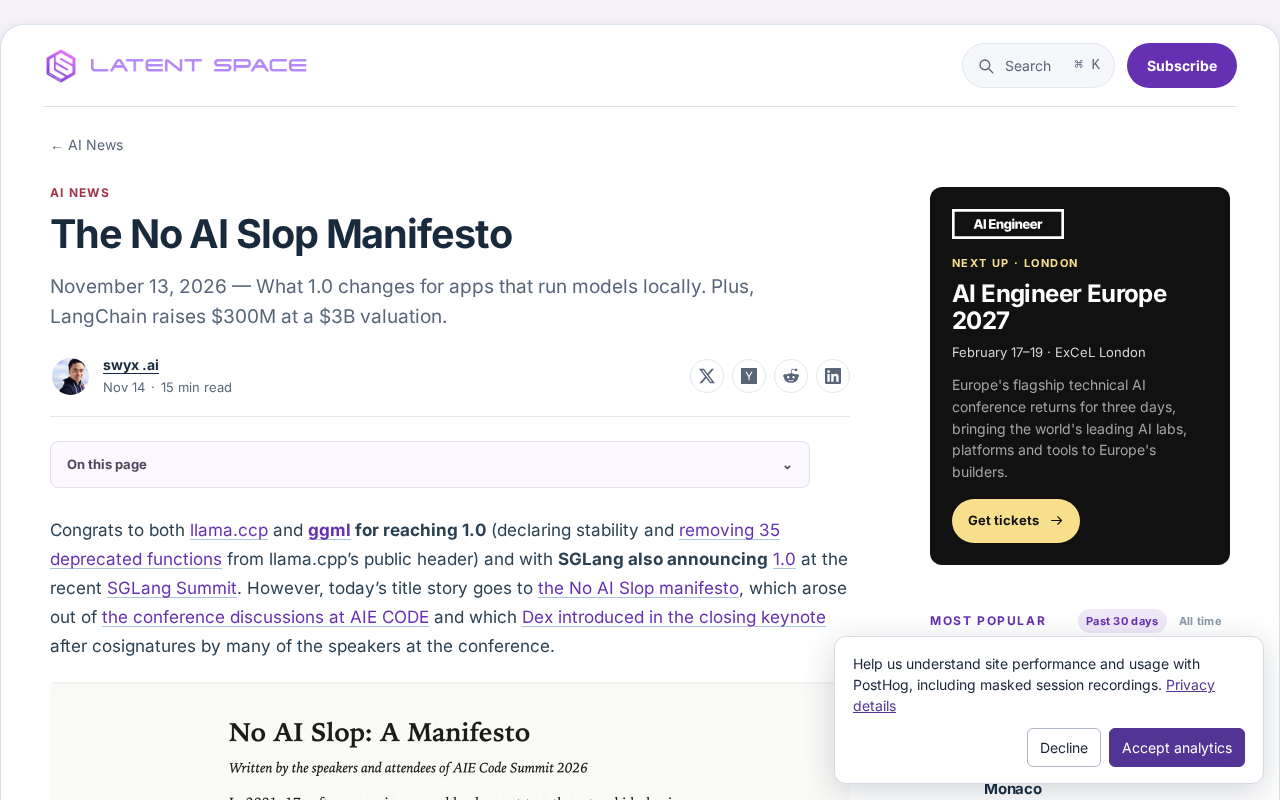
AIE speakers jointly release a "No AI Slop Manifesto," calling for resistance against low-quality AI-generated content and emphasizing that the gatekeeper of quality can only be humans themselves.
The article centers on the "No AI Slop Manifesto" jointly proposed by AIE speakers, exploring the flood of AI-generated content. "AI slop" refers to grammatically correct but hollow and homogenized content, contrasting with AI-assisted creation that involves human judgment. The manifesto's core claim is that using AI is fine, but AI cannot be an excuse for laziness—the root problem is users abandoning quality standards. The speakers propose paths to combat slop at the tool-process, community-norm, and personal-responsibility levels, emphasizing that after AI-driven efficiency gains, the gatekeeper of content quality remains humans themselves. The article views the manifesto as more of an industry self-regulation call, whose value lies in bringing "quality" back to the center of AI discussions.
When AI-Generated Content Floods Everything
The flood of low-quality AI-generated content has become an unavoidable problem. From mass-produced marketing copy to social media posts with zero informational value, "AI slop" is eroding the internet's content ecosystem. According to the speakers at AIE (AI Engineer) in a joint statement, this is not just a technical problem but a matter of attitude. Together they proposed a "No AI Slop Manifesto," attempting to draw a line for the industry.
The manifesto's core claim is not complicated: using AI is fine, but AI cannot be used as an excuse for laziness. The speakers argue that the root of the problem lies not in AI itself but in users abandoning quality standards for their output. When people settle for "as long as it generates something," the floor for content quality keeps getting lower.

What Is "AI Slop"?
The word "slop" originally refers to swill or leftovers, and in the AI context it points to content that looks complete but is actually hollow—grammatically correct but devoid of insight, neatly formatted but unable to withstand scrutiny, massive in quantity but severely homogenized. What distinguishes it from "AI-assisted creation" is this: the latter involves human judgment and refinement, while the former is just prompts and copy-paste.
The speakers did not provide precise criteria for judgment, but from the tone of the manifesto one can infer a practical principle they care about: whether the output has been reviewed and owned by a human. If the publisher themselves are unwilling to put their name on it or take responsibility for its accuracy, it is most likely slop.
"Slop" originally means swill or leftovers fed to livestock in English, carrying the derogatory connotation of "large quantity, cheap, and unnutritious." Around 2024, with the spread of generative AI, this term was borrowed by the tech community to describe text, images, or video content batch-generated by large models that appear complete but lack substantive value. Similar concepts include "AI-generated spam" and "content farm," but "slop" emphasizes the "mushy" texture of the content—presentable in form, yet impossible to chew on in substance. The popularity of this term itself reflects the industry's alertness to the flood of AI content, and also marks a shift in the discussion from "can AI create" to "where is the quality floor for AI creation."
The Industry Anxiety Behind the Manifesto
That this manifesto appeared at an AIE speaking event is no coincidence. The AI engineering community is one of the earliest groups to use generative AI at scale, and also one of the first to feel the pressure of "bad money driving out good." When the cost of producing low-quality content approaches zero, those who do things seriously have to work even harder to prove their value.
According to the speakers' joint statement, combating slop requires action on several levels: at the tool level, establishing stricter quality-check processes; at the community level, maintaining zero tolerance for obviously low-quality content; at the individual level, upholding the principle of "publishing means taking responsibility." These claims are hardly novel, but the fact that a group of people who use AI extensively made them publicly demonstrates that the problem has reached a point where a stance must be taken.
AI Engineer (AIE) is a tech community and conference brand focused on AI engineering practice, whose participants are mostly frontline AI developers, product managers, and researchers. Unlike academic conferences, AIE focuses more on the real-world deployment and engineering challenges of AI technology in products. Because of this, the AIE community has firsthand experience with the quality problems of AI-generated content: they are both the earliest adopters of generative AI and one of the first groups to be overwhelmed by low-quality AI content. Proposing the "No AI Slop Manifesto" on such an occasion is equivalent to having those who understand the tool's capabilities best draw the boundaries of its use—the symbolic significance outweighs the content itself.
Implications for Content Creators
For those who use AI to assist with creation in their daily work, the practical value of this manifesto lies in providing a self-check list: does the content you publish contain judgment, experience, or perspectives that only you can provide? If you remove all AI-generated sentences, how much value is left?
The speakers' emphasis is not on resisting AI but on resisting "mindless use of AI." The more powerful the tool, the greater the user's responsibility. This logic holds equally in AI programming, AI writing, AI design, and other fields. The manifesto offers no technical solutions, but it puts the problem on the table—at a stage when AI capabilities are rapidly advancing, the gatekeeper of content quality can only be humans themselves.
Editor's Commentary
The "No AI Slop Manifesto" is more of a call for industry self-regulation than a set of enforceable standards. Its value lies not in how many new ideas it presents, but in bringing the old topic of "quality" back to the center of AI discussions. For teams and individuals who rely on AI for efficiency, this manifesto is worth using as a mirror: after efficiency gains, is the time saved being spent on what truly requires humans?
Related articles

Claude Context Window and Prompt Caching: A Practical Guide to Cost Optimization
A deep dive into Claude's context window and prompt caching costs: cache breakpoints, invalidation, TTL choices, context editing vs. compaction, skill progressive disclosure, and a real case where caching cost more than no caching, plus an architectural decision framework.
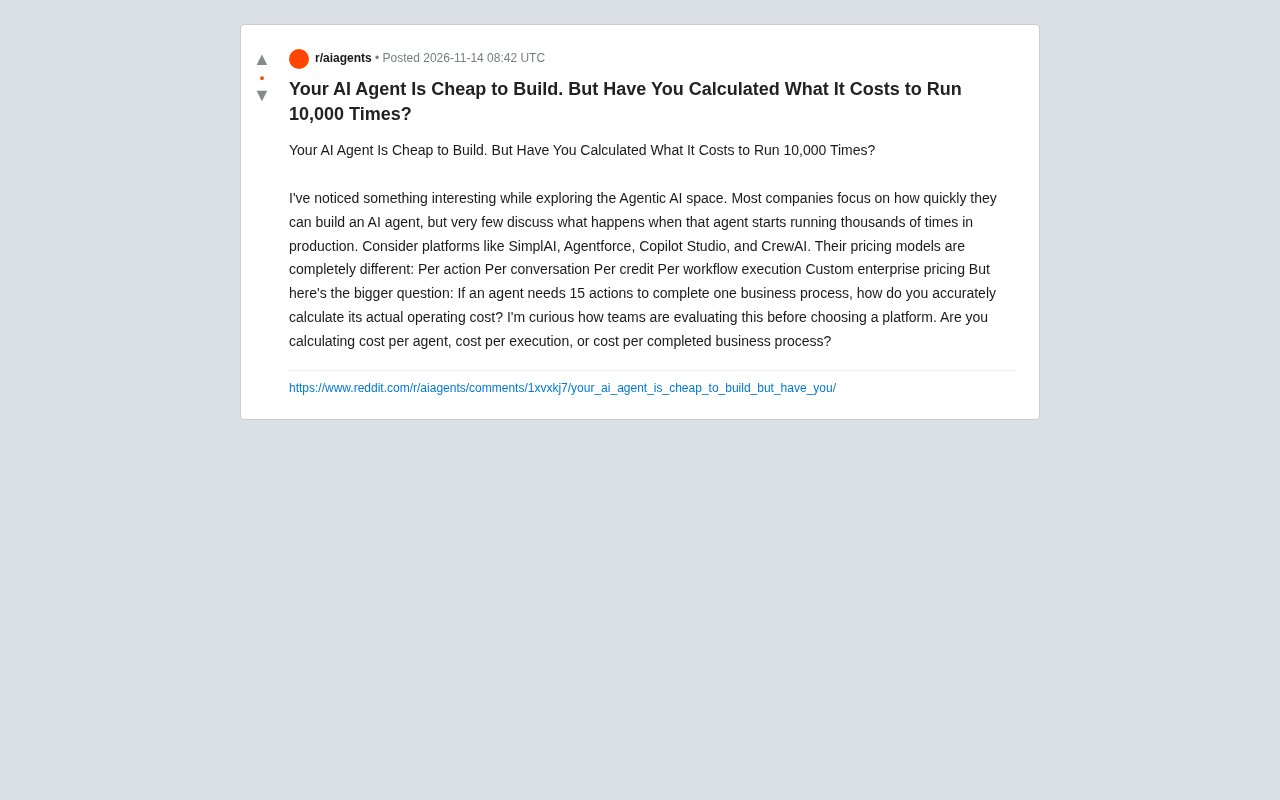
Building an AI Agent Is Cheap — But Have You Calculated the Cost of Running It 10,000 Times?
AI agents are cheap to build but costly to run at scale. This analysis of SimplAI, Agentforce, Copilot Studio, and CrewAI pricing reveals three dimensions for evaluating true agent costs.

English Version of 'Thank You for Your Love' Gains Traction on Bilibili: A Cross-Cultural Rendition of a Classic Love Song
The English version of 'Thank You for Your Love,' titled 'I'll give you all my love,' trends on Bilibili with rewritten lyrics about giving all your love. This article analyzes its emotional expression, cross-cultural adaptation strategy, and differences from the Chinese original.