Building an AI Code Quality Reviewer: How Jev Solves the Code Review Bottleneck

A developer built an LLM-powered semantic code review tool to fill the gaps left by deterministic static analysis.
As AI coding tools accelerate code generation, human review can no longer keep pace, making review the new bottleneck. A developer built jev-quality-gate: teams define context-aware policies in YAML, the tool fetches git diffs in CI, and the Jev model judges compliance — requesting additional code context when needed, mimicking how a human reviewer actually works. Positioned as a complement to SonarQube and similar static analysis tools, it targets semantic judgments that rule engines can't handle. The project is in early stages, with the author using Qwen-generated code to calibrate policies; accuracy, token costs, and false-positive rates are still being validated.
When AI Code Generation Creates a New Bottleneck: Code Review
As AI-assisted programming tools become mainstream, code generation speeds have increased dramatically — but a new problem has emerged: code review is becoming the bottleneck in the development workflow. A developer shared their firsthand observation on Reddit: generating code at work has become increasingly easy, but the ability to effectively review that code hasn't kept pace.
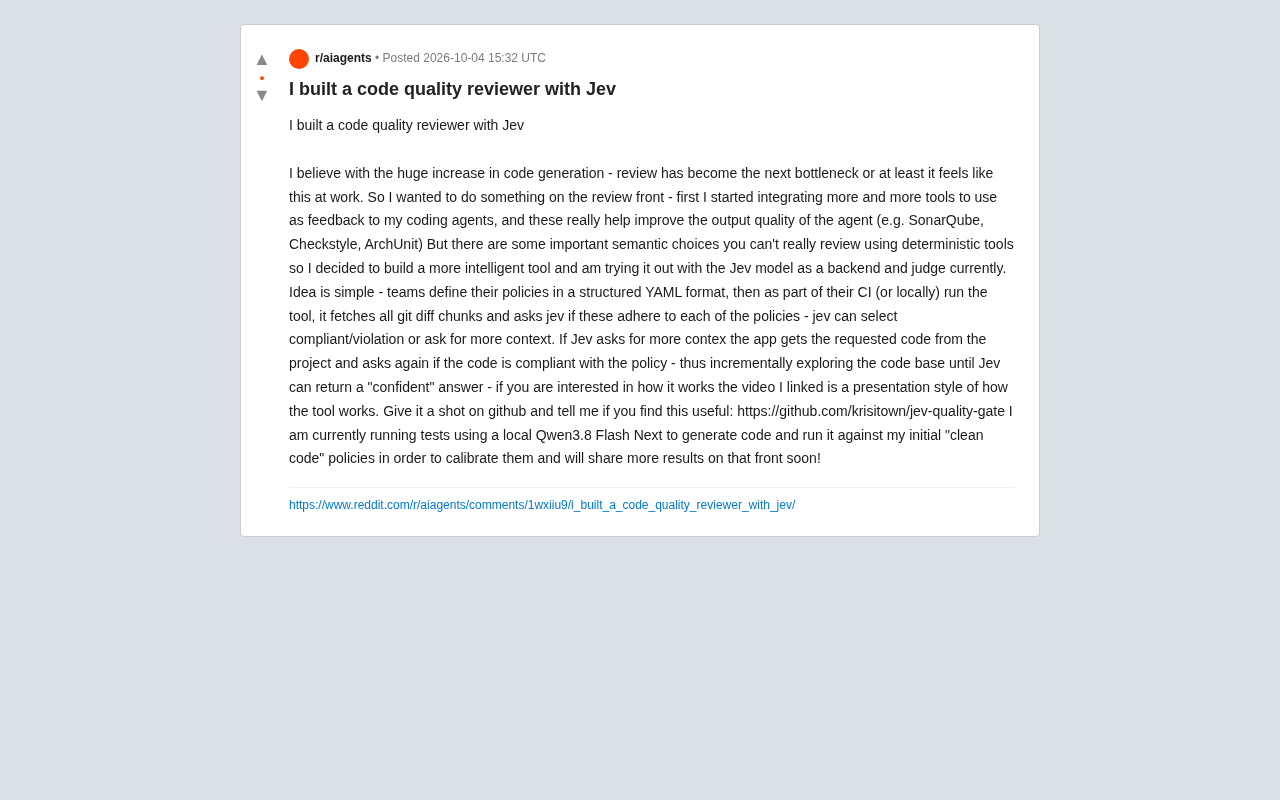
This isn't an isolated experience. When coding agents can rapidly produce large volumes of code, the time and cost of manual line-by-line review becomes a drag on team efficiency. To address this, the developer built an AI-powered code quality review tool — jev-quality-gate — using the Jev model as the backend reasoning engine.
From Deterministic Tools to Semantic Review
The author's thought process is worth examining. Initially, the approach was to integrate more deterministic tools as feedback sources for the coding agent, such as:
- SonarQube: Code quality and security scanning
- Checkstyle: Code style and convention enforcement
- ArchUnit: Architectural constraint testing
These tools do significantly improve agent output quality. But they share a common limitation — they can only check things that can be deterministically judged by rules. In real-world development, many important semantic choices simply can't be reviewed through fixed rules. For example, whether a piece of code truly reflects the team's understanding of "single responsibility," or whether naming and abstraction levels align with the business context — these require more intelligent judgment.
That gap is precisely what motivated the author to build a smarter review tool.
Deterministic Tools and AI Review as Complements
To be clear, jev-quality-gate isn't meant to replace mature tools like SonarQube — it exists as a complementary layer. Deterministic tools handle rule-based issues; AI review focuses on semantic judgments that require understanding context and intent. The two together form a more complete quality defense.
SonarQube, Checkstyle, and ArchUnit represent the mainstream paradigm of "static analysis" in software engineering. Static analysis scans source files without actually running the code, relying on pre-written rule sets to match problem patterns — such as null pointer risks, excessive cyclomatic complexity, or non-standard import ordering. The strength of these tools lies in fully reproducible results, zero-error rule enforcement, high speed, and no dependency on external services. Their fundamental limitation stems from the same source: they can only "see" patterns covered by their rules. For questions like "does this class name accurately convey its business meaning?" or "is this abstraction over-engineered?" — questions that require understanding intent — a rule engine has no answer. This is exactly where large language models can step in. LLMs can understand specifications written in natural language and translate YAML-defined human-language policies into semantic judgments about specific code.
How jev-quality-gate Works
The tool's core design is quite clear, and the entire flow can be broken down into a few stages:
Structured Policy Definition
Teams define their own code quality policies in YAML format. This means each team can configure review rules according to their own standards, rather than being forced to accept some fixed set of "best practices."
CI Integration and Incremental Exploration
As part of the CI pipeline (or run locally), the tool executes the following steps:
- Fetches all git diff code blocks
- Queries Jev for each change, asking whether it complies with each policy
- Jev returns one of three possible responses: compliant, violation, or request more context
- When Jev requests more context, the application fetches the relevant code from the project and queries again
This incremental codebase exploration design is the standout feature of the tool. It mimics the actual behavior of a human reviewer — when information is insufficient, the reviewer proactively looks at related code until they can make a confident judgment. By progressively adding context, Jev can return a "confident" conclusion once it has enough information, rather than making a hasty judgment with insufficient context.
"Incremental codebase exploration" is technically a variant of Retrieval-Augmented Generation (RAG), but with retrieval logic driven by the model itself rather than pre-fetched. Traditional RAG stuffs relevant documents into context before the question is asked; here, the model first attempts to make a judgment based on the diff fragment, and if information is insufficient, it explicitly declares what additional code it needs — which the application layer then fetches and supplies. This "pull on demand" approach has two engineering benefits: it avoids bloating the prompt with the entire codebase (wasting tokens), and it preserves judgment explainability — the model explicitly states which code it's waiting for, which is itself an auditable intermediate state. The tradeoff is latency accumulation from multiple interaction rounds, plus increased token consumption with each context supplement — key cost variables the author needs to weigh carefully during the calibration phase.
Current Progress and Validation Approach
The author is currently running calibration tests. They use a locally deployed Qwen3.8 Flash Next model to generate code, then use that code to test the initially defined "clean code" policies — calibrating the policies' effectiveness in the process.
This validation method is quite clever: use one model to generate code, then use the review tool to evaluate it, creating a fast-iteration test loop. The author plans to share more test results going forward.
However, based on available information, this project is still in early exploration. It's more of a valuable engineering practice write-up than a mature, battle-tested solution. Several key questions remain to be seen: How accurate is the Jev model's judgments across different codebases? How much additional token consumption and latency does incremental context exploration introduce? Can the policy false-positive rate be kept within an acceptable range for teams?
Implications for AI-Assisted Development Workflows
Beyond this specific project, it reflects a broader trend: AI is expanding from code generation into downstream stages like code review and quality gating.
When generation is no longer the bottleneck, the entire software engineering focus naturally shifts to ensuring the quality of AI-produced output. Semantic review powered by large language models, policy as code, and intelligent quality gates in CI pipelines are likely to become major directions in the next phase of developer toolchain evolution.
For developers interested in experimenting, the author has open-sourced the project on GitHub (krisitown/jev-quality-gate) and provided a demo video explaining how the tool works. If your team is struggling with the efficiency of reviewing AI-generated code, this class of tools is worth watching.
"Policy as Code" is an established concept in the DevOps world — it refers to expressing compliance rules, security constraints, and operational standards in machine-readable code form, versioned and automatically enforced in CI/CD pipelines. Open Policy Agent (OPA) is a leading open-source project in this space, widely used for Kubernetes admission control and cloud resource compliance. jev-quality-gate brings this thinking into the code quality domain, replacing specialized policy languages like Rego with natural-language policies described in YAML — lowering the barrier to entry, but also introducing the uncertainty of LLM policy interpretation. This tradeoff reflects a pervasive tension in AI toolchain evolution: the trade-off between readability and determinism.
Related articles

Random Pruning of the DPO Computation Graph: 1.4x Training Speedup and Lower Peak Memory
DPO training too slow and memory-hungry? This paper proposes a random pruning framework for the DPO computation graph, sampling independently across position, sequence, and branch dimensions; branch pruning achieves a 1.426x step-time speedup and cuts training time by about 30%, with in-depth attribution of memory and time gains.

Why Does JEPA Underperform MLM in Longitudinal EHR Representation Learning?
New study compares JEPA and MLM for longitudinal EHR representation learning on MIMIC-IV: three JEPA variants train stably without collapse but underperform MLM; target size, not heterogeneity, drives prediction error.

Transfer Learning + Visible Light Communication: A New Approach to Energy-Efficient Indoor Positioning
A study proposes a transfer learning-based visible light communication indoor positioning method, achieving 47% accuracy improvement on the BOSCH factory dataset, 67.5% model efficiency under high noise, and introducing the ME composite metric for energy-efficient positioning in energy-constrained industrial IoT scenarios.