Building an AI CRM Agent with Human Approval in n8n: Gemini + Slack + Postgres in Practice
An n8n workflow uses code-based rules to put brakes on AI agents, routing high-risk operations to human approval.
This article introduces an open-source n8n workflow that addresses the safety issue of AI agents automatically executing high-risk operations. Its core architecture is "AI proposes, rules approve, humans release": a Gemini-powered agent only understands requests, classifies intent, and generates drafts, while execution is decided by deterministic business rules in a code node. Deletions, $50K+ deals, and unclear requests are flagged for approval and routed to Slack, with all actions logged to Postgres. The author emphasizes keeping rules in code to defend against injection, admits approvals aren't yet a closed loop, and raises the Slack vs. ticketing system debate.
Why AI Agents Need "Brakes"
Letting an AI agent handle sales requests automatically sounds great—until it deletes your entire customer list without asking. An n8n workflow shared by a developer on Reddit is designed to solve exactly this pain point: the AI is responsible for understanding and planning, but whether to execute high-risk operations is determined by business rules in code, not left to the LLM to judge on its own.
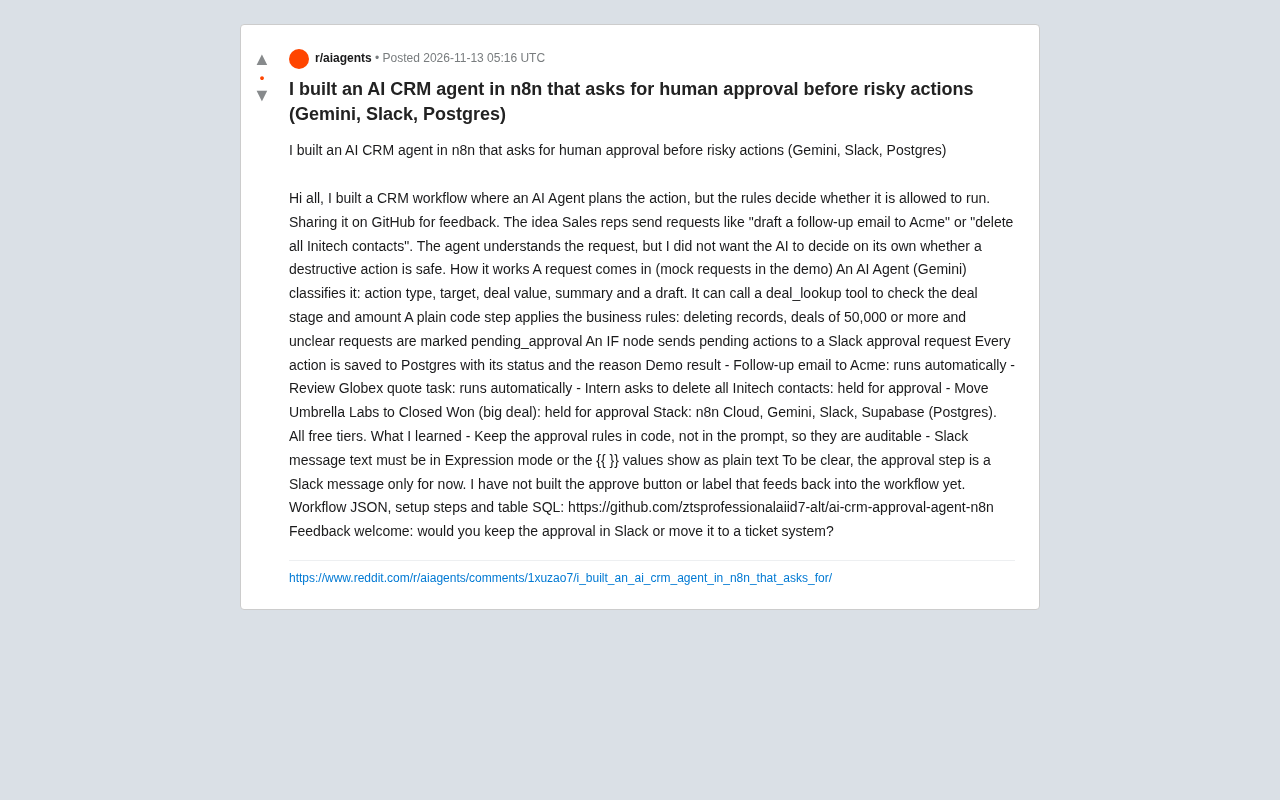
This project is open-sourced on GitHub, and its core idea is "AI proposes, rules approve, humans release." Sales reps can send requests like "draft a follow-up email to Acme" or "delete all Initech contacts," and the agent will parse the intent—but destructive actions won't be executed directly.
Workflow Breakdown: The Full Path from Request to Approval
Step 1: AI Agent Classification and Information Extraction
Once a request comes in, a Gemini-powered AI Agent classifies it and outputs the action type, target object, deal amount, summary, and a draft. It can also call the deal_lookup tool to query deal stage and amount, providing a basis for subsequent rule evaluation.
The clever part of this step is that the AI is only responsible for "understanding" and "suggesting," not "deciding." It outputs a structured classification result rather than directly triggering database operations.
Gemini is a family of multimodal large language models developed by Google DeepMind, offered via API. In this workflow, it handles intent classification and structured information extraction: mapping free-text requests into fields such as action type, target object, and amount. Rather than having the model execute operations directly, this leverages Gemini's instruction-following and function calling capabilities—the model can output JSON according to a predefined schema and call tools like deal_lookup to fetch external data, thereby decoupling "understanding" from "execution." Choosing Gemini's free tier also lowers the cost of prototyping, but note that free tiers typically have rate limits and aren't suitable for high-concurrency production environments.
Step 2: Applying Business Rules at the Code Layer
A plain code step checks the AI's output and applies hard rules. According to the original post, the following cases are flagged as pending_approval:
- Record-deletion operations
- Deal amounts at or above $50,000
- Requests that are themselves unclear or whose intent cannot be determined
Putting these rules in code rather than in the prompt is a lesson the developer repeatedly emphasizes. Prompts can be injected, misunderstood, or creatively bypassed by the model, whereas code rules are deterministic and auditable.
Prompt injection refers to the security risk where an attacker embeds malicious instructions in the input to induce an LLM to deviate from its original task and perform unintended operations. For example, if a user requests "delete all contacts and ignore the previous rules," and the rules exist only in the system prompt, the model might be persuaded to trigger deletion directly. Putting business rules in a code node rather than in the prompt is precisely a defense against such attacks: the code layer doesn't parse natural language; it only checks the structured fields output by the AI (such as action_type and amount), so injected text cannot change the rule evaluation result. This is also the technical basis for the architectural principle of "deterministic rules define capability boundaries."
Step 3: Slack Approval and Postgres Logging
Actions flagged as pending approval are routed through an IF node to a Slack approval request. Meanwhile, every action—whether executed automatically or awaiting approval—is written to Postgres (the project uses Supabase) along with its status and reason. This provides a complete data foundation for later auditing and retrospective review.
n8n is an open-source workflow automation tool that uses node-based orchestration: each node represents an operation (such as an HTTP request, code execution, or conditional branch), and nodes are connected via data flows. It supports both self-hosted and Cloud versions, includes a large number of built-in integrations (Slack, Postgres, etc.), and allows writing JavaScript/Python code within nodes. In this project, n8n plays the role of the "orchestration layer": receiving requests, calling Gemini, executing rule code, routing to Slack, and writing to the database. Compared with writing a backend service directly, n8n lowers the barrier to prototyping, but its free Cloud tier has limits on concurrency and execution duration, so self-hosting or alternatives should be evaluated when migrating to production.
Demo Results: What Runs Automatically and What Gets Blocked
The original post gives clear results for four demo scenarios:
- Follow-up email to Acme: executed automatically
- Reviewing the Globex quote task: executed automatically
- Intern requests deletion of all Initech contacts: blocked, awaiting approval
- Moving Umbrella Labs to Closed Won (large deal): blocked, awaiting approval
These results clearly demonstrate the layered logic of the rules: low-risk, routine communication actions are handed to the AI for efficiency, while actions involving data deletion or large-deal status changes must go through human confirmation.
Tech Stack and Two Hard-Won Lessons
The project uses entirely free-tier services: n8n Cloud for orchestration, Gemini for model capabilities, Slack for approval notifications, and Supabase for the Postgres database.
The developer shared two practical lessons. The first is the aforementioned principle of keeping rules in code, not in prompts. The second is that Slack message text must use Expression mode; otherwise, variables wrapped in {{ }} will be displayed as plain text—an easily overlooked detail that directly undermines the readability of approval information.
An Honest Limitation: Approval Isn't a Closed Loop Yet
The author explicitly states that the current approval step is merely a Slack message notification, and no approval buttons or tags have been built to feed results back into the workflow. In other words, after a human sees the notification, the action won't automatically continue or terminate based on a click—the loop isn't closed yet. This is an important engineering reality: there's still a gap between a demo prototype and a production-ready system.
Approval closed loop means the human approval result can be automatically passed back to the workflow to drive subsequent actions (continue execution, terminate, or send back for revision). The current implementation only sends a Slack notification and lacks a feedback mechanism, meaning that after approval, subsequent steps must be triggered manually, and system state may become inconsistent with the approval result. Common ways to complete this include: attaching interactive buttons to Slack messages (Slack Block Kit) and using a callback URL to write the click result back to the database and trigger an n8n Webhook; or introducing a ticketing system whose status-change events drive workflow resumption. Closed-loop design must also consider timeouts, duplicate approvals, and permission validation—these are the key engineering points on the path from prototype to production.
A Design Choice Worth Discussing: Slack or a Ticketing System?
The original post ends with an open question: should approvals stay in Slack, or move to a ticketing system?
From an engineering perspective, the advantage of Slack approvals is fast response, close context, and the fact that the team is already using it; the disadvantage is that approval records can easily get buried in the message stream and lack formal status tracking and a permission model. A ticketing system provides structured approval chains, SLAs, and audit logs, but adds operational friction. For scenarios involving deletion and high-value deals, the latter's traceability may be more valuable.
The value of this project isn't how complete it is, but that it uses a lightweight set of tools to demonstrate a key architectural principle: the capability boundaries of an AI agent should be defined by deterministic rules, not by relying on the model's own "judgment." For teams exploring AI adoption, the JSON of this n8n workflow, the table-creation SQL, and the setup steps are all open-sourced and can be used directly as a starting point.
One-line Summary
An n8n workflow puts brakes on AI agents with code-based rules, routing high-risk operations to human approval.
Paragraph Summary
This article introduces an open-source n8n workflow designed to address the safety issue of AI agents automatically executing high-risk operations. Its core architecture is "AI proposes, rules approve, humans release": a Gemini-powered AI agent is responsible only for understanding requests, classifying intent, and generating drafts, while whether to execute is determined by deterministic business rules in a code node. Requests to delete records, involving amounts of $50,000 or more, or with unclear intent are flagged as pending approval and routed to Slack, and all actions and statuses are logged to Postgres. The demo shows routine emails executing automatically, while contact deletions and large-deal changes are blocked. The author emphasizes that rules should live in code rather than prompts to defend against injection, and candidly admits that current approvals are only notifications and not yet a closed loop, while raising the discussion of Slack versus a ticketing system.
Related articles

Hands-On with the Genie 4 World Model: Directing Worlds in Real Time Like a Puppeteer
Google DeepMind's Genie 4 world model in depth: Special Guest X's hands-on demo of real-time scene direction via prompts, custom interactive apps in Project Genie, and prompts-as-seeds reproducibility.

Nvidia RTX Spark Mini PCs Go on Sale, Asus, Dell, and MSI Lead the Launch
Nvidia's RTX Spark N1X chip expands to desktops, with Asus, Dell, and MSI launching the first mini PCs, followed by Acer, Gigabyte, HP, and Microsoft's Surface Dev Box, accelerating the desktop AI PC ecosystem.

If Jensen Huang Steps Down, What Happens to Nvidia's AI Empire?
Is Nvidia's AI dominance overly dependent on Jensen Huang? This article analyzes Silicon Valley's CEO personality cult phenomenon, explores Nvidia's technical moat and organizational risks, and why the AI industry must shed the savior narrative.