Building an Enterprise RAG Knowledge Base from Scratch: A Complete Practical Guide

A practical enterprise RAG knowledge base tutorial for Java developers, covering the full pipeline from vectorization to recall optimization.
This article presents an enterprise-grade RAG knowledge base tutorial tailored for Java developers. Since traditional databases and ES can't handle semantic natural language queries, RAG vectorizes documents into Milvus, then pairs retrieval with LLM generation to enable conversational access to internal business data. Built on Vue 3 + Spring AI + Milvus, the tutorial goes beyond a runnable demo to address real enterprise challenges: chunking strategy, cross-chunk retrieval, recall rate improvement, AI hallucination suppression, source attribution, and document access control. Supporting features like text-to-image, user management, and sensitive word filtering are also included, along with a complete Java + AI learning roadmap from LLM selection to high-availability deployment.
Why Every Enterprise Needs a RAG Knowledge Base System
Almost every company accumulates a massive amount of proprietary business materials — but enabling the entire organization to efficiently search and retrieve that information has always been a challenge. Traditional relational databases and Elasticsearch fall short when it comes to semantic question-answering. They excel at exact keyword matching, but can't grasp the real intent behind natural language queries like "which class is a particular student in?"
RAG (Retrieval-Augmented Generation) knowledge base systems fill exactly this gap. They convert enterprise documents into vector representations stored in a vector database, then combine that with the comprehension and generation capabilities of large language models — allowing users to access internal information through natural conversation. As demonstrated in a tutorial by Bilibili creator 徐书老师, once a student roster is uploaded, you can query which class a student belongs to simply by asking — and the AI answers accurately.
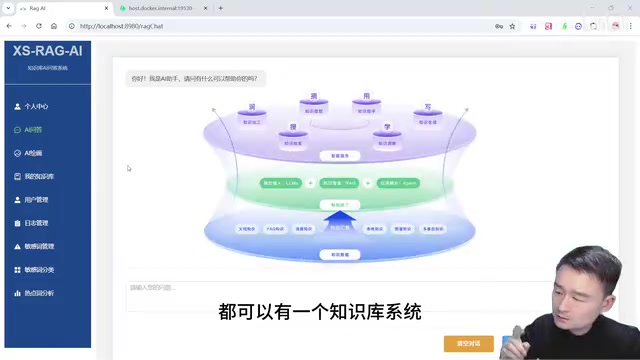
Another key benefit of this type of system is its career value. For Java developers, having a complete RAG knowledge base project on your resume is a far more distinctive differentiator than yet another traditional CRUD application.
RAG works in two phases: the retrieval phase converts the user's natural language question into a vector and finds the most semantically similar document chunks in the vector database; the generation phase feeds those retrieved chunks as context — along with the original question — to a large language model, which synthesizes them into a final answer. This "retrieve first, then generate" architecture effectively addresses two core limitations of LLMs: knowledge becoming stale due to training data cutoff dates, and the model having no awareness of private enterprise data. Compared to stuffing entire documents into the model's context window (limited by token constraints), RAG only retrieves the most relevant chunks, reducing cost while keeping responses focused. It's currently the most widely adopted approach for enterprise knowledge management.
Technical Architecture and Core Features
This knowledge base system uses a frontend/backend separation architecture: the frontend is built with Vue 3, while the backend leverages the Spring AI framework to connect with large language models and handle core logic. The technology choices reflect real-world enterprise deployment scenarios rather than a toy demo.
Two core features run throughout the system: AI-powered RAG Q&A and knowledge base document upload. To enable Q&A, business materials must first be uploaded. Documents are stored in an OSS object storage service, then go through a tokenization and vectorization pipeline before being persisted in the vector database.
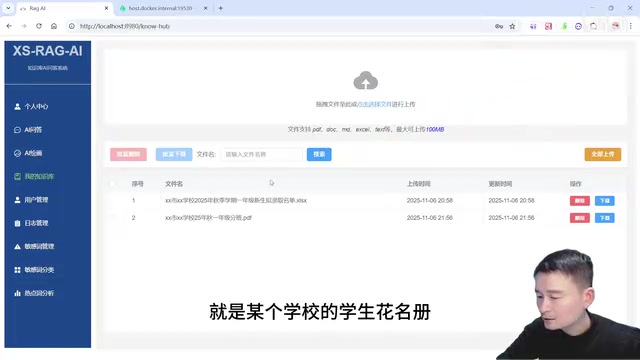
For the vector database, the tutorial selects Milvus — a top choice in terms of both performance and market share among current vector databases, and well-suited for enterprise production environments. This complete pipeline from storage to retrieval forms the fundamental backbone of any RAG application.
The fundamental difference between vector databases and traditional databases lies in the dimension of storage and retrieval. Traditional databases store structured data in rows and columns and rely on exact index lookups. Vector databases store high-dimensional floating-point arrays ("vectors" or "embeddings") and retrieve results by computing similarity metrics such as cosine similarity or dot product. Milvus is the most performance-representative open-source vector database available today, supporting millisecond-level retrieval across billions of vectors with multiple index types (e.g., HNSW, IVF_FLAT) to balance recall rate and speed. Spring AI provides a unified abstraction over mainstream vector databases, so developers don't need to write low-level retrieval logic — switching between vector store backends is as simple as a configuration change, dramatically lowering the engineering barrier to entry.
Enterprise-Level Challenges and Solutions
Many developers assume RAG is straightforward, but real enterprise development surfaces a series of genuine engineering challenges. This tutorial goes beyond simply plugging in a large model for similarity search and digs into several critical problems.
Chunking strategy is the first major hurdle — splitting documents into chunks that are too large or too small both degrade retrieval quality, and the right approach must be validated against real business data. Then comes the cross-chunk retrieval problem: when a complete answer is scattered across multiple document fragments, how do you ensure full recall? Data freshness is equally important — when source materials expire, how do you update the vector database in time to prevent the AI from returning stale information?
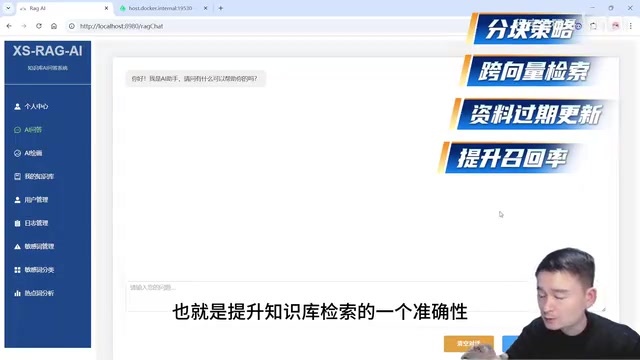
Improving recall rate directly determines the accuracy of knowledge base retrieval and is the single most important metric for system quality. The tutorial also addresses AI hallucination — the tendency to fabricate answers when no relevant information is found. Additionally, two compliance-critical features that enterprises care deeply about are covered in depth: source attribution (letting users know which document an answer came from) and access control (setting document-level permissions for different users).
Chunking strategy is one of the most underestimated components of any RAG system. Common approaches include: fixed character count splits (simple but semantically disruptive), sentence/paragraph boundary splits (preserves semantic integrity), and sliding window splits with overlap (chunks share overlapping content to prevent key information from being cut off at boundaries). Chunks that are too large introduce noise, making it harder for the model to focus; chunks that are too small may lack sufficient context for the model to produce a complete answer. Recall rate measures what proportion of truly relevant document chunks are successfully retrieved. Common techniques for improving recall include hybrid retrieval (combining vector search with keyword search), query rewriting (expanding the user's question from multiple angles before searching), and reranking (using a more precise model to re-score and re-sort the initial retrieval results).
Supporting Features and a Complete Learning Path
Beyond the core RAG capabilities, the project includes a range of supporting features that bring it closer to a fully deliverable product: text-to-image generation via prompt engineering, basic user management, log management, sensitive word management and categorization, and trending keyword analysis. These modules may not be the star of the show, but they're indispensable when deploying an enterprise system to production.
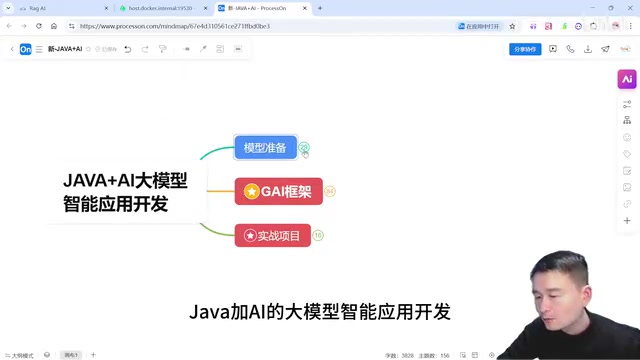
For those who want to systematically master Java + AI large model application development, the tutorial outlines a fairly comprehensive learning path: starting from LLM selection, through data cleaning and fine-tuning, to various LLM integration frameworks. Core concepts to understand along the way include conversational memory, dialogue interception, Tools / Function Calling, MCP, RAG, vectors and vectorization, and vector databases.
On the framework side, the recommended stack includes Spring AI, Alibaba's Agent Framework and Graph, and AI application monitoring platforms. The path concludes with several hands-on projects and high-availability deployment, walking through the entire lifecycle from development to production. For Java engineers, this path both fills the AI capability gap and translates directly into tangible resume value.
Summary
The real value of this RAG knowledge base tutorial lies not in demonstrating a runnable demo, but in systematically unpacking the real pitfalls you'll encounter in enterprise deployments — chunking strategy, cross-chunk retrieval, recall rate optimization, hallucination suppression, source attribution, and access control. For developers looking to transition from traditional Java development into AI application engineering, it provides a concrete and actionable path forward.
Related articles

The Millionaire's Secret Cinema: How Kaleidescape Outperforms 4K Blu-ray
Kaleidescape, the millionaire's secret Netflix, offers 4K Cinematic picture surpassing 4K Blu-ray, but requires a dedicated player, high film prices, and a crude interface. This in-depth analysis covers its technology, experience, and value—and whether it's worth it.

Benny Blanco on Failure: 95% of His Work Goes in the Trash
Hitmaker Benny Blanco breaks down fear of failure at Google: 95% of his work goes in the trash, a No. 1 single was rejected by every artist, and he fell apart at 20 from overwork. He offers a practical framework for escaping shame.

DeepSeek V4.1 Pro Enters Testing, Gemini 4 Pro Benchmark Leaked
DeepSeek V4.1 Pro enters early per-account testing and is hidden from the public selector; MiniMax M3.1 Flash preview hits TokenPlan; Gemini 4 Pro benchmarks leak with 2M token context and pricing.