Benny Blanco on Failure: 95% of His Work Goes in the Trash

Gold record producer Benny Blanco on 95% failure, a No. 1 single rejected for eight years, and the three-legged stool balance.
This article records a conversation with gold record music producer Benny Blanco at Google. He admits that 95% of his songs and ideas will never see the light of day, that failure is the norm, and that his new book *Fuck Failure* is meant to break the myth that "failure is the opposite of success." He traces fear of failure to shame in how we're raised, and shares the experience of a No. 1 single that every artist rejected and that was released only eight years later. In collaboration, he positions himself as a "therapist," advocating not shutting down others' ideas on the spot and learning to read the room; he also tells the case of sampling a video of a kid farting to make a hit. In his 20s he completely fell apart from overwork, and since then he has built a "three-legged stool" model of work, relationships, and health, and deliberately practices celebrating success and learning to delegate.
The Other Side of a Hitmaker: Failure Is the Norm
If you only look at the charts, Benny Blanco's life is a string of crushing victories—more than 30 No. 1 singles, collaborations spanning from Justin Bieber and Rihanna to SZA and Halsey, and two New York Times bestsellers. But in this conversation at Google's Playa Vista office, he barely talked about success. He talked about the trash can.
"The vast majority of things I do in a day will never see the light of day. As far as songs go, 95% of the songs I make will never make it past that little trash can at the bottom of my screen."
That sentence, coming from someone the industry sees as a Midas touch, is itself an irony. And that's exactly what his new book Fuck Failure is about: those discarded 95% aren't the opposite of success—they're the raw material of it.

The Real Source of Fear of Failure: Not Ability, but Shame
Blanco traces the root of fear of failure back to how we're raised. He describes a generational pattern of anxiety: "My mom was just afraid, doing the things her afraid mother taught her." Go to a good school, get into college, find a job—behind this planned path, the driving force is often not ambition but fear of deviating from the track.
This fear shows up in very concrete ways today: you start posting content, your friends see it, it gets three views—or you go live and the only person who joins is your best friend, and he leaves quickly. Blanco's response is blunt and direct: "Who cares? Just do it."
His logic: if you have an idea and want to give up tomorrow, then give up tomorrow and start again. But if you don't want to give up, that shame of "being seen doing it badly" is the only thing standing between you and the work.
Breaking Down "Failure": Even No. 1 Singles Were Rejected by Everyone
Blanco reveals a counterintuitive fact in the conversation: he has had songs that reached No. 1 that he pitched to every artist, and nobody wanted them.
"I have a song that took me eight years to finally put out. Because I kept pushing it at people."
The point here isn't the cliché that "persistence leads to victory," but the concrete method he offers: first ask yourself honestly, is this idea actually no good? Sometimes the A&R is right—your song really isn't good enough. But sometimes they're wrong, and what you need to do is put that seed away and take it out again a few months later.
According to what he said in the Google talk, most of what he produces in a day—songs, books, recipes, TV show ideas—won't succeed. But "it only takes one small idea to push you forward."
A&R is a traditional role in the record industry, short for Artists and Repertoire. They're responsible for finding new artists, judging whether a song suits a particular singer, coordinating production resources, and balancing commerce against art. In Blanco's account, an A&R's rejection can be either professional judgment (the song really isn't good enough) or conservatism or a misjudgment. Only by understanding the dual nature of this role can you understand why he emphasizes "first ask yourself honestly, then decide whether to persist or let go"—the creator isn't facing an all-knowing judge, but an industry link that is equally capable of making mistakes.
A Creator's Room Management: First a Therapist, Then a Producer
Asked how he gets artists of the caliber of SZA and Justin Bieber to dare throw out bad ideas in the studio, Blanco offers a framework that applies to any collaborative setting.
"You walk into a room, and no matter who you are, you're essentially their therapist."
His time budget works like this: sometimes he has only five hours to meet someone he's never met, get them to lower their guard and tell him their deepest secret, then persuade them to tell that secret to the whole world—while also making sure they don't hate him.
The concrete approach can be broken into two parts:
First, don't shut down someone's idea on the spot. If you kill an idea immediately, the other person will never want to contribute anything again. "You can say no later, but maybe if you let someone else speak first, something will come up that you never would have thought of."
Second, learn to read the room. Blanco says he sometimes won't play a song for an artist the same day, because they may not be in the right state of mind. "I'll wait until the next day. Put the song away—reading the room is important." He even mentions his mother asking how his new song turned out, him playing it for her, and her asking two seconds later what's for dinner—that kind of moment means you and the listener aren't on the same frequency, and the problem may not be the song.
How a Video of a Kid Farting Became a Hit
The liveliest case in the conversation is Blanco describing "the most absurd idea that every artist rejected." He doesn't say directly which song it is, but gives a description that's enough to make you stare:
"I have a hit song, really, because we watched a YouTube video of a kid farting. The fart was on the beat. We sampled it, built a song around it, and then of course later removed the sample. But that big hit single was built on the concept of a kid farting."
The function of this story isn't novelty—it supports his core argument: the dumbest ideas are often the spark that ignites something good. Many songs start as jokes, saying the crudest things, and then slowly turn into real lyrics.
The Three-Legged Stool Theory: He Completely Fell Apart in His 20s
Blanco's book mentions a "three-legged stool" model—work, relationships, health; lose one leg and you can't stand steady. The host asks whether he ever had a time when he focused only on work and forgot the other two legs.
His answer is unvarnished: "It blew up my life. I was probably 20. Things happened to me too early—I don't think people should have that level of success that young. My brain wasn't developed for it."
He describes a state of complete loss of control: "I completely lost my mind and had to seek help." He says he's very open about this and states clearly: therapy is great, take medication if you need it, do yoga if you want to do yoga—"whatever way makes you feel like you can keep going is fine."
His actionable advice is to do a "temperature check" every six months: at the end of the year, make a list—not just the business you want to launch next year, but a separate column for what vacation you'll take this year and what new hobby you'll learn. "All plants need water—it can't all be work."

The "three-legged stool" is a common metaphor for life balance in psychology and coaching, referring to work, relationships, and health as three indispensable pillars. Its value isn't in precise categorization but in providing a quick self-check framework: if any leg is too short, the whole thing tilts. Blanco combines it with "a temperature check every six months," effectively turning an abstract concept of balance into executable calendar actions—when making your year-end list, besides business goals, leave a separate column for vacations, hobbies, and relationship maintenance. Unlike the common "work-life balance" slogan, it requires scheduling non-work items as formal projects, rather than waiting until you have spare energy.
Learning to Celebrate: He Can't Remember What He Was Doing When His First Radio Song Blew Up
A Google employee with ADHD asks: can success become boring? Blanco uses the question to do some self-criticism.
"If you asked me where I was when my first song hit the radio, I'd have no idea. Where was I when I got my first No. 1? No idea. First Grammy? No idea."
He says that unless there's photographic evidence, he can't remember any of those moments, because his mind is always on the next thing. "I used to think savoring things wasn't cool. I don't know what was going on in my head."
Now he actively reminds himself to "soak in the glory a little longer." He also describes his real feelings about achievement: when his new book hit the New York Times bestseller list, someone asked if he was especially happy, and he said, "Honestly, I just felt relieved." Because he'd put so much into it that if it hadn't worked out he'd be devastated; when it did work out, he cared more about the fact that "what I set out to do happened" than about the number itself.
The way to deal with boredom isn't to chase more success but to change lanes: "I'm always jumping into a new genre while doing the thing everyone loves." He uses making peanut butter sandwiches as an analogy—the kid enjoys it every time, but you still want to try making something else, and if it doesn't work, switch back.
ADHD (attention-deficit/hyperactivity disorder) is not uncommon among creative professionals; its typical features include difficulty sustaining attention, sensitivity to immediate feedback, and the urge to "always be thinking about the next thing." Blanco's description of not remembering milestone moments and always having his mind on the next project has something in common with this cognitive pattern. It should be noted that this is not a clinical diagnosis, but a way to help understand why he needs to deliberately practice "soaking in the glory a little longer"—for this kind of brain, celebrating is not a natural reaction but a counter-habitual action that needs to be actively designed.
On Leverage: He Once Required His Manager to Send Him Every Email for Review First
Someone asks how to choose between "improving your own skills" and "relying on others to collaborate." Blanco's answer is crisp: "I'm not good at anything, so this question is easy."
His principle is to leave his ego outside the door first. If tomorrow he needs to build a program and someone nearby can help with the engineering, "I'm not going to say, 'Let me do it, bro.' This person is so much better than me."
But he also admits that delegating is one of the hardest things he's ever learned. When he first got a manager, he was 15 and required the manager to show him every email before sending it. "It was crazy." And learning to let go is essentially trial and error: sometimes you delegate and find the other person does it worse than you, so you note it down and adjust next time.
His understanding of leadership also falls into this framework: "Sometimes it looks like I'm not doing anything in the room. But I put these two people together, and I know they'll work well together, and I know when to step in. Sometimes you get it completely wrong and everything burns to ashes—that's fine too."
Delegation is seen in organizational behavior as the key threshold for a manager moving from "individual contributor" to "leverage role." The difficulty is usually not in identifying who is stronger, but in two things: first, accepting the short-term quality loss from others doing it worse than you; second, turning each mistake into an adjustment of the delegation parameters for next time, rather than taking the authority back. Blanco requiring to review every email at 15 is a typical "controlling start"; what he later learned was to use trial and error to build judgment about others' abilities, which is more realistic than finding a perfect collaborator in one go.
What This Conversation Means for Tech Workers
The Google host says something at the opening that makes the context of the conversation very clear: in a giant tech company, the fear of failure is real.
Blanco doesn't offer a KPI-style methodology for managing failure. What he offers is plainer: allow yourself to wrap up in a blanket and eat ice cream today, call your mom and cry, then tomorrow take a shower and do it all over again.
"I'm trying to change my life. I don't want to live in the crappy reality I created yesterday. Come on, roll the dice again and see how it goes this time."

For an environment used to measuring everything with metrics, this attitude may not translate directly into process. But it at least shows one thing: those 5% that eventually get seen were, before they became 5%, once somebody's trash can.
One-line Summary
Gold record producer Benny Blanco on 95% failure, a No. 1 single rejected for eight years, and the three-legged stool balance.
Paragraph Summary
This article records a conversation with gold record music producer Benny Blanco at Google. He admits that 95% of his songs and ideas will never see the light of day, that failure is the norm, and that his new book Fuck Failure is meant to break the myth that "failure is the opposite of success." He traces fear of failure to shame in how we're raised, and shares the experience of a No. 1 single that every artist rejected and that was released only eight years later. In collaboration, he positions himself as a "therapist," advocating not shutting down others' ideas on the spot and learning to read the room; he also tells the case of sampling a video of a kid farting to make a hit. In his 20s he completely fell apart from overwork, and since then he has built a "three-legged stool" model of work, relationships, and health, and deliberately practices celebrating success and learning to delegate.
Related articles

M&M's Spent Millions Replacing Artificial Blue Dye — Why Is It So Hard?
Mars spent millions trying to replace artificial blue dye in M&M's with spirulina, but thick material clogs pipes and residue risks mold, forcing a full production-line rebuild. Here's the engineering behind the reformulation.

Teammate Wanted for Meta Global AI Developer Hackathon: Computer Vision & Medical AI
A Reddit developer seeks teammates for the Meta Global AI Developer Hackathon, focusing on computer vision and medical AI. This article analyzes the track logic, skills-complementarity needs, and topic selection strategy behind this teaming signal.
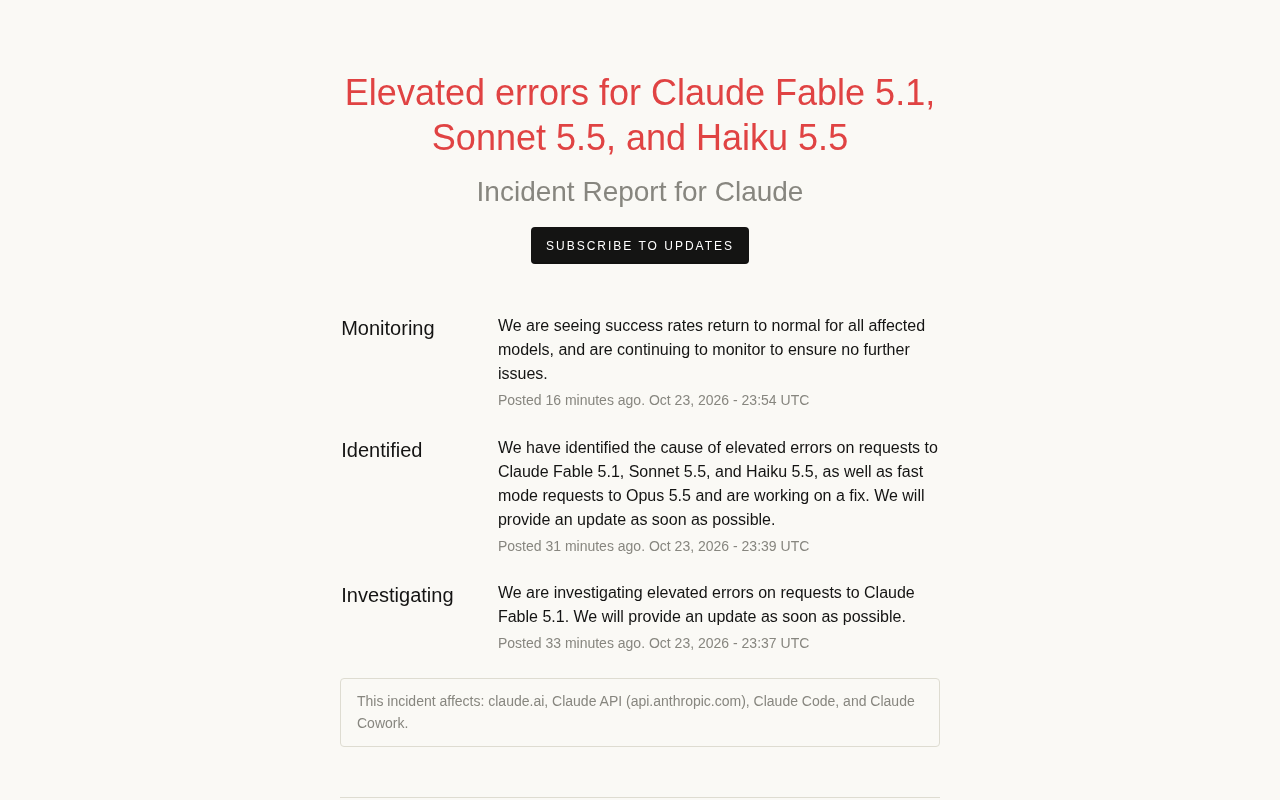
Multiple Claude Models Hit by Errors: A Postmortem of Fable 5.1, Sonnet 5.5, and Haiku 5.5
Claude Fable 5.1, Sonnet 5.5, Haiku 5.5, and Opus 5.5 fast mode saw elevated errors; Anthropic identified and resolved the issue in 17 minutes. This postmortem covers the timeline, the technical reasons for the multi-model cascading failure, and practical lessons for retry and degradation strategies.