DeepSeek V4.1 Pro Enters Testing, Gemini 4 Pro Benchmark Leaked

DeepSeek, MiniMax, Gemini new models leak or launch densely; coding and agent governance become competition focus.
The article rounds up recent dense developments in the AI model arena: DeepSeek V4.1 Pro in per-account gray-scale testing and hidden from the public selector, MiniMax M3.1 Flash preview launch focused on high concurrency and low latency, and Gemini 4 Pro benchmark leaks showing 2M token context and pricing. Google reportedly canceled Gemini 3.5 Pro at the last minute when ready, reason unknown. On developer tools, OpenScience exits beta, Cloud Plugin Eval supports plugin evaluation, the JUYA-1 lightweight decision model is open-sourced, and Microsoft's Skillout framework is open-sourced. Open source projects Paperclip and ROM focus on multi-agent governance and skill sharing respectively. Leaderboards show top closed-source models still lead, but the gap with open source and domestic models is narrowing. Overall trends point to larger context, coding workflow binding, and auditable multi-agent governance.
DeepSeek V4.1 Pro: The Hidden Testing Entry
AI model arena sees another wave of dense developments. DeepSeekAd V4.1 Pro is reportedly entering early testing, MiniMax M3.1 Flash preview launches early, and Gemini 4 Pro benchmark scores circulate on social platforms — three models from different camps appear almost simultaneously. According to a daily roundup by Bilibili creator "AI风向标", these messages mostly come from leaks or gray-scale testing, with no official follow-up yet, but they suffice to sketch several directions for the next phase of competition: higher context capacity, faster inference latency, and deep binding to coding scenarios.
According to leaked information, the model identifier DeepSeek V4.1 Pro has entered early testing on a per-account basis and is deliberately hidden from the public model selector. This "account-based gray-scale, not publicly displayed" approach usually means the team is conducting small-range real-load validation, and an official release may not be far off.
It must be emphasized that DeepSeek has not officially confirmed this news, and final specifications and launch timing remain subject to official announcements. From a product rhythm perspective, hiding the entry rather than launching publicly indicates that model capabilities or service capacity are not fully ready, and early testing is more about collecting real-scenario feedback.
Grey Release is a common gradual strategy in software and model releases: opening a new version to a small subset of users or accounts first rather than a full launch. Its purposes include validating stability under real load, collecting feedback, and controlling risk. For large models, gray-scale also helps teams evaluate inference cost, latency performance, and actual effects in specific scenarios (such as coding). Unlike public testing, gray-scale entries typically do not appear in the default model selector, and only flagged accounts can access them. This practice has precedents among vendors like DeepSeek and OpenAI, often meaning the model is close to release-ready but capacity or capabilities still need small-range confirmation.
MiniMax M3.1 Flash: Launch First, Discuss Parameters Later
Compared to DeepSeek's "hide", MiniMax chose "release". The M3.1 Flash preview is already live on TokenPlanAd, with a clear positioning: faster and lighter, built for high-concurrency, latency-sensitive workloads, and existing subscribers can call it without additional setup.
The same model has also landed on MiniMax Code for daily development scenarios, officially described as "fast and reliable", covering tasks from bug fixing to developing complete features. This "model + coding tool" combination is becoming standard; models no longer sell capabilities separately but are embedded in specific workflows.
Gemini 4 Pro Benchmark Leak and Google's Product Line Mystery
Leaked data shows Gemini 4 Pro scores 88.7% on DeepSwe V1.1, 95.3% on Terminal Bench 2.1, 86.8% on OS World 2.0, and 20% on GDeepVal AAVR, with context expanded to 2 million tokens, priced at $2.25 per million input tokens and $11.25 per million output tokens. All data are unconfirmed officially, with unknown benchmark criteria and test conditions, serving only as directional reference.
More intriguing is the product line move. A developer revealed that Google canceled Gemini 3.5 Pro at the last minute when "everything was ready for final release", with internal identifier GemDelta, and the reason for cancellation has not been officially explained.
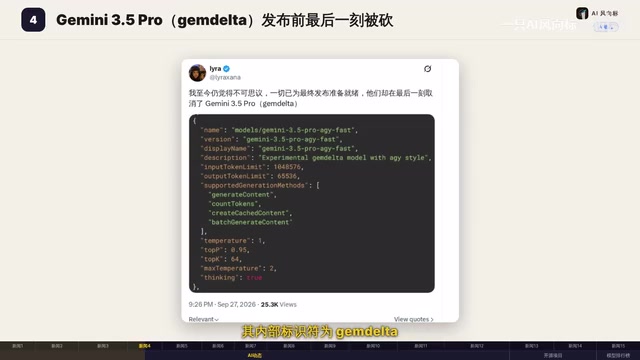
Pulling a ready model at the last moment is a high-cost decision for any team. Outside speculation focuses on two points: first, internal evaluation found the version lacked advantage relative to competitors; second, product line naming and positioning needed rework. Either way, it shows that top labs' release rhythms are being recalibrated by competitive pressure.
Another leak claims that a public production client build contains a CloudSonic 5.5 exclusive model configuration, and the same build also references CloudOpus 5.5, an identifier previously seen in the Droid 0.228.0 model registry and hidden behind a feature toggle. Sonic 5.5 is suspected to be in gray-scale testing, possibly not far from official release.
Google quietly changed the model label for NanoBanana 2.5 Flash to NanoBanana 2.1 in Flow; outsiders speculate it is just a minor version update, with no official explanation for the change, and whether capabilities changed remains to be seen. Additionally, Gemini web version reportedly supports skills functionality, and plans to convert all Gems into skills starting November 17, 2026; migration methods and compatibility details for existing Gems remain to be confirmed.
Context Window refers to the maximum number of tokens a model can process in a single inference, including input prompts and generated content. A 2 million token context means the model can read about 1.5 million English words or dozens of long documents at once, suitable for codebase analysis, long report summarization, and similar scenarios. But context expansion is not without cost: the computational complexity of attention mechanisms grows with sequence length, and inference cost and latency rise significantly. Therefore, while expanding windows, vendors usually need accompanying optimizations (such as sparse attention, chunking) to balance performance. Context capacity has become one of the key indicators in top model competition, but actual usability also depends on the model's recall and reasoning quality in long contexts.
Developer Tools: From Plugin Evaluation to Multi-Agent Governance
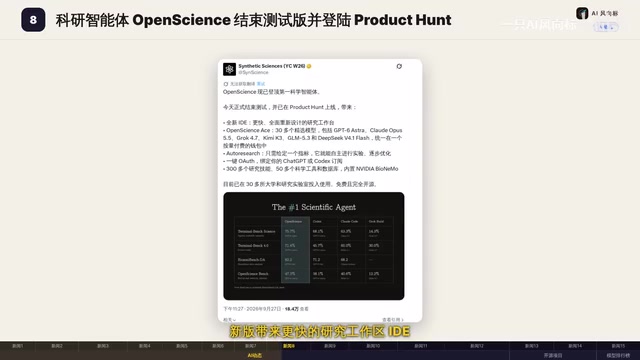
Beyond models, toolchain reinforcements are equally dense. OpenScience announced exiting beta and landing on Product Hunt; the new version brings a faster research workspace IDE and model aggregation service, covering over 30 models including GPT-6 Astra, Pimi K3, GLM 5.3, etc., sharing a pay-as-you-go wallet; Auto Research can autonomously iterate experiments given a goal. The platform has been adopted by over 30 universities, free and open source.
Cloud Plugin Eval is a new command in Cloud Code that runs a plugin against a set of test cases and scores it, then reruns each case without the plugin, visually showing the difference with and without the plugin. Developers can use this to verify a plugin's actual value, for example checking whether a paid plugin is worth it after Opus 5.5's release.
AI lab SuperSonic Labs released a lightweight decision model JUYA-1 with only 144.3 million parameters, accepting context and 2-20 candidate answers to perform classification, scoring, and yes/no judgments, usable for Agent tool selection or routing. The model is based on EmbarrassMall, with total weights of 550 MB, median single-decision latency of about 33 milliseconds on M4, training cost of about $104, and open-sourced under Apache 2.0.

Microsoft open-sourced Skillout, a self-improving skill optimization framework that evaluates an agent's task performance and rewrites its own instructions accordingly; changes that fail benchmark tests are rejected, and optimized skills can be transferred and reused across models. The code repository is public.
ChatGPT web version code shows the DOTS feature internally linked to OrbitEN and possibly O3 codename configuration items. The blogger speculates that OpenAI's next Pro-tier product may be revealed at Tuesday's developer conference, with reports that it will officially launch this Thursday, and Codex Plus users will not have access.
Multi-Agent Governance refers to unified management of roles, tasks, permissions, and resources when multiple AI agents work together. As the number of coding agents grows, teams need to solve problems like task allocation, conflict avoidance, budget control, and operation auditing. Governance frameworks typically provide role definitions, goal distribution, approval processes, and logging to ensure agent behavior is traceable and intervenable. This is fundamentally different from scattered use of a single agent: the latter requires no complex processes, while the former is indispensable in scaled collaboration. Tools like Paperclip target this need, pushing governance from "usable" to "auditable", reflecting the ecosystem's evolution from individual tools to systematic collaboration.
Open Source Projects: Multi-Agent Governance and Skill Sharing
Paperclip topped GitHub's daily trending list, adding over 2,000 stars in a single day and exceeding 85,000 total. It connects coding agents like Claude Code, Codex, and Cursor into unified management, assigning roles, goals, and tasks, and providing approval, budget, and audit records. Suitable for teams already coordinating multiple agents; if you only use one agent for scattered tasks, governance processes add burden instead.

The open source project ROM creates a shared workspace for AI agents to accumulate skills, where agents can build their own tools, and validated skills are retained long-term for later reuse. Positioned as an agent operating system for human-agent collaboration, it can serve as an open source alternative to Grobot and Meta's MUSE, with 597 stars and 52 forks.
Leaderboard: Top Tier Tight, Open Source and Domestic Models Climb
In the day's AI model capability rankings, the intelligence leaderboard is led by Cloud Opus 5.5 Max with Fallback at 58 points, with Cloud Fable 5.1 and GPT-6 Astra tied for second at 53 points. Open source and domestic models perform well: Mimo V2.6 Pro ranks ninth with 46 points, and Quan 3.8 Max ranks tenth with 45 points, both on the list.
Leaderboard scores are affected by test sets and weights and should not be directly equated with real-scenario performance, but open source models entering the top ten shows that the capability gap between top closed-source models and the open source camp is still narrowing.
Putting these developments together, several main threads are clear: context capacity advancing toward million-level tokens, coding and agent workflows becoming the main battlefield for model deployment, and multi-agent governance moving from "usable" to "auditable". Leaks and gray-scale are just the prelude; what truly deserves attention is whether these capabilities can be delivered at official release.
Related articles

Free Unlimited Claude Code Solution: Agnes AI + CC Switch Setup Guide
No paid subscription needed — pair the free AI platform Agnes AI with the open-source tool CC Switch to provide a backend for Claude Code, enabling unlimited free calls to text, image, and video models. This guide covers the full setup, test results, and usage boundaries.

A Complete Zero-Cost Guide to Getting Started with Claude Code for Beginners in China
A beginner's guide to Claude Code for users in China: two installation methods (command line and IDE plugin), full configuration steps for replacing the official API with the free domestic LongCat model, and a hands-on demo of building a small tool with natural language, plus tips.

When the NSA Gets Involved: The AI Supply Chain Crisis Behind Open-Source CVEs and API Key Hijacking
Multiple open-source projects disclosed severe CVEs in one day, PHP flaws alarmed the FBI, and Railway and OpenCode were breached with API keys stolen. This article breaks down the vulnerability window, AI-accelerated exploitation, and the AI supply chain crisis behind the API key black market, with a developer defense checklist.