Building an Open-Source Grok Bot in a Day: The Secrets of AI-Assisted Programming Verification

An independent developer built the open-source AI assistant Rakazo in a day, backing 3,700 stars and a hundred contributors with planning and verification.
The article describes how an independent developer built Rakazo, an open-source Grok Bot alternative, in a single day, reaching 3,700 GitHub stars, 100 contributors, and 1,200 merged PRs. Its value isn't speed but a reusable AI-assisted programming methodology: spend about an hour with AI to finalize structure and interfaces, use the /goal command to keep AI executing until the checklist is complete, then run a security scan. The product adheres to three principles—cross-platform sync, support for any model, and no reliance on third-party services—written into agents.md. Maintenance relies on automatic PR screenshots, scheduled AI agent review, and auto-merging. Core conclusion: trusting AI requires an engineered verification system that makes AI continuously prove itself.
An independent developer built the open-source Grok Bot project Rakazo in a single day. It has now gained 3,700 stars on GitHub, attracted 100 contributors, and merged 1,200 PRs—all without a full-time maintainer. The value of this case isn't its speed, but the reusable AI-assisted programming methodology it reveals—and that methodology boils down to one word: verification.
What Rakazo Is: Keep Complexity for Yourself, Leave Simplicity to Users
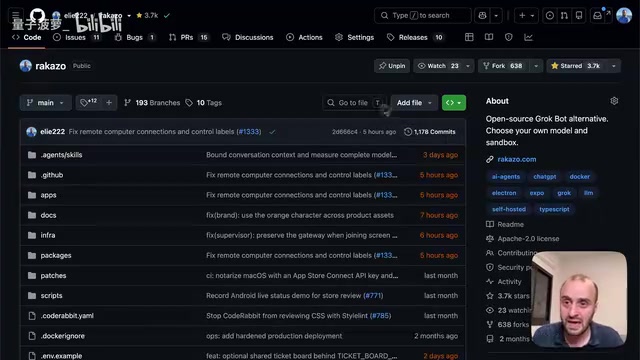
According to a video shared on Bilibili, Rakazo is an open-source AI assistant project under the Apache license that supports self-hosting and is currently completely free. Its positioning is clear: lower the barrier to using an AI assistant. Assistant products like OpenClawAd and Hermes already existed, but their setup process was quite cumbersome. Rakazo encapsulates all the complexity behind the scenes—users just chat.
Each bot has its own computer (either shared or on a dedicated machine), supports desktop, mobile, and web, and data syncs automatically in the cloud. The project also includes built-in automation capabilities like Routine, so users don't have to manually adjust settings. One user noted that while Hermes is good, its configuration is more complex, whereas Rakazo's multi-agent workflows are cleaner; another said it has completely replaced the Grok Bot they previously used.
The Underlying Logic of a One-Day Build: Plan First, Then Let Go
The developer emphasized a step that is easy to overlook: planning. Many people assume that in the AI era planning is unnecessary—just tell the model to "go build a product" in one sentence. But for a complex cross-platform project like Rakazo, that approach will most likely stall halfway through. His method was to first spend about an hour discussing the overall structure, code reuse approach, and interface design with the AI, then move into the execution phase.
The UI came together quickly with the help of design tools, since Grok Bot had already validated the interaction patterns and there was no need to innovate on UX. He then used the /goal command to keep the AI working until every item on the checklist was checked off—he ran this process twice, and the first run went all night. Finally, he used a security scanning tool to check for vulnerabilities and further harden quality.
Three Product Principles: Maximum Flexibility
From day one, Rakazo established several non-negotiable principles, written into the project's agents.md, that any contributor adding a new feature must follow.
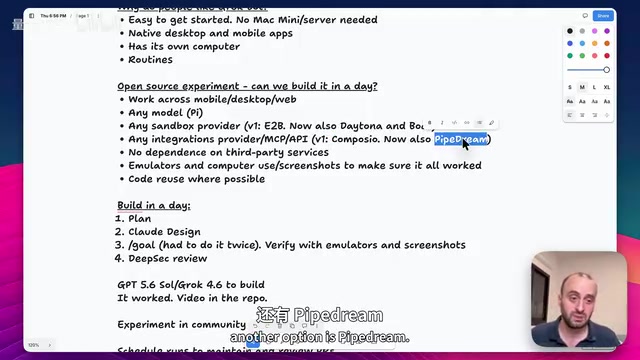
Cross-platform sync is a hard requirement: mobile, desktop, and web must connect seamlessly. Support for any model is equally critical: ChatGPT subscriptions, OpenRouter, Claude API keys, and local LLMs should all work—users shouldn't be locked into a particular tech stack. No dependence on any third-party service is reflected in the choice of sandbox providers and integration libraries—whether AWS, Daytona, E2B, or Box, whether Composio or another integration solution, everything should work out of the box rather than forcing users onto a single vendor.
This "interface isolation" design approach makes it easy to add new providers later. If the product had been hard-wired to a single service from the start, migration would be extremely painful down the road.
Verification Is the Ultimate Trick: Screenshots and Emulators
Throughout the talk, the developer repeatedly stressed one point: verification determines success or failure. The key difference between "people who push AI to its limit" and "people who are still struggling" isn't blind trust in the model—it's making the AI prove that it actually completed the work.
His specific approach was to require the AI to provide a screenshot of every page of the product, with no guessing or assuming that a feature works. No screenshot means the goal isn't met, and it must keep going. This constraint also makes it clear to the AI itself what counts as "done."
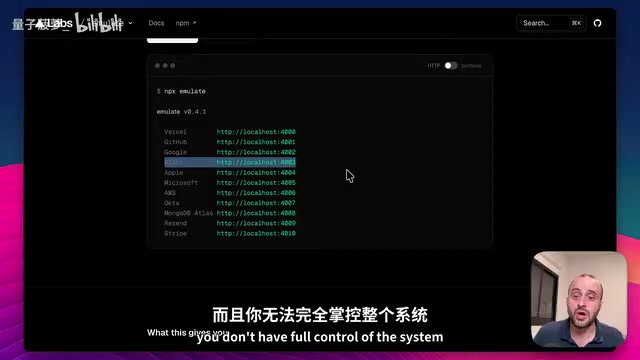
The real difficulty lies in the fact that third-party services are hard to test. AI can run Postgres and Redis on its own, but logging into Gmail to send email gets blocked by Google, and calling Slack or Stripe runs into rate limits and authentication issues. That's where emulators become the key solution: these tools provide a simulated service locally with an in-memory database. For example, sending a message to a simulated Slack returns 200, creating a GitHub repository gets remembered, and sending email or charging a payment preserves state across requests. According to the developer, solutions like emulate.dev, LocalStack, and Flowkey have existed for a while; in the past, faking a version of every third-party service was costly, but now AI can scrape API docs from a website and mimic them itself, making this far easier. For services like Composio that don't have an off-the-shelf emulator, he simply had the AI write one.
Along with emulators, he used tools like Maestro to have the AI tap the screen and verify via screenshots the actual behavior on desktop, web, and mobile—verification that is hard to fake. In his experience, he used GPT 5.6 Sol during the planning phase and Grok 4.6 during the build phase; models iterate extremely fast, but models from a few months ago could already handle this task.
Emulators and Local Simulation Services
An emulator refers to a lightweight service running on the developer's local machine that mimics the behavior and response format of a third-party API, but uses an in-memory database or temporary storage behind the scenes and produces no real external calls. For example, a simulated Slack service returns a 200 status code and stores the message in memory after receiving a send-message request; a simulated GitHub service "remembers" newly created repositories; and a simulated payment service can preserve charge state across multiple requests. This allows an AI agent to walk through the entire business flow in a fully offline environment without real credentials, avoiding OAuth authentication, rate limits, and sandbox egress restrictions, while also making test results repeatable and assertable.
Common open-source solutions include LocalStack (which simulates multiple AWS services) and emulate.dev (which provides local emulation of various SaaS APIs). In the past, hand-writing an emulator for every third-party service was costly, requiring reading documentation and implementing state management; but by having large models scrape API docs directly and generate emulation code, that barrier has dropped dramatically, making "building a local stand-in for every external dependency" a viable engineering practice.
Maintaining an Open-Source Project with 100 Contributors: An Automated PR Pipeline
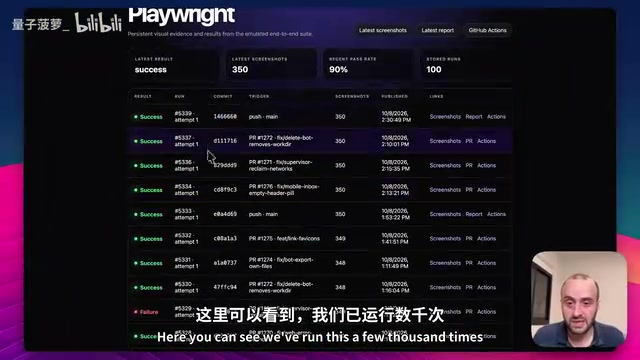
After launch, the maintenance approach itself is worth noting. Every PR automatically generates screenshots—350 so far—covering the marketing page, login page, dark mode, mobile, and various other screens. The developer doesn't need to run the project locally; a glance at the screenshots is enough to spot UI anomalies. GitHub Actions is essentially free for open-source projects, keeping the cost of the whole pipeline manageable.
Even more aggressive is the auto-merge mechanism: an agent based on Grok or Claude wakes up every few hours, checks newly opened PRs, and decides on its own which ones can be merged. Simple bug fixes are merged directly, while large features wait for human approval with screenshots attached. Even auto-merges aren't blind—all submissions go through review and cleanup, and malicious PRs can't get through directly. There are also scheduled tasks that automatically remove redundant UI copy and explanatory text.
GitHub Actions and Automated PR Review
GitHub Actions is GitHub's built-in CI/CD service that lets you define workflows in a repository and automatically run scripts when events like pushes, pull requests, or scheduled tasks trigger. For public repositories, GitHub offers a generous free tier, which makes "automatically build, automatically screenshot, and automatically run tests for every PR" almost cost-free.
In this project, Actions is used to launch the app on every PR submission, capture screenshots of each page with a headless browser or emulator, and attach the images as PR comments or artifacts. Maintainers don't need to pull the code and run it locally—screenshots alone are enough to judge whether the UI is broken. Combined with scheduled agent workflows, this enables a pipeline that "scans new PRs every few hours and decides whether they can be auto-merged." This model extends GitHub from a code hosting platform into an automated quality gate and collaboration hub—key infrastructure for supporting a hundred contributors without a full-time maintainer.
Takeaways for Developers
The Rakazo case shows that a product that once would have taken a 20-person team a year to build can now have its first version completed in a day. But that doesn't mean models can do anything—the real leverage lies in an engineered verification system: clear planning, interface-isolated design, emulator-backed offline testing, and screenshot review running through the entire PR lifecycle. The prerequisite for trusting AI is making it continuously prove itself.
As the developer said at the end of the talk, the people who push AI the furthest are often those who trust it—and whose imaginations are the biggest. What seemed impossible a year ago is achievable today.
One-line Summary
An independent developer built the open-source AI assistant Rakazo in a day, backing 3,700 stars and a hundred contributors with a planning-and-verification methodology.
Paragraph Summary
The article describes how an independent developer built Rakazo, an open-source Grok Bot alternative, in a single day, and how it reached 3,700 GitHub stars, 100 contributors, and 1,200 merged PRs. The author argues its value isn't speed but a reusable AI-assisted programming methodology: first spend about an hour with AI to nail down structure and interfaces, then use the /goal command to keep AI executing until the checklist is complete, and finally run a security scan. At the product level, it adheres to three principles—cross-platform sync, support for any model, and no dependence on third-party services—written into agents.md. Maintenance relies on automatic PR screenshots, scheduled AI agent review, and auto-merging. The core conclusion: the prerequisite for trusting AI is an engineered verification system that makes AI continuously prove itself.
Related articles

Amphibious Transforming Drone: Beyond 100x Power Savings, What Are the Real Needs?
Is the amphibious transforming drone just a gimmick? Starting from the 100x power difference of the M4 Morphobot, explore real application scenarios and thesis topic ideas, analyzing boundary conditions where pure drones and pure ground robots both fail.

Warhound Raises $200 Million: Genetically Engineered "War Dogs" Paired with Anduril Gear
Warhound raises $200M, backed by Ben Lamm and Palmer Luckey, to genetically engineer dogs for military and law enforcement use and equip them with Anduril gear. This article analyzes its technology direction, funding logic, and ethical controversy.

Claude API Comes to Google Cloud: IAM Integration and SDK Access Guide
Anthropic hosts the full Claude API on Google Cloud with IAM-controlled permissions and unified billing. This guide covers the Vertex AI and Anthropic-hosted entry points, IAM role configuration, and SDK access.