Building Collaborative AI Agent Teams with YAML: A Docker Agent Deep Dive

Docker Agent replaces agent code with YAML config, making multi-agent systems as manageable as container infrastructure.
Docker Agent introduces a YAML-first paradigm for multi-agent development. Developers describe agent roles, choose models, write instructions, and attach tools entirely in config files — no framework code required. Configs are Git-native, reviewable, and shareable. For complex tasks, multiple specialist agents collaborate via automatic delegation. The system supports built-in tools and MCP servers, and is compatible with OpenAI, Anthropic, Gemini, and Docker Model Runner, avoiding vendor lock-in.
Replacing Agent Code with Declarative Configuration
Building multi-agent systems typically involves a lot of glue code: defining roles, binding models, registering tools, and orchestrating collaboration logic. Docker Agent takes a different approach — describing the entire agent team through YAML declarative configuration, without writing agent code by hand.
The core idea is straightforward: describe an agent, choose a model, write its instructions, and attach the tools it needs. All of this lives in a single declarative configuration file. For developers familiar with Docker Compose, the experience is nearly seamless — you define the structure, and the runtime handles bringing it to life.
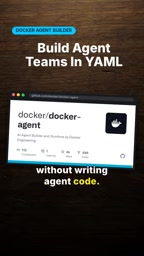
The most immediate benefit of this approach is a lower barrier to entry. You don't need to understand a framework's class hierarchy or callback mechanisms — as long as you can express an agent's responsibilities in natural language and configuration, you can get it running.
Versionable and Shareable Configuration
Writing agent definitions as YAML naturally brings them into an engineering-friendly workflow. Config files can be committed to Git, reviewed in pull requests, copied and shared across teams, and tracked as they evolve over time.

This is especially valuable for team collaboration. When agent behavior is baked into code, adjustments typically require developer involvement. When it exists as configuration, product managers, operations staff, and even non-engineering roles can participate in tuning agent behavior. Configuration becomes documentation — a single YAML file clearly communicates who this agent is, what model it uses, and what it can do.
Multi-Agent Collaboration for Complex Tasks
A single agent can only handle so much. Docker Agent's design lets you create multiple specialized agents for complex tasks, with automatic delegation between them.

This is a common but effective architectural pattern: a lead agent handles task decomposition and scheduling, while a set of specialist agents each own a subdomain — one for retrieval, one for code generation, one for result validation, for example. Delegation relationships are declared in configuration, and the runtime handles task distribution automatically, so developers don't need to write orchestration logic by hand.
This "team" style of organization gives you more control than pushing all responsibilities onto a single large model, and it's also easier to debug: when output goes wrong, you can pinpoint exactly which specialist agent's step produced the deviation.
This lead-plus-specialist architecture is commonly known in AI engineering as the "Orchestrator-Worker" or "Multi-Agent" pattern. Its core advantage lies in context narrowing through task decomposition: each specialist agent only needs to focus on its own subdomain, carries fewer tools and less context, and the model's attention within a limited context window is more focused — often producing better output quality than a single model shouldering all responsibilities. The automatic delegation mechanism means the lead agent can dynamically decide which sub-agent to call based on task content, and this routing logic itself can be inferred by the model from its instructions, without developers hard-coding every dispatch rule. The debuggability of this pattern is equally noteworthy — the input and output at each hop in the chain can be observed independently, making fault isolation far more granular than debugging the internal reasoning of a monolithic model.
Tool and MCP Integration
An agent's real value comes from the tools it can invoke. Docker Agent supports connecting built-in tools as well as MCP (Model Context Protocol) servers, including Docker-based MCP services.
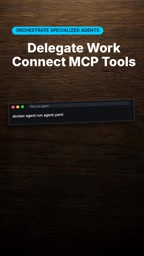
MCP, which has gradually become a de facto standard for tool integration, allows agents to access external capabilities through a unified interface. Running MCP services as containers with Docker fits perfectly with the overall "define and run" philosophy of the solution: both tools and agents are declared and launched within the container environment.
On the model side, Docker Agent isn't locked to a single vendor — it's compatible with OpenAI, Anthropic, Gemini, and Docker Model Runner. This means you can choose different model backends for different agents based on task characteristics and cost considerations, without being locked into any single provider.
MCP (Model Context Protocol) is an open protocol proposed and championed by Anthropic in late 2024, designed to give large language models a standardized way to access external tools, data sources, and services. Before MCP, different AI frameworks implemented tool-calling in their own incompatible ways, making it difficult to reuse tools across agent systems. MCP defines a unified client-server communication specification so that any MCP-compatible agent can directly invoke capabilities exposed by any MCP server — whether that's filesystem access, database queries, or third-party API calls. Running MCP services as Docker containers adds isolation and portability on top of that: each tool service has its own independent runtime environment with no dependency conflicts, and can be started with a single command on any machine with Docker installed — fully aligned with the declarative configuration philosophy.
An Engineering-First Approach to Agent Development
Taken together, this solution conveys a clear perspective: agent development should be managed like infrastructure — declarative, reproducible, and versionable.
The entire workflow can be summarized as: define your setup, run it with Docker. This aligns closely with the workflows developers have already internalized in the container era, adding almost no extra cognitive overhead.
For teams evaluating multi-agent frameworks, this YAML- and Docker-centric approach is worth serious consideration. It doesn't aim to provide the most powerful programming abstractions — instead, it makes "getting an agent team running and keeping it maintainable long-term" genuinely simple. If it fits your existing workflow, it's worth heading to the repository and giving it a try.
Related articles

CSS Anchor Positioning: A New UI Positioning Approach Without JavaScript
A deep dive into CSS Anchor Positioning: from anchor-name and position-anchor to the anchor() function, position-area shorthand, position-try-fallbacks, anchor-size, and upcoming anchor queries.

New AI Chart Interaction: Continuous Follow-up Questions and Visualization in Conversation
Explore a new AI interaction method for continuously generating charts in conversation. Use the /visualize command to ask follow-up questions and visualize answers in the same chat window, improving data analysis efficiency.

Cursor Merges Into X Subscription: Paid Plans Share Unified Usage Pool, Grok Model Coding Usage Doubled
Cursor joins The X Subscription with a unified usage pool and doubled Grok coding quota. Third-party models shift to API pricing. Existing users can keep or migrate plans.