Building RL-Powered Autonomous Research Agents with NVIDIA NeMo
Building RL-Powered Autonomous Researc…
NVIDIA NeMo uses RL-trained agent skills to build autonomous ML research workflows.
NVIDIA's NeMo-based Autoresearch approach combines reinforcement learning with modular Agent Skills to build agents that can autonomously plan, execute, and iterate on machine learning experiments. By training agents in an RL Gym sandbox and integrating with NeMo's scalable infrastructure, the system closes the loop from task planning through environment setup to feedback-driven optimization.
From Code Assistant to Autonomous Research Operator
AI coding agents are evolving from simple code completion tools into full-fledged operators capable of handling long-horizon machine learning workflows. They're no longer limited to generating code snippets — they can inspect repositories, configure runtime environments, resolve dependency conflicts, and drive complex task chains toward their goals.
The core logic behind this shift: machine learning research is inherently iterative and requires repeated trial and error. Researchers design experiments, tune hyperparameters, run training jobs, analyze results, and iterate based on feedback. This closed loop is precisely where autonomous agents can deliver value — once an agent can make independent decisions and execute actions across these stages, it can dramatically accelerate the research cycle.
NVIDIA's latest technical approach centers on combining reinforcement learning (RL)-powered agent skills with the NeMo framework to build a practical "Autoresearch" workflow.
Why Reinforcement Learning Is the Key to Upgrading Agents
From One-Shot Execution to Continuous Policy Optimization
Traditional LLM-based agents primarily rely on the general capabilities of pretrained models and prompt engineering to complete tasks. This approach often struggles with open-ended, multi-step research tasks — models lack a continuous optimization mechanism for specific environments and tend to drift off course or get stuck in unproductive loops during long-horizon tasks.
Reinforcement learning (RL) provides a critical complement. As one of the three major paradigms in machine learning, RL's core mechanism draws from operant conditioning in behavioral psychology: an agent interacts with an environment, receives reward or penalty signals, and adjusts its behavior policy accordingly — ultimately learning to maximize cumulative reward in a given setting. Unlike supervised learning, which relies on labeled data, RL doesn't require human-provided "correct answers"; instead, the agent discovers optimal behavior through trial and error. In recent years, deep RL has achieved breakthroughs in Go, video games, and robotics, and has deeply influenced LLM alignment training through RLHF.
By placing agents in an interactive "RL Gym" environment — a concept originating from OpenAI's open-source standardized RL training framework, extended in the research agent context to a sandbox designed for code execution and ML workflows — agents can experiment extensively in low-risk conditions: executing code, triggering errors, receiving execution results as reward signals, and learning to handle dependency conflicts, memory overflows, API failures, and other real-world exceptions. Through this training, agents progressively acquire more effective "Skills" — not static rules, but transferable behavioral patterns distilled through training.
Agent Skills: Reusable Modular Capability Units
The "Agent Skills" concept in NVIDIA's approach deserves special attention. It decomposes agent capabilities into modular units: each skill corresponds to a specific category of tasks, such as repository inspection, environment configuration, or error diagnosis. After RL training, these skills can be repeatedly invoked and flexibly combined in real research workflows to build more complex autonomous behavior chains.
The core value of modular design lies in reusability and composability — research teams don't need to train agents from scratch for every new task. Instead, they reuse existing skills to rapidly assemble workflows for new scenarios, significantly reducing development costs.
NeMo's Role in Autonomous Research
NVIDIA NeMo (Neural Modules) is NVIDIA's open-source generative AI development framework, with "neural modules" as its core abstraction unit. Modules are connected via directed acyclic graphs (DAGs), enabling highly flexible model composition. In the era of large models, NeMo integrates deeply with Megatron-LM, supporting advanced distributed training strategies such as tensor parallelism and pipeline parallelism, efficiently handling model training at the scale of hundreds of billions of parameters.
In this approach, NeMo serves as the infrastructure layer for model training and deployment, providing end-to-end capabilities from model fine-tuning and RL training to inference deployment — allowing developers to manage the complete agent lifecycle within a unified technology stack.
Integrating RL workflows into NeMo delivers three practical advantages:
- Training-inference consistency: The agent's training environment closely mirrors its deployment runtime, effectively reducing performance loss from the "Train-Deploy Gap" — a classic engineering challenge where models degrade due to data distribution shifts, software dependency version differences, or hardware instruction set variations between training and deployment. NeMo systematically mitigates this through a unified runtime abstraction layer.
- Scalable training capacity: Leveraging NVIDIA's GPU-accelerated ecosystem, long-horizon, large-scale RL training becomes genuinely feasible.
- Full-stack toolchain integration: Every stage from data processing to model evaluation can operate in concert within the same framework.
How the Autonomous Research Workflow Actually Operates
A typical autonomous research workflow consists of three core stages:
Task Understanding and Planning
The agent first receives a research objective — for example, "find the best-performing model configuration on a given dataset." It then decomposes this high-level goal into a series of executable subtasks and formulates an initial execution plan.
Environment Setup and Autonomous Execution
The agent independently inspects the codebase, installs dependencies, configures the runtime environment, and launches experiments. Along the way, it encounters real-world challenges — dependency conflicts, environment incompatibilities, code errors. RL-trained skills enable it to autonomously diagnose and resolve these issues rather than stalling.
Result Analysis and Feedback-Driven Iteration
Once experiments complete, the agent analyzes results and assesses whether the objective has been met. If results fall short, it proactively adjusts its strategy based on feedback — modifying hyperparameters, switching model architectures, or refining data processing pipelines — and enters the next iteration.
It's worth noting that hyperparameter tuning and architecture search are core topics in AutoML, where traditional methods include grid search, Bayesian optimization, and neural architecture search (NAS). Autonomous research agents take these methods a step further: rather than just executing predefined search strategies, they can dynamically adjust search directions based on intermediate experimental results. This essentially internalizes AutoML's decision logic as a reinforcement learning policy. The closed loop is a natural fit for the RL paradigm: every experimental result serves as a reward signal, driving the agent to continuously improve its decision quality.
Significance and Outlook
This approach represents an important direction in AI agent development: moving from assistive tools to autonomous executors. When agents can independently complete long-horizon, high-complexity machine learning experiments, they will dramatically lower the barrier and cost of research — freeing researchers from tedious engineering details to focus on higher-level creative exploration.
That said, autonomous research agents still face significant real-world challenges. Reward function design is one of the most critical technical hurdles: the reward function defines how agent behavior is evaluated, and poor design leads to "reward hacking" — where the agent finds behavior paths that score well on the reward function but are actually meaningless or even harmful. In research automation, the ultimate goals of science (discovering new knowledge, improving model performance) are difficult to quantify precisely. The tension between short-term measurable metrics and long-term research value makes reward function design both a technical problem and a deeper question about what research itself means.
Beyond that, building reliable training environments, ensuring dependability and safety in real-world settings, and guaranteeing that agent decision-making is interpretable and auditable are all important prerequisites for deploying these systems in serious research contexts.
For developers looking to explore this frontier, NVIDIA's NeMo-based approach offers a relatively complete technical path — organically combining reinforcement learning, Agent Skills, and mature AI infrastructure to lay a solid foundation for building practical autonomous research systems. As these technologies continue to mature, the era when AI doesn't just assist research but actively drives it may already be within reach.
Key Takeaways
Related articles

Code with Claude Event: AI-Powered Creative Experiments on Tiny Computers
At Code with Claude, Anthropic gave participants tiny computers to build creative projects with AI assistance, showcasing how AI coding tools empower the maker community.

Claude Code Adds Agent View: A Research Preview for Unified Session Management
Claude Code's new Agent View feature (research preview) consolidates all coding sessions into a unified list, advancing AI tools toward multi-agent orchestration.
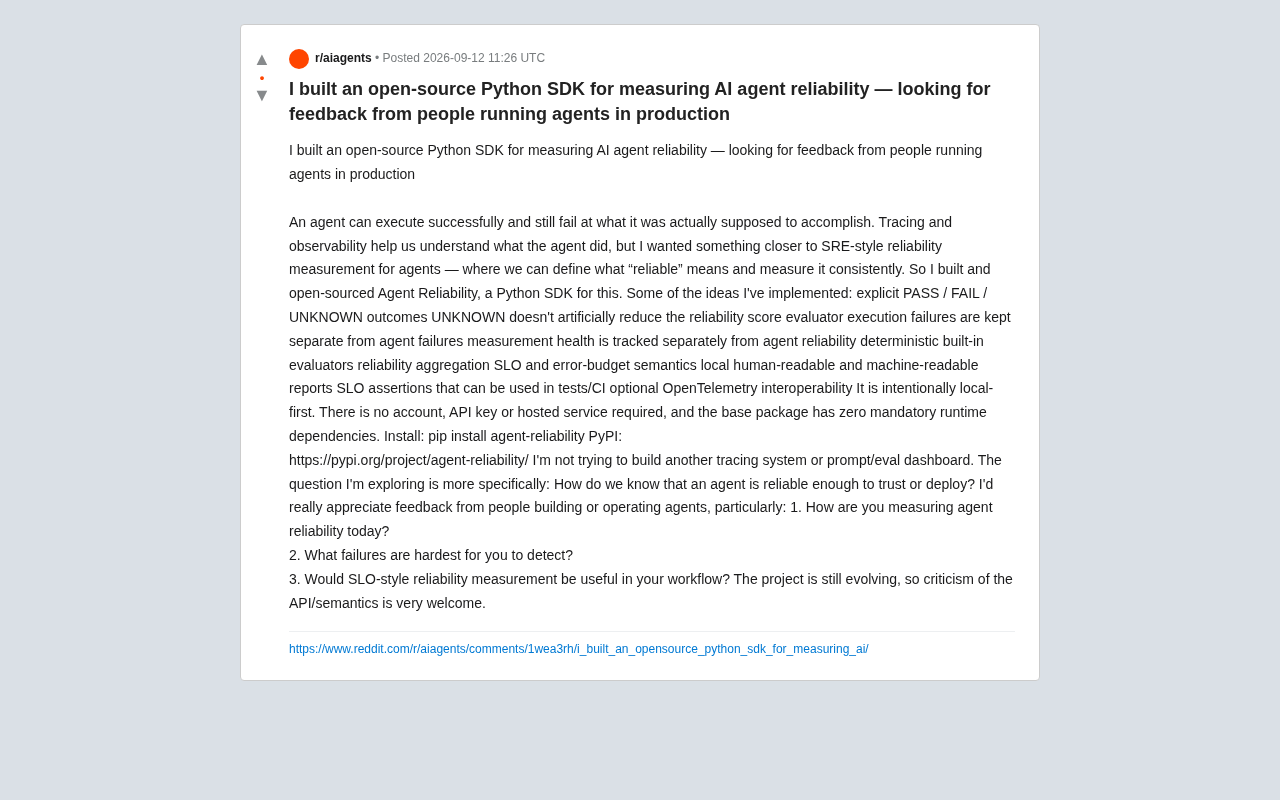
Open-Source Python SDK: Measuring AI Agent Reliability with SRE Principles
Agent Reliability is an open-source Python SDK that applies SRE's SLO and error budget concepts to AI Agent evaluation, with PASS/FAIL/UNKNOWN states, CI assertions, and zero forced dependencies.