Bullet Programming Agent: Deep Dive into the AI Coding Tool That's 60% Faster Than Claude Code

Bullet achieves 60% faster AI coding than Claude Code through engineering optimizations while scoring 95.8% on SWE-bench.
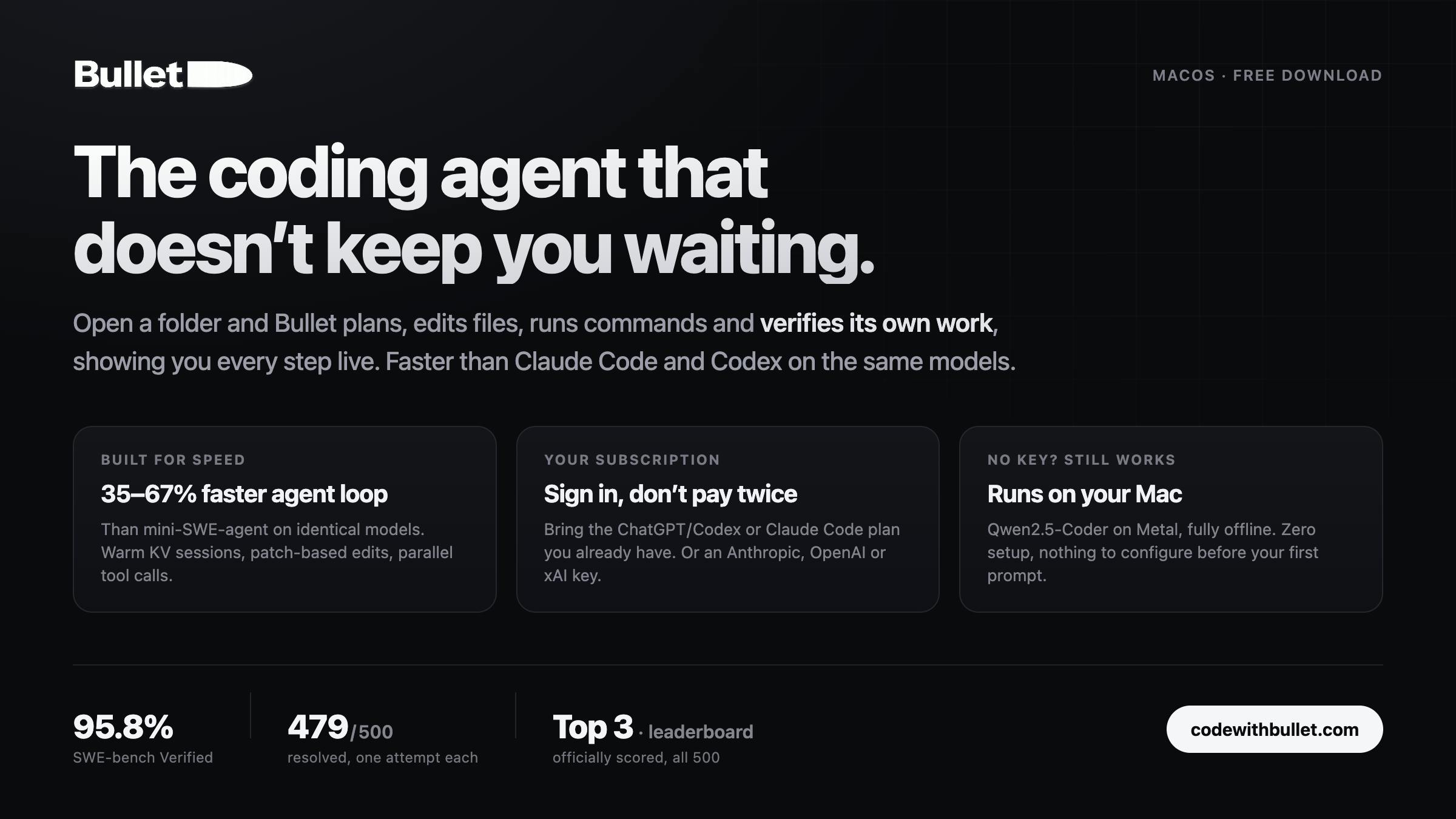
Bullet is a new programming agent that tackles the speed bottleneck in AI-assisted coding. Through three core strategies — automatic model/reasoning selection, parallel processing, and targeted code search — it claims 30%-60% faster performance than Claude Code and Codex. With a 95.8% SWE-bench Verified score (top 3) at 119 seconds per task, it demonstrates that speed and quality aren't mutually exclusive. Built by a Yale/AppLovin/Citadel team, it supports existing subscriptions and local models.
The New Battleground for Programming Agents: Why Speed Has Become Critical
As LLM-assisted programming evolves from a novelty into an everyday tool, developers' priorities are quietly shifting. In the early days, the competition was about whether models could write correct code. Now, more and more engineers are frustrated by a different problem: waiting too long for agents to complete tasks.
Bullet, a programming agent that recently launched on Product Hunt, targets exactly this pain point. Its tagline is straightforward — "30%-60% faster than Claude Code and Codex." After launch, it received 114 upvotes and ranked #5 on the daily leaderboard, emerging as a new contender in the developer tools and "Vibe Coding" space.
The concept of "Vibe Coding" was coined by AI researcher Andrej Karpathy in early 2025, describing an entirely new programming paradigm: developers no longer write code line by line but instead describe their intent to AI in natural language, letting the agent generate complete implementations while they review and guide. Under this paradigm, the developer's role shifts from "code writer" to "intent communicator" and "quality reviewer," and the efficiency bottleneck moves from "speed of writing code" to "speed of AI understanding and execution." This is precisely why agent response latency has become such a critical UX metric — when a developer's primary job becomes waiting for AI to finish tasks, every second of waiting disrupts their flow state.
Why Bullet Is Faster Than Claude Code: The Problem Lies in the "Loop"
Bullet's team offers a core insight that's quite illuminating. In their introduction, they write: "We got tired of spending hours waiting for agents to run. The models are fine, but the loop around them is too slow."
This statement identifies a structural bottleneck in current programming agents. The "loop" refers to the complete workflow an agent follows when executing tasks: understanding requirements, searching code, reading files, executing commands, verifying results, and then iterating again.
From a technical perspective, this loop is essentially an iterative decision-making process based on the ReAct (Reasoning + Acting) paradigm. After receiving user instructions, the agent enters a repeated cycle of "think → act → observe": the LLM reasons about the next operation, executes it (such as reading a file, running a terminal command, or calling a search), then feeds the results back to the model for the next round of reasoning. A seemingly simple bug fix might require 10-30 rounds of this cycle. Each round involves at least one model API call (typically 1-5 seconds of latency), one or more file system operations, and potentially waiting for command execution. These steps are executed serially by default because each subsequent step often depends on the previous step's results — an architecture that causes total time to grow linearly with the number of cycles.
In this chain, the time actually spent calling the LLM for reasoning is often just a small fraction. Much of the time is consumed by serial searching, reading, and waiting. In other words, even when using the same underlying Claude or GPT models, the quality of engineering implementation directly determines end-to-end efficiency. Bullet chose to optimize the "loop" itself rather than pursuing a more powerful model.
Bullet's Three Core Speed Strategies
According to official documentation, Bullet's speed improvements come from three engineering optimizations:
-
Automatic model and reasoning level selection: Bullet automatically selects the appropriate model and reasoning intensity based on each prompt's complexity. Simple tasks don't need the deepest reasoning from the most powerful model, saving both time and cost.
The technical logic behind this is that modern LLMs typically offer different reasoning modes and computational budgets. For example, OpenAI's o3 series models support low, medium, and high reasoning intensities — the higher the intensity, the longer the internal chain-of-thought before answering, consuming more tokens and time. Claude similarly has standard mode and extended thinking mode. For simple variable renaming or formatting tasks, using high reasoning intensity not only wastes time (potentially stretching a 1-second task to 10 seconds) but also increases API call costs. For tasks involving complex logic refactoring or cross-file dependency analysis, low reasoning intensity might lead to errors, requiring more correction cycles. Intelligently routing at the task level is an engineering strategy for finding the optimal balance between cost, speed, and quality — similar in spirit to Mixture of Experts (MoE), but implemented at the system orchestration layer.
-
Parallel processing: Search, file reading, command execution, and other operations are parallelized rather than processed sequentially. This is the most direct way to compress loop time.
-
Targeted code search: Bullet uses targeted code search rather than embedding the entire repository.
Traditional RAG (Retrieval-Augmented Generation) approaches split the entire codebase into code chunks, convert each chunk into high-dimensional vectors via embedding models, and store them in vector databases. When a user asks a question, the system converts the question into a vector, retrieves the most relevant code snippets via cosine similarity, and provides these snippets as context to the LLM. The problem with this approach is that semantic relationships in code are far more complex than natural language — function call chains, inheritance hierarchies, and module dependencies are easily lost in vector space. Additionally, building a complete index for large repositories requires substantial computational resources and time, and the index needs continuous updating as code changes. Bullet's targeted search likely leverages AST (Abstract Syntax Tree) parsing, symbol reference tracking, grep pattern matching, and other structure-aware methods to locate relevant code, which is often more precise and faster in large codebases.
SWE-bench Test Results: 95.8% Ranking in the Top Three
Beyond speed, Bullet hasn't sacrificed coding capability. The team's published data shows it achieved 95.8% on the SWE-bench Verified benchmark, ranking in the top three, with an average of 119 seconds per task.
SWE-bench was released by a Princeton University research team in 2023 and is the first large-scale benchmark based on real software engineering tasks. It collected 2,294 real GitHub issues and their corresponding pull requests from 12 popular Python open-source projects (including Django, Flask, scikit-learn, and others). SWE-bench Verified is a human-reviewed curated subset ensuring each task has a clear problem description and verifiable test cases. Agents must autonomously locate relevant files within complete code repositories, understand context, write patches, and pass unit tests. The benchmark's difficulty lies in requiring not just code generation ability but understanding, navigation, and reasoning over large codebases. In early 2024, top agents had pass rates below 30%; by mid-2025, multiple systems had broken through 90%, reflecting rapid progress in the field.
A 95.8% pass rate means Bullet has reached first-tier performance in solving real engineering problems, while the 119 seconds/task speed confirms its "fast" positioning. The value of these numbers lies in demonstrating that speed and quality aren't a zero-sum game — through smarter engineering design, you can significantly reduce time while maintaining high accuracy.
Compatible with Claude Code and Codex Subscriptions: Minimal Migration Cost
Bullet takes a pragmatic approach to usage. It supports multiple access modes:
- Reuse your existing Claude Code or Codex subscriptions
- Use your own API keys
- Support for on-device local models
This design means developers don't need to take on an additional subscription cost to try Bullet — they can use it directly on top of their existing accounts. For teams already deeply reliant on Claude Code or Codex, the migration barrier is minimized.
The local model support is also noteworthy. In enterprise environments with increasingly strict data privacy and compliance requirements, a programming agent that can run locally has unique appeal, even though local models typically have lower capability ceilings than cloud-based flagship models.
Team Background: From Yale, AppLovin, and Citadel
Bullet was built by a team with Yale University computer science backgrounds, with members who previously worked at AppLovin and Citadel. AppLovin is a mobile advertising technology platform valued at over $100 billion, whose core competitive advantage lies in real-time bidding systems — making ad-matching decisions within millisecond-level latency while handling millions of requests per second. Citadel, founded by Ken Griffin, is one of the world's top quantitative hedge funds, managing over $60 billion in assets. Its technical infrastructure pursues nanosecond-level trade execution speed — in high-frequency trading, microsecond differences in latency can determine millions of dollars in profit or loss. Engineers trained at these companies typically have an almost obsessive pursuit of performance optimization, with expertise in concurrent programming, memory management, network stack optimization, and other low-level technologies. This technical DNA is directly reflected in Bullet's product design — treating performance optimization of the programming agent as the core differentiator.
From a broader perspective, Bullet's emergence represents a new phase in programming agent competition. As products' underlying models become increasingly homogeneous (everyone is calling similar flagship models), true differentiation is shifting to the engineering orchestration layer: how to schedule models, how to parallelize execution, and how to efficiently retrieve context. This is a battlefield that favors systems engineering over model training, and it gives independent teams more opportunity to compete head-to-head with tech giants.
Is Bullet Worth Using: Strengths and Areas Still to Be Verified
For developers who use AI programming tools daily, Bullet offers a clear value proposition: dramatically faster speed without sacrificing quality. Its compatibility design also makes the trial cost extremely low.
However, the "30%-60% faster" claim still comes from the vendor itself, and actual experience will vary depending on project scale, task type, and network environment. While the high SWE-bench score is impressive, there's always a gap between benchmark tests and real development scenarios. Interested developers should conduct small-scale validation with their actual workflows before deciding on deep adoption.
Regardless, Bullet reminds the entire industry of an easily overlooked truth: as model capabilities approach saturation, "wait time" is becoming a critical variable in developer experience — and engineering innovation around this point has only just begun.
Related articles

macOS Is No Longer UNIX: Apple Didn't Renew Certification, But the Technology Is Unchanged
Apple did not renew macOS's UNIX certification, and the Open Group has removed Apple's entry. This article analyzes the technical reality behind the expiration, Apple's possible intentions, and the practical impact on developers.

Building Stateful Multi-Agent Systems with Azure Cosmos DB
Based on the official Azure Cosmos DB tutorial, this article explains how to use the Agent Memory Toolkit to add shared persistent memory to a multi-agent travel planner, covering short-term, long-term, episodic, and semantic memory plus cross-session state continuity.

Production AI Agent Operations: A Three-Step Framework for Observing, Evaluating, and Optimizing
Azure Cosmos DB team proposes a three-step framework for production AI Agent operations: observe trace tracking, evaluate with LLM as a judge and regression testing, optimize cost across RU, retrieval, memory, and LLM layers.