Bundi: The Server and Uptime Monitoring Tool That Won't Cry Wolf
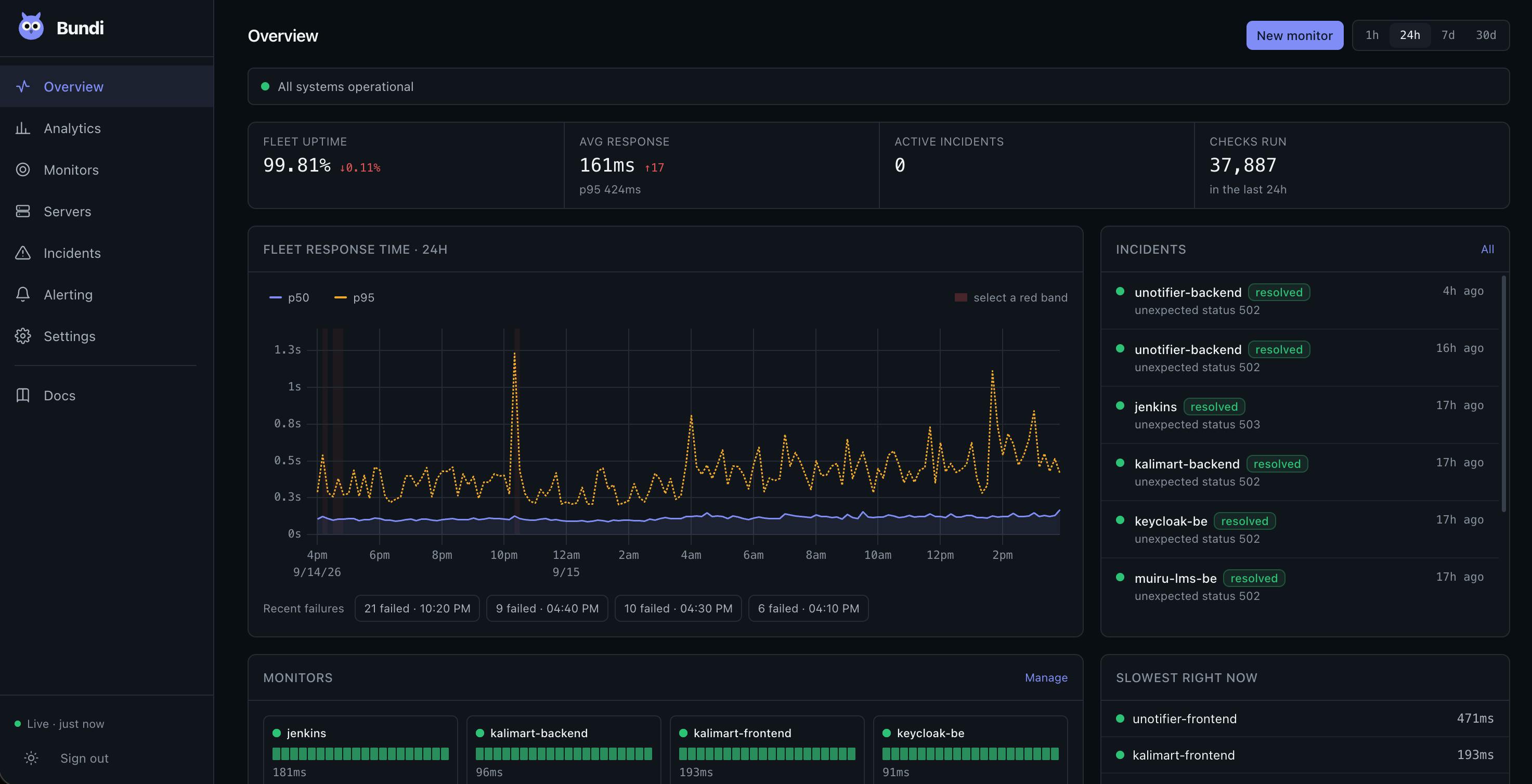
Bundi is a lightweight server monitoring tool built around one core idea: no false alarms.
Bundi is a lightweight ops monitoring tool for indie developers and small teams, focusing on three high-frequency scenarios: URL availability, cron job execution, and server disk status. Its core philosophy is "no false alarms" — a single slow response won't trigger an alert, tolerating transient noise like network jitter; when a real outage is confirmed, it notifies everyone once and then stops, addressing the alert fatigue that plagues ops teams. Compared to complex enterprise solutions like Datadog or PagerDuty, Bundi takes a lightweight, focused approach with minimal setup and friendlier pricing. Currently in early stages on Product Hunt, its real-world reliability and alert accuracy are still pending validation.
The most frustrating problem with ops monitoring tools usually isn't missed alerts — it's alert overload. A text message jolts you awake at 3 AM, only to reveal the server was just half a second slow. This "boy who cried wolf" pattern of false alarms gradually desensitizes teams to alerts entirely. Bundi, a newly launched monitoring tool, puts "no false alarms" at the center of its pitch, aiming to solve a pain point that has plagued developers for years.
What Is Bundi
Bundi's brand mascot is an owl that never sleeps — symbolizing that it keeps watch over your systems through the night so you don't have to. Its features span three core monitoring scenarios: URL availability, cron job execution, and server disk status.
These three categories cover the most common operational needs for small-to-medium services and individual developers. Is the website online? Did background scheduled jobs run on time? Will a full disk suddenly crash the service? These seemingly basic but easily overlooked risks are the root cause of many production incidents. Bundi is currently listed on Product Hunt under Productivity, SaaS, and Developer Tools, and was built by Chris Muiru.
The "No False Alarms" Product Philosophy
Bundi's most interesting design principle is captured in this line: "One slow response? It shrugs. Actually down? It emails everyone once, then politely stops."
This reveals two key product decisions. The first is tolerating transient spikes. A single slow response won't trigger an alert, avoiding false positives caused by network jitter or temporary load spikes. This stands in sharp contrast to traditional monitoring tools that fire off alerts at the first sign of anything unusual.
The second is alert deduplication and restraint. When a genuine outage is confirmed, it notifies all relevant parties once — not in a relentless barrage. "Politely stops" means it won't keep sending duplicate alerts throughout the same incident. This is one of the primary drivers of alert fatigue, and for ops teams who've been buried in notification floods, this kind of restraint is genuinely appealing.
Alert fatigue is a well-documented systemic problem in the operations field. Research shows that when monitoring systems frequently generate false positives, engineers gradually deprioritize alerts — or ignore them entirely — mirroring the consequences of ICU alarm fatigue in healthcare. The industry typically measures monitoring quality by "signal-to-noise ratio": the higher the proportion of actionable alerts among all alerts, the better a team's response speed and accuracy. Mainstream monitoring systems typically filter noise through trigger thresholds (e.g., alert only after 3 consecutive check failures), sliding window statistics, or anomaly detection algorithms. Bundi's "shrug" logic is essentially a simple threshold strategy from the first two categories — low implementation complexity, but with limited ability to identify complex intermittent failures.
Who It's For and What Problem It Solves
Bundi's positioning is clear: it serves developers and small teams who just want to "finally get a good night's sleep." Compared to enterprise-grade monitoring solutions like Datadog and PagerDuty — powerful but complex to configure and expensive — Bundi takes a lightweight, focused approach.
Rather than trying to cover every monitoring dimension, it does three high-frequency essentials well: URL, cron, and disk. For indie developers or early-stage teams running one or two websites and a handful of scheduled scripts, this "just enough" type of product is often a better fit than a sprawling platform — no complex onboarding, and you're not paying for features you'll never use.
Cron job monitoring is an underappreciated blind spot in ops. Traditional monitoring tools are good at detecting whether a service is online, but scheduled tasks are inherently passive — if a job doesn't run, the monitoring system has no way to sense the "silence." The industry typically solves this with "heartbeat monitoring": after completing execution, the job proactively sends an HTTP request or ping to the monitoring service, and if no heartbeat is received within the expected time window, an alert is triggered. Healthchecks.io is a leading product in this niche. Bundi's inclusion of cron monitoring as a core feature suggests it likely uses a similar heartbeat mechanism, though no public technical documentation has confirmed the specific implementation.
Early-Stage Observations
Based on Product Hunt data, Bundi currently has 8 upvotes and 1 comment, ranking 20th — an early-stage product just finding its footing. This means its real-world stability, alert accuracy, and the breadth of its notification channels (only email has been mentioned publicly) all still need market validation.
The core value of any monitoring tool is trustworthiness — it can't go down itself, and its logic can't be wrong, or it becomes a new risk rather than a safeguard. Bundi's "no false alarms" promise points in the right direction, but whether it can truly distinguish noise from real failures in practice will require more mature algorithms and long-term feedback from a broader user base.
Conclusion
Bundi has identified a real and widespread pain point in the monitoring space: alert fatigue. Through the image of a tireless owl, it communicates a product ethos of restraint, reliability, and minimal disruption. For developers tired of being bombarded with false alarms who just want a decent night's sleep, this kind of lightweight monitoring tool is worth keeping an eye on. That said, as an early-stage product, its reliability and feature depth will need time to prove themselves.
Related articles

AI Agent Fundamentals: The Three Core Components — Brain, Memory, and Tools
A beginner's guide to AI Agents: covering the three core components (brain, memory, tools), four stages of LLM deployment, and why Agents matter for real business use cases.

Boycotting Software That Doesn't Support Linux: One Developer's Philosophy of Choice
A Linux-only developer shares his philosophy of boycotting non-Linux software — without sacrificing productivity — and explains how coding agents like Claude Code are closing the gap with commercial tools.
Why Do All AI-Generated Projects Look the Same? The Aesthetic Homogenization Problem in Vibe Coding
Why do vibe coding projects all use purple gradients and dark glassmorphism? We break down the technical roots of AI aesthetic homogenization and how to escape it.