BYD Whale MPV Offers 559-Mile Range, Purple Electric Minivan Defies Pragmatism
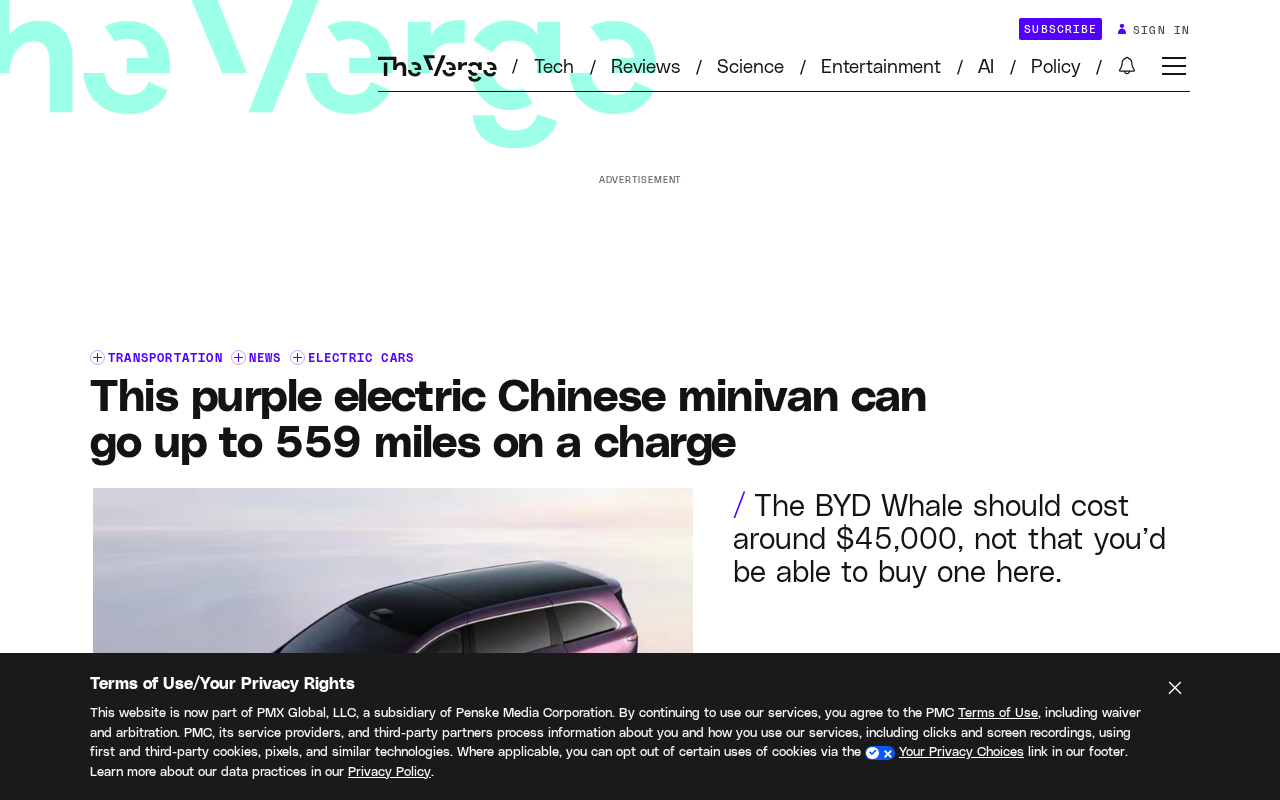
BYD launches the flagship electric MPV Whale with an estimated 900 km range, aiming to fix the range shortcoming of electric MPVs.
BYD has unveiled the flagship purple electric MPV "Whale," with an official estimated range of 559 miles (900 km), far exceeding the VW ID Buzz's real-world ~200 miles. The article analyzes the range dilemma caused by boxy, high-roof designs and how the Whale counters it with a large battery, low-drag styling, and thermal management. The purple color and Whale name signal flagship positioning and brand elevation, matching China's MPV shift from business to family use. If delivered in production, the 900 km range would transform long-distance travel and business reception, though estimates differ from real-world conditions. BYD's battery details, charging power, and pricing remain unannounced.
Title
BYD Whale MPV Offers 559-Mile Range, Purple Electric Minivan Defies Pragmatism
Meta Description
BYD unveils flagship electric MPV Whale with an estimated 559-mile (900 km) range and eye-catching purple body. Compared to the Volkswagen ID Buzz's mere 200 miles, can the Whale solve long-distance anxiety for electric MPVs? This article analyzes its positioning, the significance of its range, and China's competitive electric MPV landscape.
Article Content
Electric minivans have long been seen as the ultimate form of pragmatism: they can carry people, haul cargo, and fit a large battery. But over the past few years, electric MPVs on the market have always left something to be desired in terms of range—the Volkswagen ID Buzz achieved only about 200 miles in real-world testing in 2023, leaving long-distance travel anxiety intact. Now, Chinese brand BYD has offered a new answer: a flagship purple electric MPV called the "BYD Whale," with an official estimated range of up to 559 miles (900 kilometers).
The Range Dilemma of Electric MPVs and How to Break It
The physical characteristics of electric MPVs make it difficult to balance range and space. The boxy body creates a huge frontal area, and the high-roof design further worsens aerodynamic drag; to accommodate a 7-seat layout, the battery pack often can only be laid flat under the floor, limiting capacity. The Volkswagen ID Buzz's 200-mile range is a typical example—it satisfies nostalgia and space needs, but turns long-distance travel into a planning challenge.
The BYD Whale's estimated 900-kilometer range is equivalent to bringing the range capability of electric MPVs up to a level comparable to gasoline MPVs. Behind this is BYD's accumulated expertise in battery pack energy density and vehicle energy consumption management. Although the official battery capacity has not been announced, based on current electricity consumption levels, the Whale is likely equipped with a battery pack far larger than those of同级 competitors, while offsetting the disadvantages of a boxy body through low-drag styling and thermal management optimization.
The drag coefficient (Cd value) is a dimensionless parameter that measures a vehicle's air resistance and directly determines the energy required to overcome air resistance at high speeds. Due to their boxy shape and high-roof design, MPVs typically have a drag coefficient above 0.30, while streamlined sedans can be as low as around 0.22. Air resistance is proportional to the square of vehicle speed, so at high-speed cruising, drag becomes the dominant factor in energy consumption. For electric MPVs, every 0.01 reduction in drag coefficient can increase high-speed range by about 5-8 kilometers. This is why the BYD Whale needs low-drag styling optimization—even with a boxy body, details such as a rounded front fascia, hidden door handles, and a flat underbody are needed to offset the disadvantage of frontal area.
Positioning Signals of a Purple Flagship
Choosing purple as a flagship color is not common in the automotive industry. BYD clearly wants to send a signal through the Whale: electric MPVs don't have to be only about function; they can also have attitude. From the product name, "Whale" suggests traits of being massive, gentle, and capable of carrying loads, which aligns closely with the user mindset for MPVs.
According to the original report, the Whale is positioned as a "flagship purple peoplemover." This phrasing reveals BYD's hope that the Whale is not just a tool vehicle but also a carrier for brand elevation. In the Chinese market, MPVs are shifting from business reception to family travel scenarios, and demand for high-end electric MPVs is growing—the Whale's arrival is timely.
The term "peoplemover" originates from the North American name for multi-purpose vans, emphasizing passenger-carrying efficiency rather than luxury; the Volkswagen ID Buzz's official positioning has used this term. BYD positioning the Whale as a "flagship purple peoplemover" is in fact a borrowing and upgrade of this category term: while retaining the functional attribute of a "people carrier," it layers on "flagship" and "purple" labels of flagship status and individuality. This naming strategy echoes the trend of China's MPV market shifting from business reception to family travel—family users need large space but also want the vehicle to express personal aesthetics, and the purple color precisely captures this psychology.
What 900 Kilometers of Range Means
If the estimated 559-mile (900-kilometer) range can be delivered on production vehicles, it will substantially change the use cases of electric MPVs. Take family long-distance travel as an example: 900 kilometers is enough to cover most intercity round trips without needing to charge en route. For business reception, this means drivers don't have to insert charging waits into itineraries, achieving efficiency close to gasoline vehicles.
Of course, there is a gap between "estimated range" and real-world range. Highway driving, full loads, and air conditioning use will significantly reduce actual mileage. BYD needs to prove in actual deliveries that the Whale's range degradation control can meet user expectations. But even with a discount, the nominal 900 kilometers is enough to give the Whale a clear advantage in its class.
Estimated range usually refers to the range figure obtained under a specific test standard, and test procedures vary significantly across regions. China's CLTC (China Light-duty Vehicle Test Cycle) standard leans toward medium- and low-speed urban conditions, with a constant test ambient temperature, so the resulting range values are often higher than Europe's WLTP and the U.S. EPA standards. Take the Volkswagen ID Buzz: its EPA real-world figure is about 200 miles, while the European WLTP nominal value is close to 260 miles—a clear difference. Therefore, if the BYD Whale's 900 kilometers is a CLTC estimate, converting it to EPA or real-world highway range may require a 20-30% discount. Understanding the differences between test standards is a key prerequisite for judging the true value of "900 kilometers."
The Collective Push of Chinese Electric MPVs
The BYD Whale is not an isolated product. Chinese brands are collectively pushing forward in the electric MPV segment, from the Denza D9 to the Zeekr 009 to the Li Auto MEGA, each using large batteries and high-voltage platforms to solve range pain points. If the Whale's 900-kilometer range materializes, it will further raise the competitive threshold in this sub-market.
The comparison with the Volkswagen ID Buzz is particularly interesting. The ID Buzz gained attention with its retro design but clearly compromised on range and practicality; the BYD Whale does the opposite, using range and spatial practicality as core selling points while creating buzz through color and naming in design. The two approaches reflect different market understandings of electric MPVs: the European market values lifestyle expression, while the Chinese market values functional satisfaction.
The Electrified Endgame of Pragmatism
Electric minivans are seen as the carrier of "ultimate pragmatism," and range is the last shortcoming in their practicality. With an estimated 900-kilometer range, the BYD Whale attempts to fill this gap. If the production vehicle can approach this figure, electric MPVs will truly be capable of replacing gasoline MPVs—not as a second car, but as a family's only vehicle.
The purple body and Whale name may be mere marketing cleverness, but behind the 559-mile range is a key step for electric MPVs moving from "adequate" to "good to use." What remains to be seen is when BYD will reveal the Whale's battery details, charging power, and pricing—information that will determine whether it can evolve from a talking point into a volume seller.
One-line Summary
BYD launches the flagship electric MPV Whale with an estimated 900-kilometer range, attempting to address the range shortcoming of electric MPVs.
Paragraph Summary
BYD has unveiled the flagship purple electric MPV "Whale," with an official estimated range of 559 miles (900 kilometers), far exceeding the Volkswagen ID Buzz's real-world figure of about 200 miles. The article analyzes the high drag and range dilemma of electric MPVs caused by boxy bodies and high-roof designs, noting that the Whale breaks through with a large-capacity battery, low-drag styling, and thermal management optimization. The purple color and Whale naming convey flagship positioning and a brand-upward signal, aligning with the trend of China's MPV market shifting from business to family use. If the 900-kilometer range is delivered in production, it will change long-distance travel and business reception scenarios, but there is a gap between estimates and real-world conditions. Chinese brands are collectively pushing forward in the electric MPV segment, and the Whale's battery details, charging power, and pricing remain to be announced.
Related articles

GLM-5.4 Loop Transformer: 75B Parameters Deliver Trillion-Scale Reasoning
GLM-5.4 turns a 750B pretrained model into a Loop Transformer—28 layers looped twice, zero new parameters, AIME 25 up 11.3, outputs 14% shorter, reasoning moves into implicit depth.

Landlord's Comeback: Terminal Liver Cancer Survivor Relies on Tenant Wish System to Stay Alive
A Bilibili short drama follows Wu Youfu, who after transmigrating is diagnosed with terminal liver cancer and binds a Wish System, fulfilling three female tenants' wishes to earn lifespan rewards and unlock mind-reading, invisibility, and other skills as his condition improves from terminal to mid-stage.

Viral Griddle-Cake Stand Sparks Rent Doubling: Who Really Owns the Traffic?
In a viral Bilibili video, griddle-cake vendor Lao Bai makes a whole street famous, then the landlord doubles rent to 200,000. This article examines the dispute over offline traffic ownership: where is the boundary between property rights and individual creativity?