Bypassing Transformer Softmax with Static Contraction: A New Approach to Attention Optimization
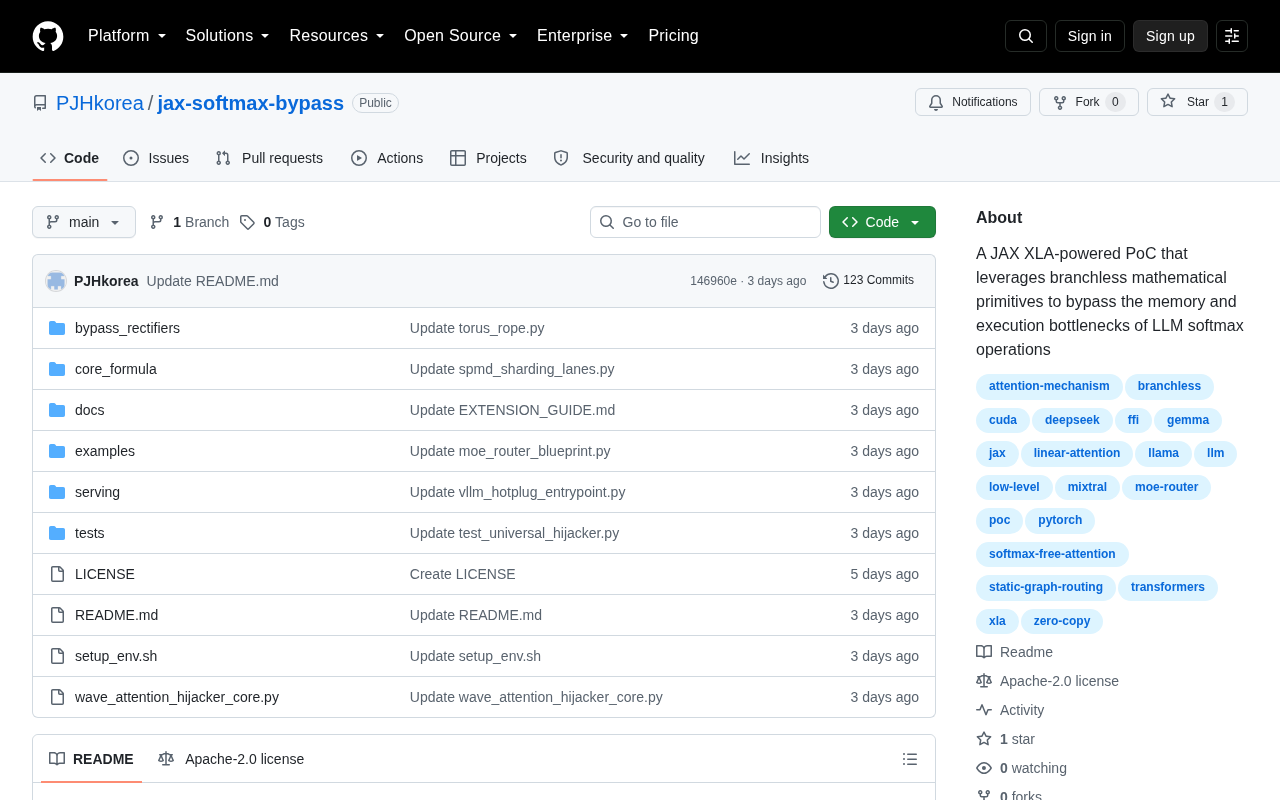
An early-stage project exploring static tensor contraction as a replacement for Softmax in Transformers — promising direction, but lacking empirical evidence.
This article analyzes an early-stage Hacker News project claiming to bypass Softmax in Transformers using "Static Contraction." Softmax is the core normalization component in self-attention, but its exponential operations and row-wise normalization make it a bottleneck for low-precision deployment and long sequences. Static contraction follows the research community's long interest in linear attention, with potential benefits including eliminating exponential ops and improving compile-time optimizability. However, the key challenge is that Softmax's competitive attention allocation grants models strong expressiveness — a trade-off linear approaches have historically struggled with. Given the project currently lacks technical documentation and benchmark data, the author recommends cautious attention until full experimental results are available.
Background: The Softmax Bottleneck in Transformers
In the standard Transformer architecture, one of the core computations in the attention mechanism is the Softmax operation. It normalizes attention scores into a probability distribution, determining how much each token attends to every other token. However, Softmax is also a non-trivial performance bottleneck in self-attention — it involves exponential operations, row-wise normalization, and global dependencies that are difficult to parallelize and quantize, making it especially resource-intensive for long sequences.
A project recently posted on Hacker News as a "Show HN" proposes an interesting direction: bypassing Softmax in Transformers through Static Contraction. While the post currently has limited public information (only 4 upvotes and no comments at time of writing), the premise itself touches on a critical issue in large model efficiency optimization and is worth exploring in depth.
What Is "Bypassing Softmax with Static Contraction"?
Based on the technical intent conveyed by the title, "Static Contraction" refers to replacing or circumventing the runtime dynamic Softmax normalization with a predetermined, structured tensor contraction operation.
Tensor contraction is a general linear algebra operation that sums a multi-dimensional tensor along specified dimensions — matrix multiplication is essentially a special case of tensor contraction. If attention weight computation can be restructured as a series of static, pre-schedulable contraction operations, the theoretical benefits include:
- Eliminating exponential operations: Softmax relies on
exp()computations, which are numerically sensitive and difficult to quantize at low precision. Removing it simplifies the numerical path. - Improved parallelism: The computation graph of static contraction can be determined at compile time, making it more amenable to hardware scheduling and operator fusion.
- Reduced memory and bandwidth pressure: Avoids intermediate state storage during row-wise normalization.
It's worth emphasizing that this line of thinking is not unprecedented in academia. In recent years, numerous studies have explored "Linear Attention," "Softmax-free Attention," and various kernel method approximations, all attempting to replace the quadratic complexity of standard attention with linear complexity. This Show HN project can be seen as an engineering attempt within that broader research direction.
Potential Value and Technical Significance
Efficiency and Deployment Friendliness
Eliminating or replacing Softmax has direct implications for inference efficiency optimization. In edge device deployments and low-precision inference scenarios (such as INT8/INT4 quantization), exponential operations are often a concentrated source of quantization error and computational overhead. If static contraction can bypass this step while preserving model expressiveness, it would have a meaningful impact on the cost structure of model deployment.
The Expressiveness Trade-off
Any approach that bypasses Softmax must answer a fundamental question: does it sacrifice model expressiveness? The nonlinear normalization and "competitive" attention allocation that Softmax provides — allowing a small number of tokens to receive disproportionately high weights — is one of the key reasons Transformers perform so well. Static or linearized alternatives have historically tended to make compromises on long-range dependency modeling and fine-grained semantic discrimination. Whether this project can empirically overcome that hurdle is the key criterion for evaluating its value.
A Note of Caution: Information Is Still Limited
It must be noted objectively that the public information available for this Show HN post is very limited — there is no accompanying technical summary, no benchmark data, no community discussion (0 comments), and only a handful of upvotes. This means:
- We cannot verify the accuracy of the "static contraction" approach on real models;
- We cannot confirm its speedup relative to standard attention or existing linear attention methods;
- We also cannot determine whether it is a general-purpose method or only applicable to specific tasks or architectures.
For any approach claiming to "bypass" a core component, the community typically expects controlled experiments on standard benchmarks (e.g., language modeling perplexity, long-sequence tasks). Until that data appears, the most rational stance is to stay interested but withhold judgment.
Implications for Practitioners
Even if the final effectiveness of this specific project remains to be verified, the line of thinking it represents still holds value for AI engineers and researchers:
- Revisiting "default components": Many design choices in Transformers are now taken for granted, but every element — Softmax, positional encoding, LayerNorm — may still harbor optimization opportunities.
- The trend toward compile-time static computation: Shifting as much runtime dynamic computation as possible to compile time is an important engineering direction for improving hardware utilization, consistent with the broader trend of operator fusion and graph optimization.
- The ongoing trade-off between efficiency and accuracy: Deploying large models always involves finding a balance between "faster" and "more accurate," and explorations like this are a concrete embodiment of that tension.
Conclusion
"Bypassing Transformer Softmax with Static Contraction" is an exploration that points in the right direction but still needs empirical support. It touches on one of the most fundamental questions in large model efficiency optimization and continues the research community's long-standing interest in Softmax-free attention. It's worth watching whether the project will eventually release complete technical documentation and benchmarks — that will be the true basis for evaluating its real value. Until then, it serves as a useful reminder: even the most mature architectures still leave room to be reimagined.
Related articles

RTX 5090 Stock Crisis: Why Third-Party Sellers Are Charging $9,500
NVIDIA's RTX 5090 has vanished from U.S. online retail, with third-party sellers asking up to $9,500. Here's how AI compute demand is driving GPU prices to extremes.
Apple Siri May Support Swapping in Claude and ChatGPT — Code Already Shows Signs
Leaked code shows Apple is developing third-party AI model integration for Siri, potentially allowing users to swap in Claude or ChatGPT under EU DMA pressure.

EPA Moves to Scrap Power Plant Greenhouse Gas Emission Standards Amid Surging AI Energy Demand
The EPA plans to eliminate all power plant greenhouse gas emission standards, just as AI, EVs, and manufacturing drive electricity demand higher — making U.S. power potentially far dirtier.