Cache or Denoise Less? The Residual Reuse Debate in Flow-Matching World Action Models

On flow-matching world action models, cutting denoising steps beats cross-cycle caching for stability and cost.
The study compares cross-cycle caching (e.g., C$^3$ache) with direct denoising-step reduction on the 6B-parameter Fast-WAM world action model over LIBERO-Goal. Two-step no-cache denoising stays within two percentage points of ten-step success across all 500 initial states and cuts per-call latency from 202 ms to 92 ms. Cost modeling shows a cache retaining two fresh steps can save at most ~11%–14% overhead and cannot beat two direct steps. Caching is highly sensitive to time shift and noise resampling, with success dropping from 95% to 63%. The authors recommend establishing the few-step non-inferiority boundary before evaluating caching.
When Robot Policies Start "Reusing" Computation
Flow-matching robot policies must repeatedly call the network to complete multi-step denoising when generating each action chunk. To save compute, researchers have proposed cross-cycle caching schemes such as C$^3$ache, which stores intermediate computation results from previous replanning calls for reuse on the next call. The question is: is the speedup from this kind of caching really more worthwhile than simply "taking fewer denoising steps"?
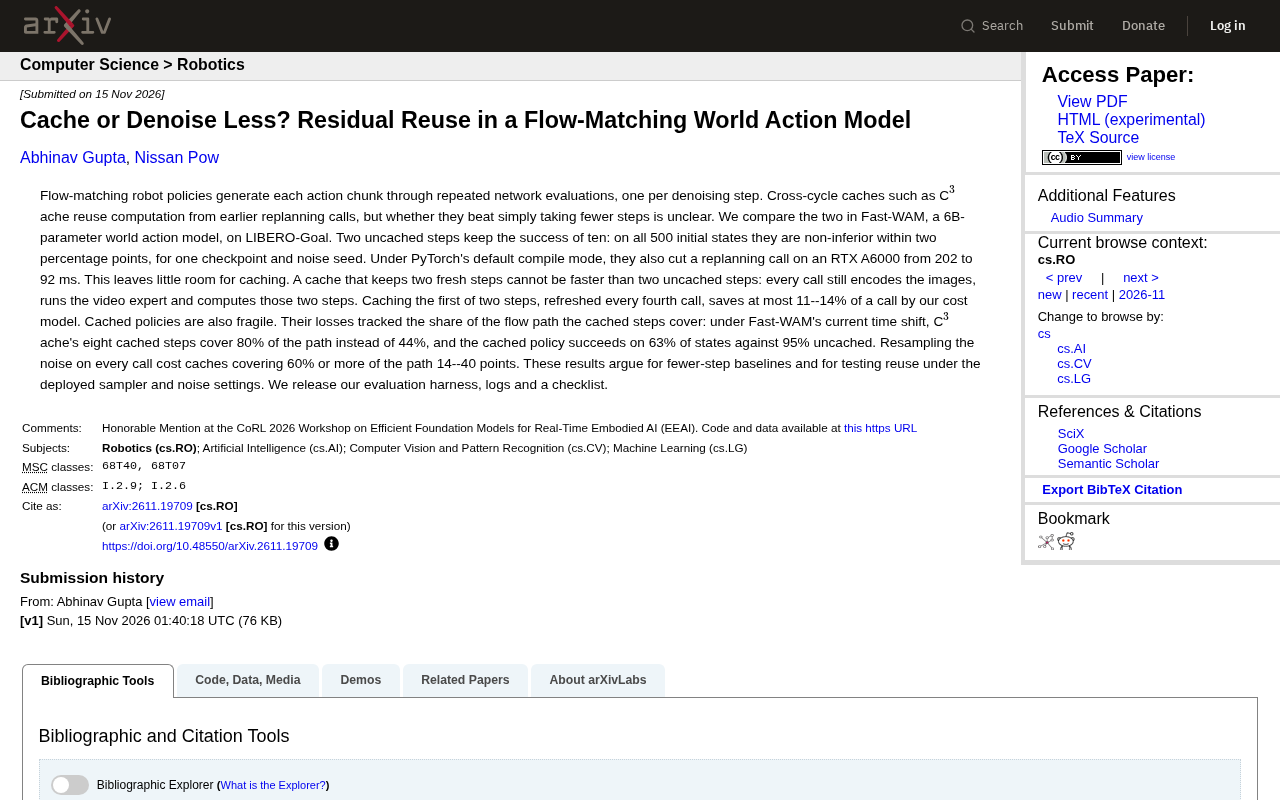
A paper titled Cache or Denoise Less? Residual Reuse in a Flow-Matching World Action Model directly compares these two approaches on a 6-billion-parameter world action model called Fast-WAM, using the LIBERO-Goal benchmark. The conclusion is quite straightforward: in most deployment scenarios, reducing denoising steps yields more stable and reliable gains, while the optimization headroom left for caching mechanisms is rather limited.
Flow-Matching is a class of generative modeling methods whose core idea is to learn a continuous transformation (a "flow") from a simple prior distribution (such as Gaussian noise) to a complex data distribution. In robot policies, it is used to generate action sequences: starting from random noise, the process gradually "flows" toward the target action through numerical integration (often discretized into multi-step denoising via the Euler method). Each denoising step requires one neural network call to predict the velocity field, so more steps mean more expensive computation. Compared with diffusion models, flow matching can typically achieve comparable generation quality with fewer steps, which is the theoretical basis for the viability of the "few-step denoising" approach.
World Action Model (WAM) refers to an architecture that jointly models environment dynamics prediction and action generation: the model not only outputs actions but also implicitly or explicitly predicts future observations (such as video frames), giving the policy a degree of "imagination" capability. Such models have large parameter counts (e.g., the 6-billion-parameter Fast-WAM in this paper) and high per-forward-pass overhead, making inference acceleration a key deployment bottleneck—and this is the backdrop against which the caching and few-step denoising approaches compete.
Core Comparison of the Two Approaches: Cutting Two Steps, Barely Any Performance Drop
The research team first validated a naive baseline: without any caching, can the policy still maintain success rates if denoising steps are reduced from ten to two?
Across all 500 initial states in LIBERO-Goal, the two-step no-cache version's success rate was within two percentage points of the ten-step version—a non-inferiority result. It should be noted that this result corresponds to a specific checkpoint and noise seed, not a universal guarantee across all configurations, but it at least shows that step redundancy is real: cutting most denoising steps does not immediately break performance.
The speed gains are equally notable. Under PyTorch's default compilation mode on an RTX A6000, the two-step approach reduced the time per replanning call from 202 ms to 92 ms. A reduction of this magnitude is already close to what many caching schemes dream of achieving.
Non-inferiority is originally a statistical concept from clinical trials, referring to a new approach being no worse than the standard approach within a predefined acceptable margin, rather than requiring strict superiority. Borrowing this framework in robot policy evaluation means researchers set a tolerance threshold for success rate差距 (two percentage points here) in advance; as long as the gap between the two-step and ten-step versions falls within the threshold, the step reduction is considered to cause no substantive performance harm. This approach is more engineering-relevant than simply reporting "slightly lower success rate" because it explicitly quantifies the "acceptable performance loss," making it easier for deployers to decide whether to adopt it based on task risk.
LIBERO-Goal is a subset of the LIBERO robot manipulation benchmark, focusing on long-horizon goal-conditioned tasks: the agent must understand a goal specified by language or images and maintain planning consistency across multi-stage manipulation. It contains multiple task suites and a large number of initial states (500 in this paper), so it is often used to test policy robustness under in-distribution and mild distribution shift conditions. Note that the success rate on this benchmark is the primary source of evidence for the non-inferiority conclusion; generalization across benchmarks and robots still requires additional validation.
The Ceiling of Caching: It Can't Be Faster Than "Two Steps Themselves"
The paper presents a compelling cost argument: a cache that retains two fresh steps cannot be faster than simply running two steps without caching. The reason is that each call still has to encode images, run the video expert, and compute those two steps—caching cannot eliminate these fixed overheads.
Using a cost model, the authors estimate that even if the first of two steps is cached and refreshed every four calls, at most only 11%–14% of the overhead in a single call can be saved. In other words, the savings that caching can squeeze out are not on the same order of magnitude as the overall time reduction from simply cutting steps. This also explains why caching strategies struggle to find a foothold in the Fast-WAM setting.
The Fragility of Caching: Time Shift and Noise Resampling
More concerning than speed is stability. The paper finds that the loss of caching strategies is highly correlated with the proportion of the flow path covered by the cached steps. Under Fast-WAM's current time shift setting, C$^3$ache's eight cached steps cover 80% of the path, whereas the ideal case should cover only 44%; as a result, the caching strategy succeeded on only 63% of states, compared with 95% for the no-cache version.
Noise settings are equally sensitive. If noise is resampled on each call, caches covering more than 60% of the path lose 14 to 40 percentage points. This means caching scheme performance depends strongly on the sampler and noise configuration at deployment time, and may fail in a different environment. The authors therefore recommend that reuse mechanisms be evaluated under the actual deployment sampler and noise settings, rather than reporting numbers only under ideal conditions.
Time shift is a scheduling parameter in flow-matching/diffusion samplers that determines how denoising steps are distributed over the integration interval—for example, concentrating more steps early or late in the flow path. Different time shifts change the contribution weight of each step to the final action, so "which steps" are cached and "what proportion of the flow path the cache covers" directly affect reuse error. The paper notes that C$^3$ache's eight cached steps cover 80% of the path under the current shift, far exceeding the ideal 44%, meaning the reused intermediate results carry too much information that should have been recomputed, and errors accumulate accordingly.
Noise resampling refers to redrawing the initial noise on each replanning call. Since flow-matching generation trajectories depend on the initial noise, if two calls use different noise, the previously cached intermediate activations correspond to a different flow path, and direct reuse introduces systematic bias. This is precisely why caching is highly sensitive to noise configuration: with fixed noise, the cached trajectory is consistent and reuse is effective; with resampling on each call, the cache and fresh steps are "misaligned," and success rates drop sharply.
Implications for Practitioners
The value of this work lies not in rejecting caching research, but in providing a clear comparison framework: on flow-matching world action models, first confirm the performance boundary of the few-step baseline, then discuss whether reuse still offers gains. If two steps can preserve success rates and halve call latency, then the design space for caching is compressed considerably.
For deployers, the pragmatic path is to first run ablations on step reduction to confirm the non-inferiority margin on their own tasks, then evaluate whether caching can still do anything with the remaining overhead. The paper also open-sources evaluation tools, logs, and a checklist to help the community reproduce such comparisons under uniform conditions.
In the field of robot learning, where information from multiple sources intertwines, such "counterintuitive but verifiable" conclusions are especially valuable: they advance the discussion from "can caching accelerate" to "under what conditions is caching worth doing"—which is exactly what engineering deployment truly cares about.
One-line Summary
On flow-matching world action models, directly reducing denoising steps is more stable and cost-effective than cross-cycle caching, and caching has limited optimization headroom.
Paragraph Summary
This study compares two acceleration approaches—cross-cycle caching (such as C$^3$ache) and directly reducing denoising steps—on the 6-billion-parameter Fast-WAM world action model using the LIBERO-Goal benchmark. Results show that two-step no-cache denoising achieves a success rate within two percentage points of the ten-step version across all 500 initial states, while reducing per-replanning-call latency from 202 ms to 92 ms. A cost model further shows that a cache retaining two fresh steps cannot be faster than directly running two steps, and at best saves only about 11%–14% of overhead. Caching is also highly sensitive to time shift and noise resampling, with success rates potentially dropping from 95% to 63%. The authors advocate first confirming the non-inferiority boundary of the few-step baseline before evaluating whether caching is worthwhile.
Related articles

GTA 6 Multiplayer Racing Gameplay: Fun Times with Friends
YouTube friends' multiplayer gameplay: six new GTA 6 racing maps, custom vehicle disputes, puzzle track design, planes vs. scooters asymmetric showdown, plus player feedback on network sync and controls.

GNOME Moves to Ban All AI Contributions, Open Source Community Faces Split
GNOME Foundation proposes a draft policy banning all AI contributions across code, docs, translations, and more. Community reaction is split, accelerating divisions in open source.

From Cloud to Local: A Complete Guide to Full Control of AI Coding Workflows
From Claude Code cloud baseline to OpenCode+OpenRouter to LM Studio local models, this course uses one app to show how AI coding workflows progressively reclaim control. It compares sub-agent splitting, large/small model division of labor, and cost/privacy trade-offs, plus key engineering techniques for making small models work.