GNOME Moves to Ban All AI Contributions, Open Source Community Faces Split
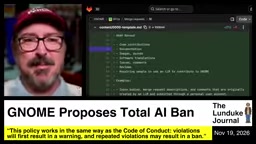
GNOME proposes a total ban on AI contributions, sparking open-source community division and fork risk.
GNOME recently proposed a draft policy to completely ban AI-related contributions, allowing only private local use, with violators subject to bans. The proposal has Board and Foundation support; most community members are satisfied, but some long-time contributors find it too lenient. The open-source community is divided on AI: the Linux kernel embraces AI-assisted development, while Haiku and several distributions have banned AI contributions. Analysts say the ban could cause developer loss and a fork into "AI GNOME" and "non-AI GNOME."
GNOME's Radical Proposal: A Total AI Ban
The open-source desktop environment GNOME recently proposed a draft policy that would completely ban any AI-related contributions. Under the proposal, all project-related activities—including code, documentation, images, audio, translations, issues, comments, and reviews—must not use large language models (LLMs). The proposal explicitly states: "Using LLMs to create, review, or document content is not permitted, and no amount of subsequent editing can change the fact that it was originally AI-generated."
The severity of this ban is rare: the only permitted use is "private, local use," meaning developers may use AI on their personal devices, but it must not involve the GNOME project and must not be publicly discussed. Violators will first receive a warning, and repeated violations may result in a ban.
According to analysis by the YouTube tech commentary channel Lunduke Journal, the proposal has received "unanimous support" from the GNOME Board and Foundation. Although community feedback is still being solicited, the likelihood of passage is extremely high. The commentary notes that this amounts to a "thorough, complete, and absolute ban" on AI.
GNOME is one of the most mainstream open-source desktop environments in the Linux ecosystem, supported by the GNOME Foundation and governed by a community-driven model. Its core projects include GNOME Shell, the Mutter window manager, and the GTK graphical toolkit. The GNOME Board handles strategic decisions, while the Foundation manages legal and financial affairs. This draft AI ban was proposed by community members and requires Board approval and community discussion before it may ultimately be written into the project's code of conduct or contribution guidelines. Because GNOME is the default desktop on many mainstream Linux distributions (such as Fedora and Ubuntu), its policy changes have a demonstrative effect on the entire open-source desktop ecosystem.
Community Reaction: Majority Support, Some Say It's "Not Harsh Enough"
Surprisingly, community feedback has been polarized. Most commenters expressed satisfaction with the proposal, offering only minor suggested changes. But more notably, some long-time contributors believe the ban is "too lenient"—they argue that GNOME should ban any developer who uses AI in their private life, even if it is unrelated to the project.
Lunduke Journal commented: "They want to regulate what technology people use outside of GNOME. That's insane. What's next—banning Xbox instead of PlayStation?"
The Open Source World Divides: AI Supporters vs. Opponents
GNOME's proposal is not an isolated case. The open-source community is forming clear opposing camps on the AI issue. The Haiku project (an open-source BeOS clone) has already banned AI contributions, and several mainstream Linux distributions have taken similar stances. However, the Linux kernel is open to AI and actively embraces AI-assisted development.
"GNOME itself is a Linux distribution, while the Linux kernel is developed with AI assistance—yet GNOME wants to ban AI development. How can these two completely different sets of rules coexist?" Lunduke Journal asked.
This split is not only technical but also vaguely reflects differences in political stance. The commentary observes that depoliticized or more conservative projects tend to embrace AI, while projects with a strong left-leaning character (such as GNOME) explicitly ban it.
The Linux kernel is the benchmark for the most open AI policy in the open-source community. Kernel maintainers have clearly stated that AI-assisted tools (such as code generation and static analysis) may be used for patch submission and review, as long as contributors comply with the Developer Certificate of Origin (DCO) and bear responsibility for quality. This stands in sharp contrast to GNOME's total ban. The kernel community places greater emphasis on pragmatism and engineering efficiency, while desktop projects like GNOME emphasize community ethics and originality. This difference reflects the collision between "results-oriented" and "process-oriented" cultures in open-source governance, and explains why completely different AI rules can emerge within the same ecosystem.
Future Impact: GNOME May Face Forks and Talent Loss
If the ban is ultimately implemented, it is expected to cause a large number of AI-supporting developers to leave GNOME, and may even trigger a project fork, creating two branches: "AI GNOME" and "non-AI GNOME." Lunduke Journal predicts that the non-AI version of GNOME may stagnate due to talent loss, while the AI branch may accelerate progress.
"This isn't just about the pace of AI development—it's that they are driving out and excluding contributors who were doing human development," the commentary concluded. "The project shrinks while competitors accelerate ahead."
As more open-source projects take clear stances on AI, this分裂 trend may intensify further in the coming months. For developers and users, choosing which camp to join will become an unavoidable question.
Project fork is the act, in the open-source community, of copying a codebase and developing it independently when some contributors are dissatisfied with the project's direction. Famous historical forks include GNOME 2 to MATE desktop and OpenOffice to LibreOffice. Forks can disperse a project's resources and split the community, but they can also spur innovation. If GNOME implements an AI ban, AI-supporting developers may create a branch that allows AI contributions, forming "AI GNOME." However, the success of a fork depends on attracting enough active contributors and users; otherwise, it may become a niche project. Lunduke Journal's prediction is based on this logic: the non-AI version may stagnate due to talent loss, while the AI version may accelerate development through efficiency advantages.
One-line Summary
GNOME's proposal to completely ban AI contributions sparks division and fork risk in the open-source community.
Paragraph Summary
GNOME recently proposed a draft policy that would completely ban any AI-related contributions, permitting only private local use, with violators subject to potential bans. The proposal has support from the Board and Foundation, and most community members are satisfied, but some long-time contributors believe the ban is too lenient. The open-source community is divided on AI: the Linux kernel actively embraces AI-assisted development, while Haiku and several other distributions have banned AI contributions. Analysts believe the ban could lead to developer loss and a project fork, creating two branches: "AI GNOME" and "non-AI GNOME." This分裂 trend may intensify along political lines, forcing more projects to choose sides in the future.
Related articles
GTA 6 Multiplayer Racing Gameplay: Fun Times with Friends
YouTube friends' multiplayer gameplay: six new GTA 6 racing maps, custom vehicle disputes, puzzle track design, planes vs. scooters asymmetric showdown, plus player feedback on network sync and controls.

From Cloud to Local: A Complete Guide to Full Control of AI Coding Workflows
From Claude Code cloud baseline to OpenCode+OpenRouter to LM Studio local models, this course uses one app to show how AI coding workflows progressively reclaim control. It compares sub-agent splitting, large/small model division of labor, and cost/privacy trade-offs, plus key engineering techniques for making small models work.

When Claude Writes 90% of the Code, Should Developers Say Goodbye to Hand-Writing?
Tech creator Theo discusses how AI tools like Claude now write over 90% of code: hand-writing is fading, nostalgia is fine but shouldn't belittle AI builders—curiosity and adaptability are the next generation's core edge.