Caddi: Record Your Screen Once to Create an AI Agent — A New Paradigm for Back-Office Automation

Caddi turns a single screen recording into a production-ready AI agent for back-office automation.
Caddi is an AI automation tool that generates production-grade agents from a single narrated screen recording. By combining AI reasoning with deterministic execution, it overcomes traditional RPA's brittleness and high barrier to entry. Users can update workflows in plain English, while full audit logs and scoped permissions ensure enterprise-grade trust and control.
Show Your Work Once, and It Learns the Job
In the automation space, there's a long-standing pain point: to get a machine to do your work, you first have to spend a huge amount of time "teaching" it. Traditional RPA (Robotic Process Automation) and workflow-building tools typically require detailed requirements gathering, developer involvement, and step-by-step manual configuration. Caddi, a new product that ranked #2 on Product Hunt with 301 upvotes, aims to solve this problem with an approach that mirrors how humans actually learn.
Caddi's core philosophy is captured in its tagline — "Agent that builds agents by only showing your work only once." All a user needs to do is record a narrated screenshare, and Caddi will understand the entire task workflow and automatically build a production-grade AI agent capable of running on your real tool stack.
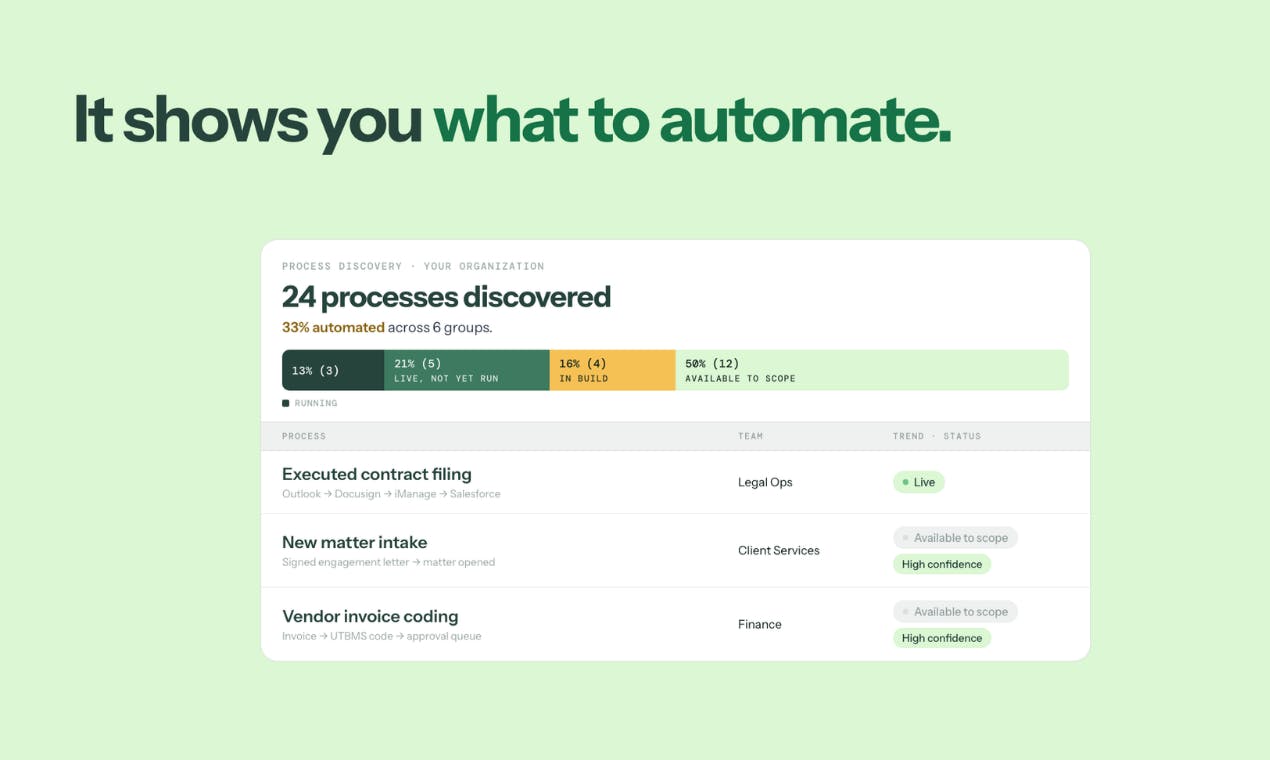
This "watch once and learn" model essentially transplants the way you'd train a new employee onto AI. You don't need to write rules or draw flowcharts — just demonstrate a back-office task as you would for a colleague, explain what you're doing, and let Caddi handle the rest.
What Problem Does Caddi Actually Solve?
Caddi's positioning is crystal clear: automating back-office work. These tasks are often repetitive and tedious, yet require switching between multiple real systems — CRMs, email, spreadsheets, internal tools, and more. Given that the product is categorized under Productivity, Legal, and Artificial Intelligence on Product Hunt, it's clearly targeting professional scenarios where processes are well-defined but too complex for simple scripts.
How Caddi Differs from Traditional RPA
Traditional RPA tools suffer from two fundamental problems — they're "brittle" and have a "high barrier to entry":
- Requires specialized configuration: Often needs IT or developer involvement, making it difficult for business users to build automations on their own.
- High maintenance costs: When a UI or process changes, existing automation scripts easily break.
- Lacks comprehension: They mechanically replay clicks and keystrokes without understanding the logic behind the task.
Caddi addresses these issues by combining AI reasoning with deterministic execution to balance flexibility and reliability. AI reasoning enables it to understand task intent and handle a degree of variation, while deterministic execution ensures that every step in a real business environment is predictable and controllable. This is especially critical for back-office automation, where processes can't afford any "improvisation."
Update Your Automations in Plain English
Another noteworthy feature of Caddi is its support for updating existing automations using natural language.
In the real world, processes are never static. Approval rules get adjusted, fields are added or removed, and processing logic evolves. With traditional solutions, any change means going back to the configuration interface — or worse, scheduling developer time. Caddi lets users describe modifications in plain English, such as "From now on, send any order over $10,000 to finance for review first," and the system adjusts the agent's behavior accordingly.
This dramatically lowers the barrier to maintaining automated workflows, transforming "changing a process" from a technical task into a business communication task — putting the people who actually understand the business in direct control of automation.
Trustworthy and Controllable: Audit Logs and Permission Management
For an AI automation product targeting enterprise back-offices, being "smart" isn't enough — it also has to be trustworthy. Caddi emphasizes two key aspects here:
- Every run is logged: All operations are traceable, making audits and troubleshooting straightforward. This is critical for compliance-heavy scenarios in legal, finance, and similar domains.
- Every permission is scoped: Agents can only operate within their granted boundaries, preventing unauthorized access to sensitive data or execution of unapproved actions.
These two features directly address the top concerns enterprises have when adopting AI automation — auditability and security boundaries. When an AI agent is genuinely working inside your core systems on your behalf, "what it did" and "what it can do" must be crystal clear.
An Industry Signal Worth Watching
Caddi's emergence represents a paradigm shift underway in automation tools: from "people adapting to tools" to "tools learning from people."
Over the past decade, RPA sparked a wave of enterprise automation, but its steep implementation and maintenance costs have been persistent criticisms. With the reasoning capabilities brought by large language models, a new generation of AI automation products is attempting to use "demonstration as programming" to reduce the barrier to building automations to near zero. Caddi's approach of combining AI comprehension with deterministic execution can be seen as a middle ground between two extremes — pure LLM Agents that are "not reliable enough" and pure RPA that is "not flexible enough."
Of course, as an early-stage product, Caddi still needs to prove itself in real-world complex scenarios: Can narrated screen recordings cover enough edge cases? How does AI reasoning degrade gracefully when encountering unseen situations? These are the key questions that will determine whether it can truly penetrate enterprise back-offices. But at the very least conceptually, Caddi points toward a compelling direction — enabling every business professional to train their own digital assistant, just as they would onboard a new team member.
Related articles

DeepSeek's Open-Source Inference Framework: The Compute Economics Behind $330K Annual Revenue Per GPU
DeepSeek's open-source inference framework reveals a $38/GPU/hour floor price—how the $330K/year per-GPU math works, plus prefill-decode disaggregation and KV cache.

Leaked DeepSeek Internal Chat Screenshot: Open Source Doesn't Mean Giving Away the Whole Empire
Leaked DeepSeek internal chat screenshot goes viral, with netizens joking about what's left after open-sourcing. This article analyzes the difference between open-source models and giving away all assets, explaining why computing clusters, engineering teams, and business channels can't be replicated, and the ecosystem positioning logic behind open source as a business strategy.

Open-Source Skill Tested: One Sentence Lets AI Auto-Dub and Animate a Video
Bilibili creator Ali's open-source Animation Machine Skill lets AI Agents auto-write scripts, dub, create Remotion animations, and export videos. This article breaks down installation, Doubao TTS configuration, the two-confirmation mechanism, and performance differences across models.