Cal AI Hits $30M Revenue in Two Years: How Influencer Marketing Drove AI App Growth

Cal AI hit $30M+ revenue in two years via scaled influencer marketing, proving distribution is AI's new competitive edge.
Cal AI reached $30M+ in revenue in two years and was acquired by MyFitness in March. Its growth relied not on a technical moat but on systematic influencer marketing—organizing mid-tier creators into a "creator matrix" on short-video platforms. Leveraging algorithmic preference for organic buzz, it reached niche audiences at low cost using affiliate links and promo codes. The case shows distribution now matters more than product in AI. Risks include rising CAC and algorithm dependency.
The AI app space never lacks products—what it lacks is a way for users to discover them. Cal AI reached over $30 million in revenue in just two years and was acquired by MyFitness in March, a case study that's being endlessly discussed in AI startup circles. Its core growth strategy didn't rely on any technical moat in the product itself, but rather on large-scale, systematic influencer marketing that built an efficient traffic network across short-video platforms.
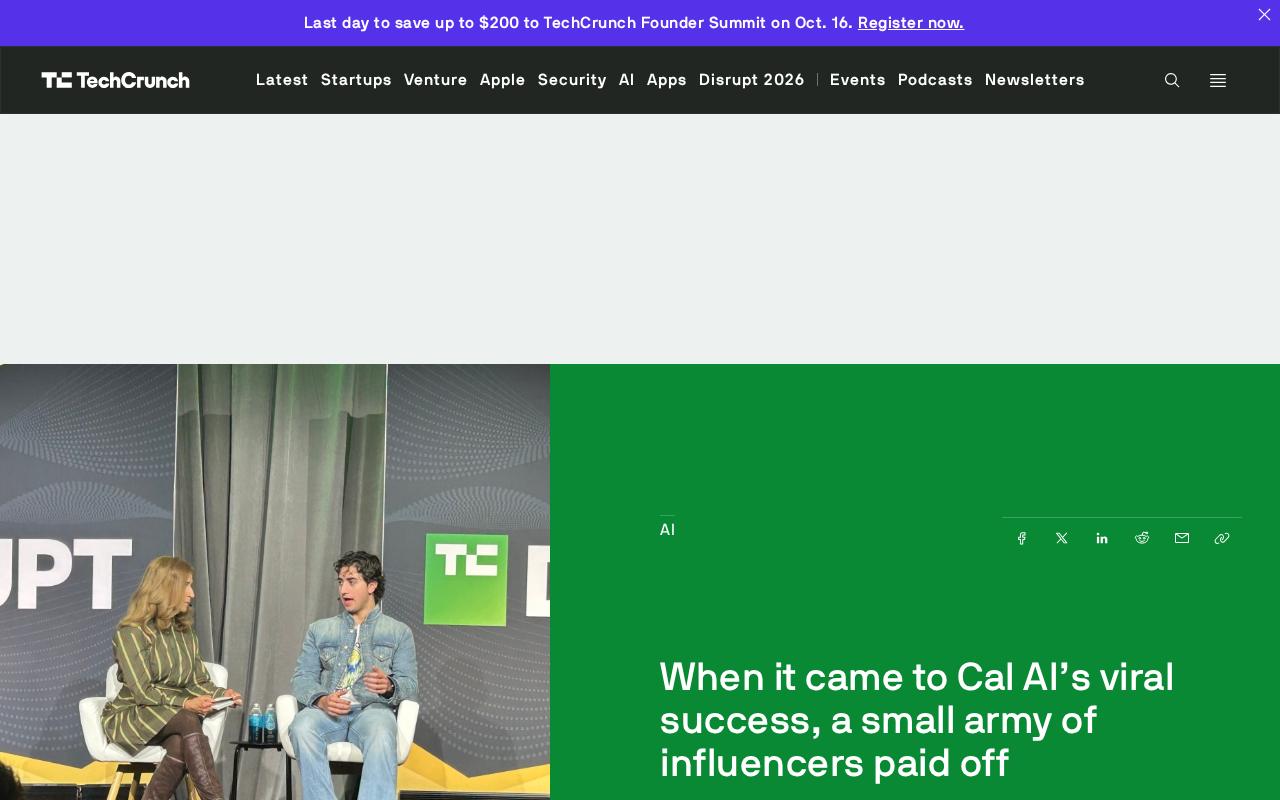
Influencer Marketing: A New Growth Engine for AI Apps
Not Just Ad Spend—A Scaled Creator Matrix
According to TechCrunch, Cal AI's success is inseparable from what it described as a "small army" of influencer promoters. That description itself reveals the key insight: it wasn't a handful of top-tier celebrities endorsing the product, but a collective distribution effort by a large number of mid- and small-tier creators.
This model is especially effective in the short-video ecosystem. When dozens or even hundreds of creators simultaneously post similar product experience content, the algorithm pushes product information to highly segmented target audiences. Compared to traditional ad placements, this approach has a lower cost per reach and carries the trust endorsement of the creators.
Mid-tier creators typically refer to content creators with follower counts between 10,000 and 1 million, sitting between top-tier influencers and ordinary users. Compared to top bloggers, they charge less, are more willing to collaborate, produce content that feels more authentic to real users, and often specialize in a specific vertical (such as fitness, weight loss, or healthy eating). By partnering with a large number of mid-tier creators in bulk, brands can create a "flooding" effect in a short time, covering multiple niche audiences. This strategy is sometimes called a "creator matrix" or "KOC (Key Opinion Consumer) marketing." Its core logic is trading quantity for density and authenticity for trust, thereby leveraging the platform's organic traffic distribution.
What $30 Million in Two Years Really Means
For an AI app, reaching $30 million in revenue within two years means average monthly revenue exceeding $1 million. This figure is quite healthy for consumer AI products. More importantly, it proves the viability of the "AI + influencer marketing" path—the product doesn't need to be perfect, but the distribution channel must be precise enough.
MyFitness completed the acquisition in March for an undisclosed amount. Judging from the acquirer's business focus, Cal AI's product capabilities are highly complementary to MyFitness's fitness ecosystem. This acquisition looks more like an integration of traffic capabilities with product ecosystem.
Affiliate Links are promotional links with tracking parameters that creators place in video descriptions or comment sections. When users download, register, or purchase through that link, the system can accurately identify which creator drove the conversion and settle commissions or discount shares accordingly. Promo Codes work on a similar principle—each creator is assigned a unique discount code that can be tracked when users place orders. These two mechanisms upgrade influencer marketing effectiveness from "impressions" to quantifiable "conversion rates" and "customer acquisition cost (CAC)," enabling brands to precisely evaluate each creator's return on investment (ROI) and dynamically optimize their spending mix. For AI apps, this lets growth teams operate influencer channels much like they would run paid advertising.
Why This Playbook Works in the AI App Space
The growth logic behind Cal AI isn't complicated, but its execution was taken to the extreme.
Short-video platform recommendation algorithms favor high-frequency, diverse, and authentic-feeling content. When a large number of mid-tier creators simultaneously post their Cal AI experiences, it perfectly matches these characteristics. Everyone expresses themselves differently, in different scenarios, and the algorithm identifies it as "organic buzz" rather than "advertising," giving it more organic traffic.
Another factor is that the experience barrier for AI apps has dropped dramatically. Users can download and try a product immediately after seeing a video—the conversion path from "seeing" to "using" is extremely short. This makes influencer promotion easier to quantify than traditional SaaS products.
Based on analyses of this case by Bilibili creators and YouTube channels, Cal AI's influencer strategy has several clear execution characteristics: selecting vertical creators related to health, fitness, and lifestyle; content formats centered on genuine usage documentation rather than hard advertising; and tracking conversions through affiliate links or promo codes. Together, these details form a replicable growth framework.
Recommendation Algorithms and "Organic Buzz" Signals: The core distribution of major short-video platforms (such as TikTok, YouTube Shorts, and Douyin) relies on recommendation algorithms that judge whether content deserves broader reach based on metrics like completion rate, engagement rate, and content diversity. When a large number of different creators post content on similar topics but in varied formats within the same timeframe, the algorithm tends to identify it as an organic trend rather than commercial placement, giving it higher organic traffic weight. This is precisely the underlying mechanism that enables Cal AI-style matrix strategies to punch above their weight and leverage free traffic. Conversely, once a platform detects obvious homogeneous advertising characteristics, it may throttle reach—making authentic and differentiated expression critical.
Lessons and Risks for AI App Growth
The Cal AI case sends a clear signal to AI entrepreneurs: in an era of increasingly homogenized model capabilities, distribution capability is becoming the core competitive advantage. Building a good product is just the entry ticket—whether you can make enough target users aware of your product is what determines survival.
But this path is not without pitfalls. Over-reliance on influencer marketing means growth costs will rise as competition intensifies. As more and more AI apps flood short-video platforms to compete for creator resources, acquisition costs are bound to rise. Moreover, the conversion effectiveness of influencer content depends heavily on platform algorithm changes—if recommendation mechanisms shift, the entire growth flywheel could grind to a halt.
For teams building AI products, Cal AI's value isn't about "whether you should do influencer marketing"—it's about revealing a more fundamental question: does your product have use cases that creators can naturally express? If an AI tool's user experience is intuitive enough and its results visible enough, it's naturally suited for short-video dissemination.
This also explains why tool, health, and productivity AI apps are more likely to produce growth stories—their results can be visually demonstrated in short videos, which is exactly the kind of content influencer marketing needs most.
Product-Market Fit Extended to Product-Messaging Fit: Traditionally, PMF means the product meets market demand. In the short-video era, however, you also need to consider whether the product is "spreadable"—that is, whether its results can be intuitively demonstrated and resonate within 15-60 seconds. Health apps can show weight changes and diet tracking; productivity tools can demonstrate one-click generation and auto-organization. But certain back-end AI tools (such as data cleaning or model fine-tuning platforms) are difficult to showcase in short videos, making it harder to replicate Cal AI's path. Before choosing a growth channel, entrepreneurs should first assess whether their product naturally has "visualizable results" and "narrative use-case scenarios"—this determines the feasibility and ceiling of influencer marketing.
One-line Summary
Cal AI hit $30M+ in revenue in two years through scaled influencer marketing, revealing that distribution capability is becoming the core competitive edge for AI apps.
Paragraph Summary
Cal AI reached over $30 million in revenue within two years and was acquired by MyFitness in March. Its core growth strategy wasn't a technical moat but systematic influencer marketing. By organizing a large number of mid-tier creators into a "creator matrix" on short-video platforms, leveraging algorithm preferences for organic buzz, it reached niche audiences at low cost and tracked conversions via affiliate links and promo codes. The case shows that in an era of homogenized AI model capabilities, distribution matters more than the product itself. But the model also faces rising acquisition costs and platform algorithm change risks. For AI entrepreneurs, the key question is whether their product has short-video-ready scenarios that creators can naturally express.
Related articles

uGAP: An AI Platform Unifying 100+ African Geospatial Datasets
uGAP is an African geospatial AI platform by a University of Cape Town team, unifying 120+ African datasets with a Python SDK for discovery, processing, and model training, already used in cyclone flood mapping.

Cursor Can Now Control Your Computer: AI Agents Can Drive Desktop Apps for Testing
Cursor adds desktop control: AI agents can drive desktop apps like the iOS Simulator to test their own features. We analyze the impact on dev workflows, possible technical approaches, and reliability concerns.

Vibecoding a Custom Inference Engine: High Hopes, Harsh Reality
A Reddit developer shares the real experience of vibecoding a custom inference engine: running GGUF Q4 models in the browser with WebGL2 and GLSL, only to fall into tokenizer debugging hell. This article analyzes the engineering challenges of browser-side LLM inference and why cloning llama.cpp is the more rational choice.