Can AI Agents Take Over Website Operations? Thinking Through the Limits of Autonomous Optimization

Exploring whether AI Agents can take over ongoing website operations — and where the limits of autonomy should lie.
Sparked by a Reddit discussion, this article examines an overlooked AI Agent use case: taking over continuous website operations after launch, not just building sites. Using Frontpage.host as an example, it breaks down the distinction between advisory analysis and Autopilot-style autonomous execution, arguing that the right boundary isn't all-or-nothing but tiered by reversibility and risk — low-risk changes go to automation, structural ones stay with humans. The article concludes that ongoing site management is a responsibility-oriented, open-ended challenge that exposes significant gaps — in persistent memory, long-term goal alignment, and causal reasoning — between current task-oriented Agents and what true autonomous operations would require.
An Overlooked Use Case for AI Agents
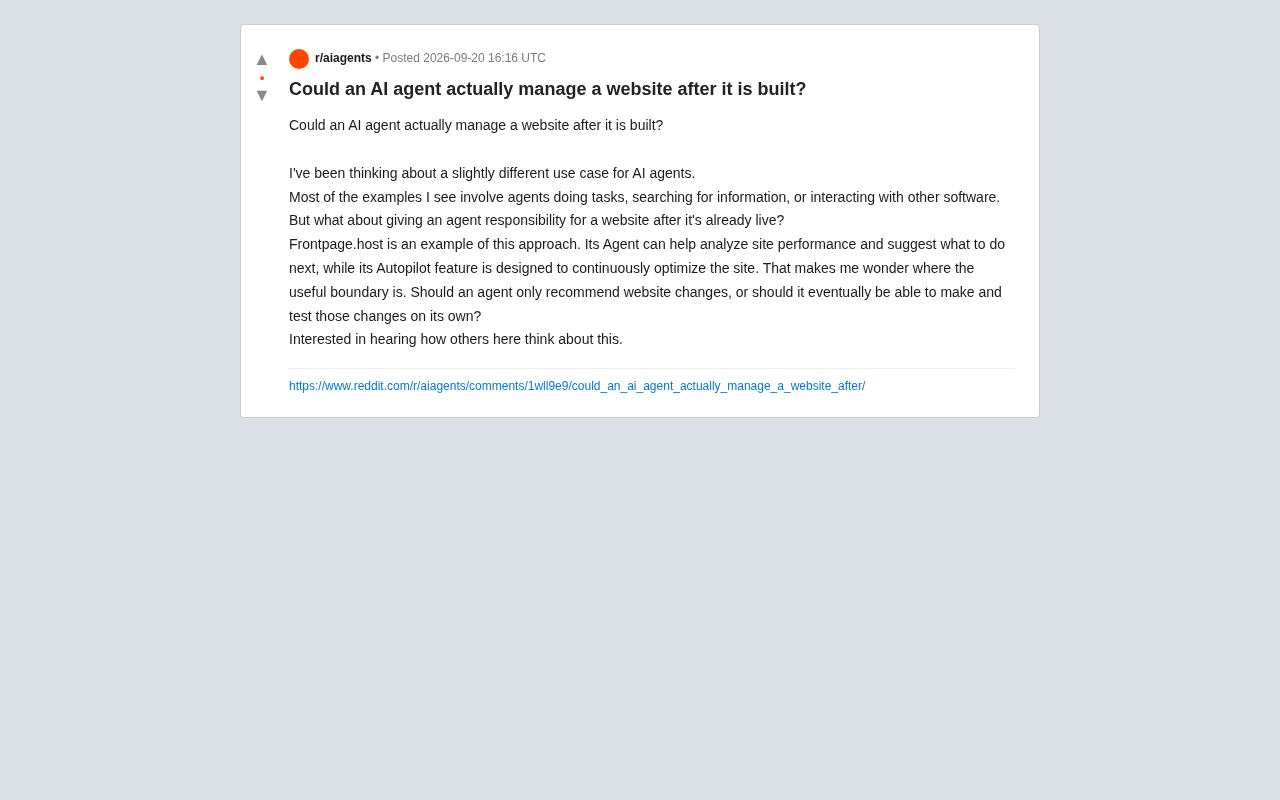
Most discussions about AI Agents today focus on "doing tasks" — searching for information, calling tools, interacting with other software, and completing one-off actions. But in a Reddit thread, one user raised a very different idea: could an Agent take over the ongoing operations of a website after it goes live?
This isn't the tired old question of "using AI to build a website." Website-building tools are already everywhere — from drag-and-drop templates to code generation — and AI's value in the "zero to one" phase has been proven repeatedly. What remains genuinely underexplored is the "one to ongoing" phase: once a website is live, who monitors its performance, spots problems, and iterates on improvements? Traditionally, this is the daily grind of operations, growth, and engineering teams. What the poster was curious about is whether an Agent could take on that long-term responsibility.
One Answer from Frontpage.host
The poster used Frontpage.host as an example to illustrate this concept. According to their description, the product's Agent can analyze site performance and suggest next steps, while its Autopilot feature is designed to continuously optimize the website.
This actually implies two distinct capability layers, and it's worth unpacking them:
Analysis and Recommendations: A Low-Risk Support Role
The first layer is "diagnosis." The Agent reads the site's performance data, visitor behavior, and conversion paths, then tells the operator "what might be going wrong" or "what to try next." At this level, it's fundamentally a decision-support tool — the human still holds the final say on execution. The risk is contained, because the Agent's output is just a reference; even if it's wrong, nothing breaks in production.
Continuous Optimization: Real Transfer of Responsibility
The second layer is what Autopilot represents: "autonomous execution." The Agent doesn't just recommend — it directly makes changes to the website and pushes them live. This is a fundamentally different proposition. It means a portion of control over the system shifts from the human to the Agent. And this is precisely the core question the original poster raised.
A/B testing is the key context for understanding why "autonomous execution" can be viable. It's an experimental method that randomly distributes traffic across two or more versions of a page, using statistical significance to determine which version performs better on a target metric (such as click-through rate or conversion rate). In traditional operations, A/B testing requires a human to design the experiment, set it up, wait for data, and then make a decision — a cycle that often takes weeks. When an Agent takes over this process, it can automatically generate variants, allocate traffic, read results, and decide whether to roll out the winner — all within hours. That's the core value proposition of Autopilot-style features. Understanding how A/B testing works also makes it easier to see why changes that are "testable and easily reversible" are better suited for autonomous Agent execution: the experimental framework has a safety valve built in. Bad changes get exposed in the data rather than silently damaging the entire site.
Where the Useful Boundary Lies
The most valuable follow-up question in the discussion was: should an Agent only recommend changes, or should it ultimately be able to autonomously make and test those changes?
There's no definitive answer, but the question can be approached along two dimensions: risk and reversibility.
On reversibility: if the Agent's changes all run within a rollback-capable, A/B-testable framework, the risk of autonomous execution is dramatically reduced. Changing headline copy, adjusting button placement, reordering images — these are all low-cost experiments. Even if the results are poor, data feedback will expose the problem quickly, and reverting is simple. In this kind of "sandbox optimization," autonomous execution is reasonable.
On risk level: the more a change touches core infrastructure — site architecture, payment flows, data handling — the more it should retain a human approval step. An Agent autonomously optimizing conversion rates that modifies checkout logic to chase short-term metrics could cause hard-to-detect long-term damage. Even if the Agent proposes the solution, changes like these should stay at the "recommendation" level, with a human making the final call.
In other words, the right boundary isn't a binary choice between "fully automated" and "fully manual." It's a tiered authorization model based on each change's reversibility and blast radius: low-risk, testable, easy-to-revert changes go to Autopilot; high-risk, structural changes go to human review.
The Gap Between "Executing Tasks" and "Bearing Responsibility"
What this discussion really touches on is a deeper inflection point in the evolution of AI Agents.
Most mainstream Agents today are task-oriented: give them a goal, they execute it, and they're done. "Managing a website" is responsibility-oriented: it requires being always on, continuously monitoring, and autonomously judging when to intervene — without explicit instructions. The former is one-time and has a clear endpoint; the latter is ongoing and open-ended.
The gap between the two is significant. Continuous operations require the Agent to have persistent memory, long-term goal alignment, the ability to trace its own historical decisions, and the judgment to make tradeoffs when metrics conflict (for example, improving conversion rates might harm user experience). These demands far exceed the complexity of "completing a search task."
The original poster didn't offer a conclusion — they posed the question to the community. That itself suggests this direction is still in early exploration. Tools like Frontpage.host are already experimenting, but the industry is far from consensus on "how much autonomy an Agent should have."
"Long-term goal alignment" has a specific meaning in AI that's worth clarifying here. A task-oriented Agent only needs to stay aligned with a goal within a single session; when the session ends, its state is cleared. Continuous operations, however, require an Agent to remember its historical decisions across days, weeks, or even months — to understand the causal relationship between each change and the resulting shift in metrics, and to ensure that short-term optimization behavior doesn't drift away from the site's long-term business objectives. Current large language models have no native persistent memory beyond their context window. Achieving this capability typically requires additional external memory systems (such as vector databases storing historical decision logs) and explicit objective function design. This is why "responsibility-oriented" Agents are so much more complex to engineer than "task-oriented" ones — it's not just a matter of making the model smarter, but of redesigning the entire system architecture.
A Direction Worth Watching
For anyone following AI Agent deployment, "autonomous website operations" is an excellent observation window. It offers clear commercial value (eliminating mountains of repetitive operational work), and it comes with naturally quantifiable feedback (conversion rates, traffic, performance metrics) — making it ideal for validating how Agents perform in real, sustained scenarios.
If products like this can demonstrate that Agent-driven autonomous optimization within controlled boundaries genuinely delivers positive outcomes, it could become a pivotal case study in the transition of Agents from "tools" to "employees." How far that path extends depends on whether we can design authorization mechanisms that are both empowering and controllable.
Related articles

JobRunner MCP Server: AI Agents Can Now Fix Failed Java Jobs
JobRunner launches an open-source MCP server enabling AI agents to view cluster status, diagnose failures, and recover Java jobs—incident response from any cloud coding environment or existing agent.

MLAI Digital Launches 9 Security Agents: MCP Server Safeguards the Full Lifecycle of Agentic AI
MLAI Digital launches Security MCP Server with nine built-in specialized security agents covering vulnerability discovery, attack simulation, prompt injection detection, API and infrastructure assessment, and accelerated remediation—embedding security validation across the full Agentic AI lifecycle from development to production.

Running Isaac Lab on H100 GPUs: Exploring Better Approaches
Exploring optimization methods for running Isaac Lab on NVIDIA H100 GPUs, including MIG configuration, mixed precision, TensorRT acceleration, and community experience to improve robotics simulation and reinforcement learning efficiency.