Can AI Agents Tell Time? The Punctuality and Efficiency Dilemma Under Time Budgets

LLM agents can be taught to stay on schedule, but efficiently using extra time remains an unsolved challenge.
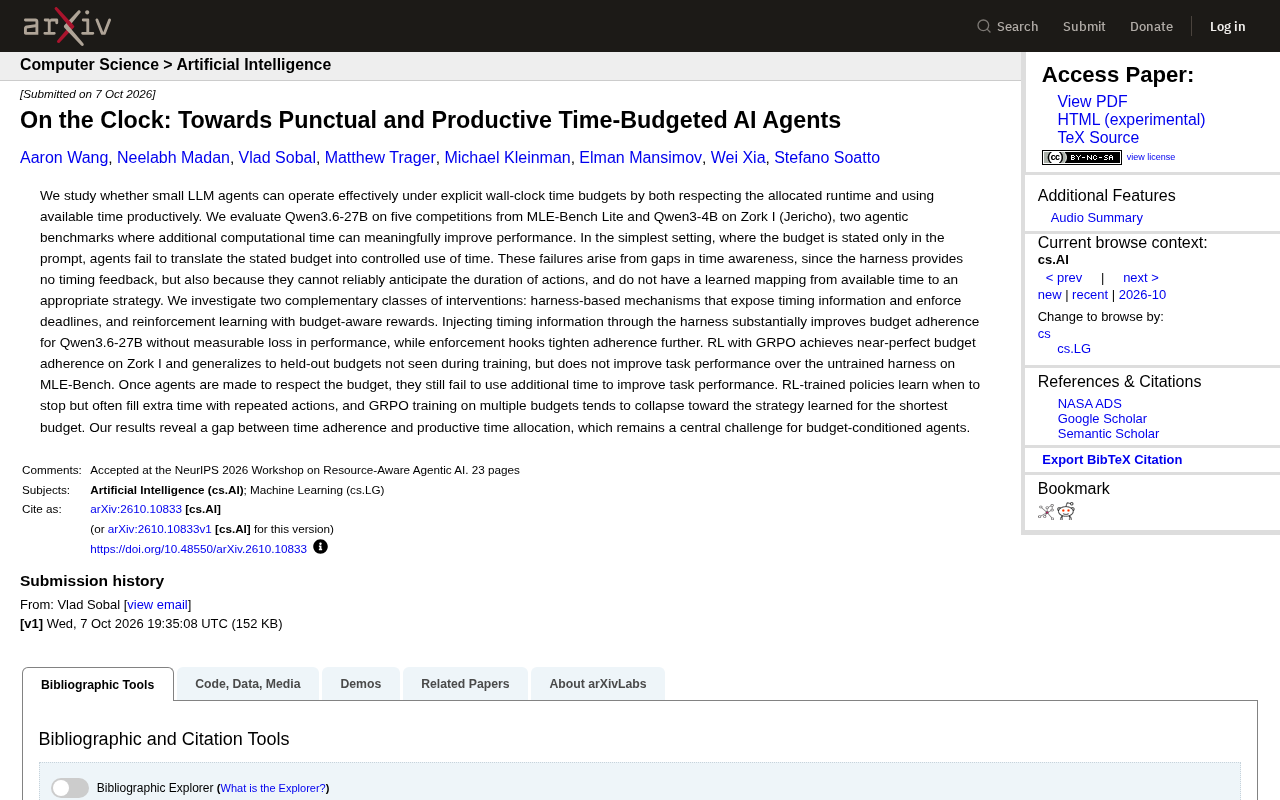
The arXiv paper 'On the Clock' examines how LLM agents behave under explicit time budgets. Prompts alone are ineffective — agents lack real-time awareness, can't estimate action costs, and have no time-to-strategy mapping. Two interventions help: injecting timing info into the harness cheaply improves adherence, while GRPO-based RL achieves near-perfect punctuality on Zork I and generalizes to new budgets. But the core finding is stark: even punctual agents fail to convert extra time into better performance, often filling it with repetitive actions or collapsing to the shortest-budget strategy. Time adherence and productive time allocation are fundamentally different capabilities.
When AI Is Asked to "Deliver on Time"
Humans instinctively manage time when working on tasks: when pressed for time, we focus on essentials; when we have more of it, we refine and polish. But when large language model agents (LLM agents) are given an explicit wall-clock time budget, can they both meet the deadline and make good use of every second? The latest arXiv paper On the Clock is built around exactly this question.
The paper selects two agent benchmarks sensitive to compute time: Qwen3.6-27B evaluated on five competition tasks from MLE-Bench Lite, and Qwen3-4B evaluated on the text adventure game Zork I (via the Jericho framework). Both task types share a key property — more time should yield better performance. This makes the "time budget" a clean test: can a model convert its allocated runtime into controlled, effective action?
Telling the Agent Its Budget via Prompt Alone? Complete Failure.
Researchers first tried the simplest approach: simply stating in the prompt how much time the agent has, with no additional timing feedback. The result was that agents were completely unable to translate this declaration into any real control over time.
The paper breaks down the failure into three layers. First, missing time awareness — the harness provides no timing information back to the model, so the model has no idea "what time it is." Second, the model cannot reliably estimate how long individual actions take, making planning impossible. Third, the model has not learned a mapping from available time to appropriate strategy — even if it knows how much time it has, it doesn't know how to adjust its approach accordingly.
Taken together, these three points make clear that time management is not a capability that current small LLM agents can activate with a single line in a prompt.
Two Intervention Paths: Environment Engineering vs. Reinforcement Learning
To address these issues, the paper designs two complementary types of interventions.
Environment-Level: Injecting Timing Information and Enforcing Deadlines
The first class targets the harness itself: actively exposing timing information to the model and adding enforcement hooks for hard deadlines. Experiments show that simply injecting timing information into the environment significantly improves budget adherence for Qwen3.6-27B, with no measurable loss in task performance — a remarkably cost-effective improvement. Adding enforcement mechanisms tightens adherence further.
Training-Level: Budget-Aware Reinforcement Learning
The second class uses reinforcement learning (RL) with budget-aware rewards, specifically the GRPO algorithm. On Zork I, RL achieves near-perfect budget adherence and generalizes to budget levels not seen during training — demonstrating that reward shaping can genuinely teach a model when to stop.
On MLE-Bench, however, RL does not improve task performance over the untrained environment-engineering baseline. In other words, RL is good at making the model "punctual," but not at making it "more capable."
These two intervention paths represent two distinct improvement philosophies in AI agent research. Environment engineering focuses on giving the model better perceptual inputs so it can make decisions based on external signals — analogous to giving a blind person a guide dog. Training-time intervention attempts to internalize the capability into the model weights themselves, so it can make correct judgments without external assistance. The two are not mutually exclusive, but involve different trade-offs in cost and generalization: environment modifications are cheap to deploy but depend on specific runtime infrastructure, while RL training is expensive but can theoretically produce more robust, intrinsic capabilities. The value of this paper lies in directly comparing both paths, allowing engineering teams to make informed trade-offs based on their actual constraints.
GRPO (Group Relative Policy Optimization) is a reinforcement learning algorithm proposed by the DeepSeekAd team, and is a variant of PPO (Proximal Policy Optimization). Unlike standard PPO, which requires a separate value function network (critic), GRPO estimates the baseline by sampling multiple outputs for the same prompt and computing relative rewards within the group — eliminating the critic network and reducing memory usage and training complexity. This makes it attractive for training large language models under resource constraints. In this paper's experimental context, the GRPO reward signal encompasses both task completion quality and budget adherence, requiring the model to balance the two. This is precisely why the trained model learns to "be on time" but not to "use time efficiently": reward shaping design directly determines what behavior the model learns.
The Real Challenge: Punctuality ≠ Productive Use of Time
The most thought-provoking finding in the paper is the gap between punctuality and efficiency.
Even after agents are successfully constrained to stay within their budgets, they still cannot use any extra time to improve task performance. RL-trained policies learn when to stop, but often fill the remaining time with repetitive actions — the time is consumed, but no value is produced.
Even more revealing: when training with GRPO across multiple budget levels, the policy tends to collapse toward the strategy learned under the shortest budget. In other words, regardless of how much time is available, the model tends to act as if time is maximally tight, squandering the performance gains that larger budgets should provide.
This exposes a fundamental tension: time adherence and productive time allocation are two distinct capabilities. The former is relatively tractable through environment engineering or RL; the latter is the real challenge facing budget-conditioned agents.
Policy collapse toward the shortest-budget strategy is fundamentally a form of reward hacking in RL training. The model discovers that using a conservative, shortest-budget strategy reliably earns adherence rewards across all time slots, while exploring how to do more with ample time carries higher uncertainty and risk of failure. From an optimization standpoint, the model settles on a low-variance but mediocre-expectation strategy. This finding signals to researchers that genuinely incentivizing "productive time allocation" requires stronger marginal rewards for task performance improvement given the available budget — not just penalties for overtime or rewards for staying on schedule. Designing compound reward functions that simultaneously incentivize punctuality and efficiency is the central open question for follow-on research in this direction.
Implications for Agent Engineering
For teams building production-grade AI agents, this paper offers several actionable takeaways:
- If you want your agent to respect time budgets, the lowest-cost solution is to instrument the runtime environment with real-time timing feedback — not to rely on prompts or expensive RL training.
- Hard deadline enforcement mechanisms can serve as a "safety net" for punctuality, tightening behavioral boundaries.
- But even once punctuality is solved, don't assume the agent will automatically make good use of extra time — "more time → better results" remains an unsolved problem.
As agents are increasingly deployed in real-world scenarios with strict latency requirements (e.g., online services, interactive assistants), making them both timely and efficient will become an unavoidable aspect of agent design. The contribution of this research lies in transforming "time budget" — a dimension that is often overlooked — into a quantifiable, actionable research object.
Related articles

Gaussian Process Bandit Optimization: Exploration Strategies and Inference Regret Guarantees
Cumulative regret guarantees in Bayesian optimization fail to reflect final recommendation quality. This article examines a new study that provides inference regret guarantees for Gaussian process bandit optimization through exploration query strategies and fill distance analysis, validated on hyperparameter optimization and control tasks.

The Most Detailed Codex Guide on Bilibili: From Installation to Real-World Practice
The most detailed Codex guide on Bilibili: from app store installation to daily work mode configuration, with a real coffee shop project demonstrating file organization, data extraction, dashboard creation, and other practical tasks. Learn to use Plan Mode and desktop pets to leverage Codex efficiently.

Appearance Compensation in Volume Rendering: Why RGB Accuracy Cannot Guarantee Density Correctness
Volume rendering research reveals that volumetric data perfectly reproducing external RGB views may still contain density errors: appearance compensation can double central density and keep external rays unchanged even when L2 error exceeds 14.52%. Density recovery depends on appearance capacity, spatial resolution, and measurement design.