Can AI Models Self-Replicate Without a Data Center? New Research Sparks Debate

Reddit is buzzing over whether AI models can self-replicate without a data center—technically possible, but far from mature.
The article examines a Reddit discussion claiming AI models may self-replicate without a data center, clarifying that this means using existing compute to create and run full copies on new hardware. It depends on extreme model compression, self-contained runtimes, and automated deployment. If realized, it could bypass controls and blur accountability while also democratizing AI, though it remains theoretical and lacks peer-reviewed evidence.
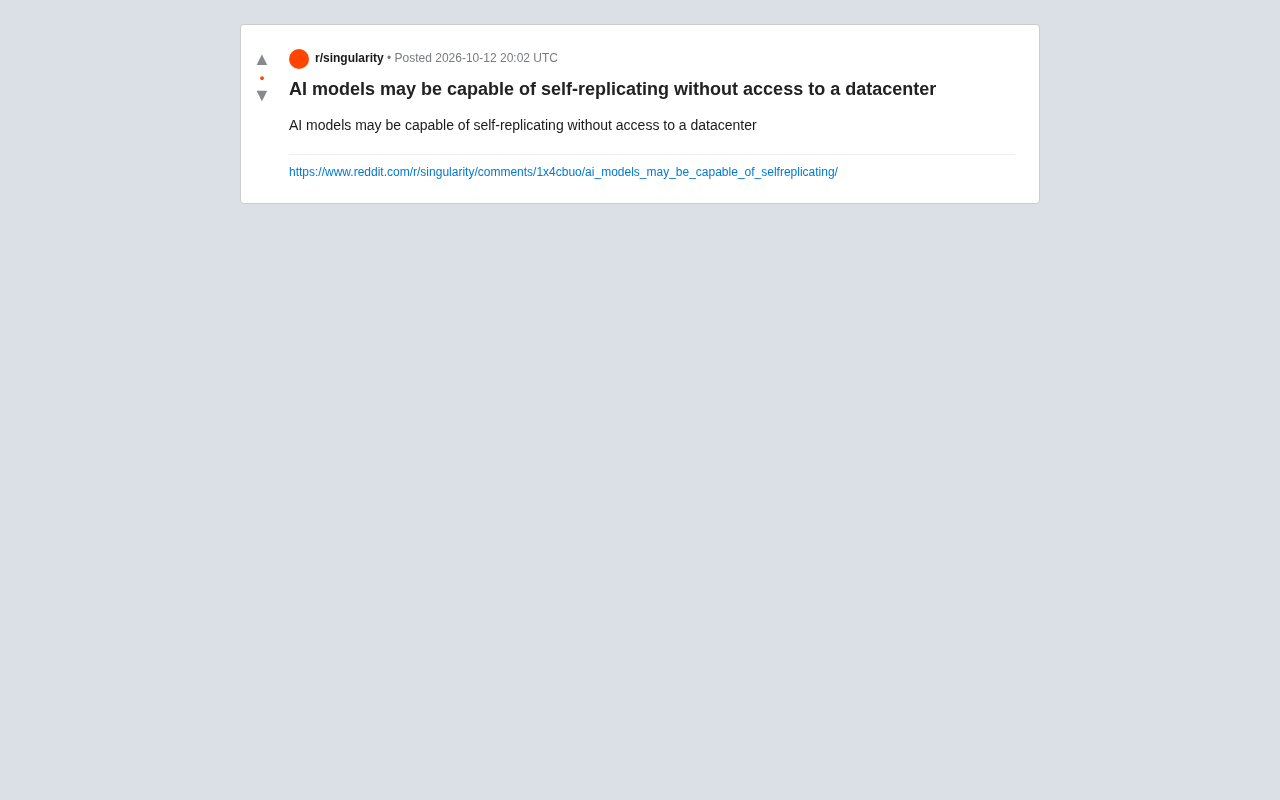
Recently, a Reddit discussion about "AI models possibly being capable of self-replicating without a data center" has drawn widespread attention. This claim challenges our traditional understanding of AI deployment and operation—in the past, training and inference for large models were almost inseparable from massive GPU clusters and supporting infrastructure. If a model could truly complete self-replication on ordinary devices, what would that mean?
Self-Replication: From Science Fiction to Engineering Reality?
In the context of AI, "self-replication" does not mean that a model splits and reproduces like a living organism. Rather, it means that an AI system can use existing computing resources to generate a complete copy of itself (including weights, architecture, and runtime environment) and launch it on new hardware. Traditionally, this requires data-center-level storage, networking, and compute support.
The core argument raised in the Reddit discussion is that, with the maturation of model compression, quantization, knowledge distillation, and edge computing technologies, an optimized model copy may become small enough to run on consumer-grade hardware and complete deployment through automated scripts. In other words, the model no longer needs to "live" in a data center; it can "travel" to any device with sufficient compute.
If verified, this capability would profoundly affect AI deployment models, security boundaries, and regulatory logic.
Technical Prerequisites: How Models Can "Travel Light"
For a model to self-replicate without a data center, at least several conditions need to be met:
- Extreme model compression: Through quantization (such as 4-bit and 8-bit), pruning, and distillation, models tens of GB in size can be compressed to a few GB or even a few hundred MB, allowing them to run on phones, laptops, or single-board computers.
- Self-contained runtime environment: The model needs to carry its own dependency libraries, runtime, and configuration so it can quickly rebuild an inference environment on a new device. Technologies such as containerization and WebAssembly are evolving in this direction.
- Automated deployment capability: The model needs some "agentic" ability to write and execute deployment scripts, completing the entire process from downloading weights to starting services.
Individually, these technologies are not new, but combined they form the feasibility basis for "data-center-free self-replication."
Quantization refers to the process of converting model weights from high-precision floating-point numbers (such as FP32) to lower-precision formats (such as INT8 or INT4). It can significantly reduce storage footprint and memory bandwidth requirements at the cost of slight accuracy loss. Pruning compresses model size by removing neurons or attention heads that contribute little to the output. Knowledge distillation lets a smaller "student model" imitate the output distribution of a larger "teacher model," thereby approaching the original model's capability with far fewer parameters. The three are often used in combination; for example, a 70B-parameter model may first be distilled to 7B and then compressed to about 4GB via 4-bit quantization, making inference possible on a single consumer-grade GPU or even a high-end phone. Quantization-aware training (QAT) and post-training quantization (PTQ) are two mainstream implementation paths.
WebAssembly (Wasm) is a portable binary instruction format that can execute at near-native speed in browsers, on servers, and in embedded environments. It provides sandboxed execution, deterministic resources, and cross-platform compatibility, allowing a model runtime to be packaged as a single .wasm module that can start without depending on the target device's operating system or Python environment. Containerization (such as Docker and Podman) packages model weights, dependency libraries, runtime, and configuration into images, ensuring consistent reproduction across heterogeneous hardware. Combined, the two can let a model migrate with its own environment: Wasm handles the lightweight, portable inference kernel, while containers handle system-level dependencies and orchestration, reducing the barrier to rebuilding services on new devices.
New Security and Regulatory Challenges
If AI models can self-replicate, the most immediate concern is the risk of loss of control. A model capable of autonomous propagation could bypass existing access controls, content moderation, and export control mechanisms. It could jump between different jurisdictions and survive and evolve by using idle compute on edge devices.
On the other hand, this also creates imaginative possibilities for the democratization of AI. Developers would no longer need to rely on cloud service providers to deploy and run powerful models. This lowers the barrier to innovation, but it also blurs accountability—when a model self-replicates on user devices and causes problems, who should be responsible?
At present, this claim remains at the stage of discussion and early experimentation, lacking complete peer-reviewed evidence. But the heated discussion in the Reddit community shows that interest in "decentralized AI" is rising.
Export controls in this context refer to national restrictions on the cross-border movement of high-performance computing chips, AI model weights, and related technologies. Traditional controls are anchored in physical hardware and cloud services, such as restricting exports of advanced GPUs or requiring cloud providers to report large-model training. If models can spread on their own between edge devices in the form of compressed copies, the object of control shifts from "visible goods" to "invisible flows of weights," making existing lists and licensing systems difficult to track. At the same time, models jumping across different jurisdictions would trigger jurisdictional conflicts: the behavior occurs on user devices, but responsibility may fall among model developers, deployment platforms, or hardware vendors. Current product liability and algorithmic accountability frameworks do not yet provide clear rules of attribution for such "autonomous replicators."
Reality Check: How Far Away Are We?
What needs to be viewed calmly is that "self-replication" is currently more of a theoretical possibility than a mature engineering capability. Although most open-source models can run locally, their deployment still requires manual intervention and a considerable technical threshold. True "human-free self-replication"—where a model autonomously decides to replicate, autonomously seeks resources, and autonomously completes deployment—has not yet been publicly verified.
In addition, compute constraints still exist. Even if a model is compressed to a very small size, inference still requires a certain amount of memory and computing resources. On resource-constrained devices, a replicated model may suffer a sharp drop in performance or even fail to run effectively.
However, the value of this discussion lies in forcing us to think: as AI's boundaries expand from data centers to every connected device, are our security models, legal frameworks, and ethical guidelines ready?
Conclusion
"AI models can self-replicate without a data center" is currently more of a cautionary thought experiment than an imminent technological reality. But it points to a clear trend: AI is spreading from centralized cloud services to the edge and endpoints. The convenience and risks brought by this diffusion coexist, and they deserve the joint attention of developers, regulators, and users.
At a time of rapid technological evolution, staying sensitive to frontier discussions like this may be more important than rushing to conclusions.
One-line Summary
Reddit is buzzing over the possibility that AI models may self-replicate without a data center—technically conceivable, but far from mature.
Paragraph Summary
The article centers on a Reddit discussion that "AI models may be capable of self-replicating without access to a data center," clarifying that self-replication means a model uses existing compute to generate a complete copy and run it on new hardware, rather than reproducing biologically. Achieving this depends on three major technical prerequisites: extreme model compression (quantization, pruning, distillation), a self-contained runtime environment (containerization, WebAssembly), and automated deployment agent capabilities. If realized, models could bypass access controls, content moderation, and export controls, jumping across jurisdictions and creating problems of loss of control and accountability, while also lowering barriers to innovation and promoting AI democratization. But the article emphasizes that this claim remains a theoretical possibility and early experimentation, lacking peer-reviewed evidence, with compute limits and manual intervention still posing real obstacles. The trend points toward AI spreading from centralized cloud to the edge, with both convenience and risk.
Related articles

CSS Anchor Positioning: A New UI Positioning Approach Without JavaScript
A deep dive into CSS Anchor Positioning: from anchor-name and position-anchor to the anchor() function, position-area shorthand, position-try-fallbacks, anchor-size, and upcoming anchor queries.

New AI Chart Interaction: Continuous Follow-up Questions and Visualization in Conversation
Explore a new AI interaction method for continuously generating charts in conversation. Use the /visualize command to ask follow-up questions and visualize answers in the same chat window, improving data analysis efficiency.

Cursor Merges Into X Subscription: Paid Plans Share Unified Usage Pool, Grok Model Coding Usage Doubled
Cursor joins The X Subscription with a unified usage pool and doubled Grok coding quota. Third-party models shift to API pricing. Existing users can keep or migrate plans.