Can AI Q&A Tools Solve College Application Anxiety? A Sober Analysis of Their Value and Limitations

AI college application tools offer useful starting points but cannot replace personalized decision-making.
As AI Q&A tools emerge to help Chinese students navigate the stressful Gaokao college application process, this article examines their capabilities and limitations. While these LLM-based tools can provide basic information and defuse family arguments, they tend toward generic optimism, lack dynamic industry insight, and cannot account for individual circumstances. The article argues for focusing on transferable skills, AI collaboration ability, and genuine passion when choosing majors.
A New Variable in College Application Season: The Rise of AI Consulting Tools
Every year during China's Gaokao (national college entrance exam) season, choosing majors and filling out college applications becomes a source of anxiety for millions of families. Major selection, career prospects, AI displacement risks... disagreements between parents and students often escalate into heated arguments. China's college application process has long suffered from severe information asymmetry — with over 3,000 higher education institutions and more than 700 undergraduate majors nationwide, the sheer volume of information is overwhelming. Many families, especially those in rural areas and small towns, lack access to reliable information channels. Traditional solutions include guidance from school teachers, purchasing application guidebooks, and paid consulting services — but these are either limited in coverage or prohibitively expensive, with one-on-one application consulting ranging from several thousand to over ten thousand yuan. It's against this backdrop that AI Q&A applications have begun targeting this scenario, attempting to serve as "professional advisors" using artificial intelligence, providing basic information services to massive numbers of users at extremely low marginal cost.
A Bilibili video showcases a typical scenario: a niece wants to major in new media operations, but her family worries it will be "easily replaced by AI," leading to an impasse. The video recommends using AI Q&A tools like "Qianwen APP" to obtain professional analysis, attempting to resolve family conflicts through technological means.

The AI college application tools currently flooding the market are mostly built on large language model (LLM) technology. These models, trained on massive text datasets, can generate fluent, seemingly professional natural language responses. However, it's important to understand that LLMs are fundamentally probabilistic text generation systems — they predict the next most likely word rather than truly "understanding" career prospects or job markets. Some more advanced tools employ Retrieval-Augmented Generation (RAG) architecture, which retrieves relevant structured data from external knowledge bases (such as historical admission scores, major rankings, employment rate statistics) before the model generates its response, then injects this data as context to produce more accurate, evidence-based answers. But RAG's effectiveness is highly dependent on the quality and update frequency of the external knowledge base — if the underlying data is incomplete or outdated, the generated responses will be equally unreliable.
How Good Are AI Responses About Career Prospects?
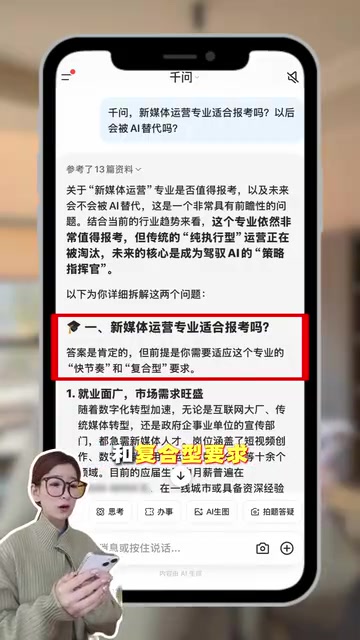
In the video, a user asks the AI: "Is new media operations a good major to apply for? Will it be replaced by AI in the future?" The AI provides a relatively rational response:
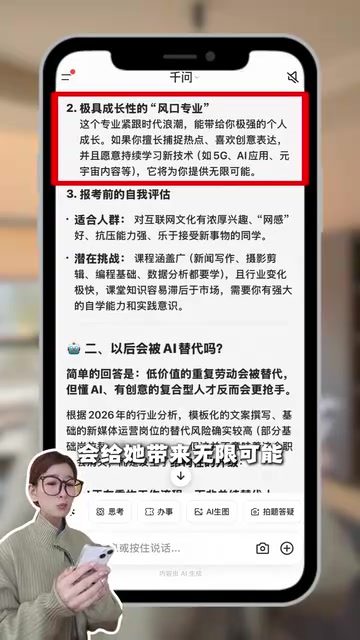
- New media operations is worth applying for, but requires adapting to fast-paced and multidisciplinary demands
- Only low-value repetitive labor will be replaced by AI
- Creative, multidisciplinary talent will be in higher demand
- If the child enjoys creative expression and is good at catching trends, this direction has growth potential

Objectively speaking, this response points in the right direction. The current industry consensus is indeed that AI primarily replaces standardized, repetitive work rather than positions requiring creative judgment and interpersonal communication. This assessment is also supported by academic research — a 2023 joint research paper by OpenAI and the University of Pennsylvania found that approximately 80% of the U.S. workforce has at least 10% of their work tasks affected by GPT-class models, while about 19% of workers have over 50% of their tasks potentially impacted. A McKinsey Global Institute report predicts that by 2030, up to 375 million workers globally may need to switch occupational categories. However, it's worth noting that "replacement" and "transformation" are two different concepts — every technological revolution in history has eliminated some jobs while simultaneously creating many new ones. The key variable is the gap between the speed of technology penetration and the speed at which education systems adapt.
Core competencies in new media operations — content planning, brand tone management, and user insights — are indeed difficult to fully replace in the short term. However, to understand the real employment landscape of this major, more industry context is needed: new media operations as a formal university major began to be established at scale in Chinese universities around 2015, typically under journalism and communication or marketing disciplines. Career paths for this major span content planning, social media management, short video operations, brand communication, user growth, and many other sub-fields. China's digital marketing market exceeded one trillion yuan in 2024, but internal differentiation within the industry is severe: core operations positions at leading platforms and brand companies offer attractive salaries and growth potential, while new media positions at many small and medium enterprises face repetitive work content and low salary ceilings. AI tools (such as automated copywriting, intelligent editing, and automated data analysis) are indeed changing how this industry works, but currently they're more about improving efficiency than completely replacing human labor.
Three Limitations to Watch Out For
However, these AI responses also have obvious shortcomings:
First, responses tend to be optimistic and generic. AI tends to give answers that "address both sides but remain overall positive," lacking precise analysis tailored to specific student situations (such as score range, province, target institution tier). The employment prospects for a new media major at a 985-tier university versus the same major at an ordinary vocational college are worlds apart, but AI often doesn't proactively make this distinction. This pattern of "correct but useless" responses fundamentally stems from the training mechanism of large language models — models tend to generate "safe" responses that fit most scenarios rather than sharp judgments for specific situations.
Second, they lack dynamic industry judgment. The new media industry changes extremely fast, and the current employment landscape may be completely different from what it looks like four years later at graduation. Judgments based on AI training data may not accurately predict future market demand. LLM training data typically lags by several months or even longer, and even with RAG technology connecting to external databases, it's difficult to capture subtle shifts in industry trends.
Third, they cannot replace in-depth consulting. College application decisions involve complex factors such as the student's personality traits, family financial conditions, and geographic preferences — these require deep communication with professional consultants, not just a few rounds of Q&A.
The Right Way to Use AI College Application Tools
These AI Q&A tools are not without value — the key lies in how you position their role.
What They're Good For
- Preliminary information gathering: Quickly understanding the basics of a major, its curriculum, and career directions
- Bridging information gaps: For families in educationally under-resourced areas, AI can at least provide a basic information framework, partially alleviating the structural problem of unequal educational resource distribution
- Defusing emotional standoffs: When parents and children are at loggerheads, a "third-party" analysis can indeed help both sides calm down
What They're Not Good For
- Cannot serve as the final decision-making basis: AI responses are generic and cannot replace in-depth analysis of individual circumstances
- Cannot replace data queries: Hard data such as specific admission scores, rankings, and enrollment plans should be verified through official channels like provincial education examination authority websites and university admissions pages — the accuracy of this data directly determines admission outcomes
- Cannot replace professional consulting: Complex tasks like designing institution tiers and "reach-match-safety" strategies still require experienced professionals. The "reach-match-safety strategy" (冲稳保策略) is the core methodology in China's parallel college application system — "reach" means applying to institutions whose admission scores are slightly above your own, betting on the possibility of acceptance; "match" means applying to institutions that closely align with your scores; and "safety" means applying to institutions whose admission scores are clearly below yours as a fallback. Properly designing this strategy requires comprehensive consideration of historical admission data, ranking fluctuations, enrollment plan changes, cyclical admission patterns, and many other variables — it's a highly experience-dependent task, and AI's reliability in this area remains unproven.
Choosing a Major in the AI Era: Three Fundamental Principles
This case reflects a deeper question — in an era of rapid AI development, how should we choose a major?
Rather than agonizing over whether a specific major "will be replaced by AI," it's better to focus on several more fundamental dimensions:
- Transferability of skills: Choose majors that cultivate foundational abilities (critical thinking, communication and collaboration, creative expression) rather than those that merely teach specific tool operations. There's an important concept in educational research called the "T-shaped professional" — deep expertise in one vertical domain combined with broad cross-disciplinary knowledge and transferable skills horizontally. In the AI era, the value of this talent structure will become even more pronounced.
- Ability to collaborate with AI: The core competitive advantage of the future isn't "competing with AI" but "leveraging AI effectively." People who can harness AI tools to boost efficiency will have an advantage in any industry. This means that regardless of what major you choose, developing digital literacy and AI tool proficiency will become a required course.
- Sustainability of interest and passion: No matter how fast AI replacement progresses, someone who is truly passionate and continuously deepens their expertise can always find irreplaceable value. Psychological research shows that learning and work driven by intrinsic motivation far surpasses extrinsically motivated performance in depth, persistence, and creativity.
Returning to the case in the video, rather than arguing about whether new media operations "will be replaced," it's better to seriously evaluate whether the child truly has passion for content creation and is willing to continuously learn new technologies. These are questions that no AI can currently answer for you.
Conclusion
As supplementary tools for information acquisition, AI Q&A tools have indeed lowered the barrier to knowledge access. But when facing life-changing decisions like college applications, they can only be one reference among many, not the decision itself. True wisdom lies in knowing what AI can help you do — and more importantly, knowing what you must figure out for yourself.
Related articles

Grok 4.5 Feels Weaker in Cursor? A Deep Dive into AI Coding Tool Integration Differences
Users report Grok 4.5 underperforms in Cursor vs. the official terminal. We analyze how system prompts, context management, parameters, and tool calling create AI coding tool integration gaps.

Carta: Pandoc Rewritten in Rust — 45x Faster, 20x Smaller
Carta is a Rust reimplementation of Pandoc with a 9MB binary (1/20th of Pandoc) and up to 45x faster conversion. Supports Markdown, DOCX, LaTeX, and Pandoc JSON filters.

A Beginner's Guide to AI Agents: Core Principles and Learning Paths Explained
Learn AI Agent core principles from scratch: understand how Agents differ from LLMs, their execution mechanisms, why rule design matters, and find the right learning path for your goals.