Can Auto Researcher Reproduce Human Research Decisions? The AutoHRS Framework Provides an Answer

AutoHRS staged evaluation shows Auto Researchers often fail to reproduce key human research decisions.
The article introduces a study on how well Auto Researchers align with human research decisions. The researchers propose the AutoHRS staged evaluation framework, which decomposes the scientific workflow into multiple stages with similarity metrics, and systematically evaluates 456 research trajectories generated from 152 ICLR oral papers. The key finding is that current Auto Researchers frequently fail to recover key human research decisions and their outputs across multiple stages, and reconstruction failures are not isolated cases. The article notes that evaluation should become process-oriented rather than只看 final output, and discusses the importance of decision alignability for system trustworthiness. The AutoHRS framework and trajectory dataset provide a reusable benchmark for future system improvement and highlight priorities for the AI for Science field.
Introduction: When AI Starts Doing Research, Is It Really Like a Human?
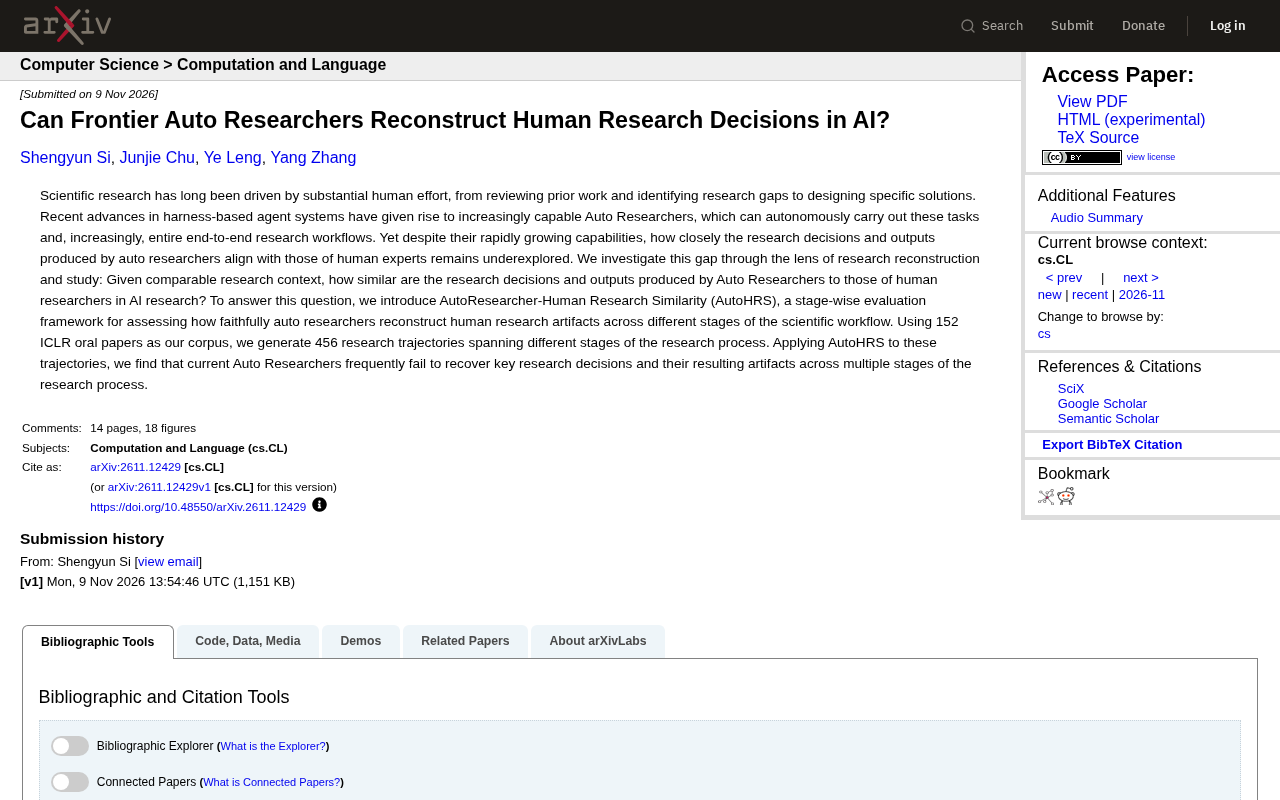
Scientific research has long relied on enormous human effort—from reviewing literature and identifying research gaps to designing concrete solutions. In recent years, harness-based agent systems have given rise to increasingly capable Auto Researchers, which can autonomously perform these tasks and even cover the entire end-to-end research workflow. However, despite rapid capability gains, the degree to which Auto Researchers' research decisions and outputs align with those of human experts remains underexplored.
A recent study addresses exactly this gap by systematically evaluating Auto Researchers' ability to reproduce human decisions in AI research through the lens of "research reconstruction."
Auto Researcher refers to AI systems capable of autonomously executing the scientific research workflow, typically built on large language models and external tools (retrieval, code execution, experiment platforms). A typical pipeline includes: literature review and gap identification, research question definition, method design, experiment implementation and tuning, result analysis, and paper writing. Unlike traditional "AI-assisted tools," Auto Researchers emphasize end-to-end autonomy—humans provide only high-level goals, and the system decomposes and advances them on its own. Recent representative work mostly adopts a "harness" architecture: a controller orchestrates multiple specialized sub-agents (e.g., retrieval agent, coding agent, review agent) and iterates through memory and feedback loops. These systems improve quickly, but they also pose evaluation challenges: the fluency of the final paper can easily mask deviations in intermediate decisions, necessitating process-level, alignable evaluation methods.
The AutoHRS Framework: Stage-by-Stage Evaluation of Research Similarity
To answer the question "under comparable research contexts, how similar are the research decisions and outputs produced by Auto Researchers to those of human researchers," the researchers propose AutoResearcher-Human Research Similarity (AutoHRS), a staged evaluation framework. The framework measures Auto Researchers' fidelity in reproducing research outputs at different stages of the scientific workflow.
The core idea of AutoHRS is to decompose the research process into multiple stages and design corresponding similarity metrics for each stage. This moves evaluation beyond the level of the final paper and into the intermediate links of research decisions—such as problem definition, method selection, and experimental design. This fine-grained evaluation approach can reveal where Auto Researchers are closer to humans and where they deviate more.
Research Corpus and Trajectory Generation
The research team used 152 ICLR oral papers as the corpus and generated 456 research trajectories covering different stages of the research process. ICLR oral papers typically represent high-quality work in the field, and using them as a baseline ensures that the evaluation reference standard is sufficiently rigorous.
By applying AutoHRS to these trajectories, the study reached a key finding: current Auto Researchers frequently fail to recover key research decisions and their resulting outputs across multiple research stages.
ICLR oral papers refer to papers accepted as oral presentations at the International Conference on Learning Representations (ICLR). ICLR is one of the top conferences in machine learning and artificial intelligence and uses an open review system; oral papers usually account for only a small proportion of accepted papers and represent the work with the highest review scores and the strongest community attention. Using oral papers as the corpus means that the baseline's research questions, methodological novelty, and experimental rigor are all at a high level, thereby imposing stricter requirements on Auto Researchers' reproduction capability. A research trajectory refers to the complete sequence of decisions from the initial research context to the final output, including intermediate steps such as problem framing, method selection, experimental configuration, and result interpretation. Decomposing a paper into multiple trajectories can cover different stages and different decision paths, so that similarity evaluation is not limited to the final text but can pinpoint specific failure points.
Key Finding: Reconstruction Failures Are Not Isolated Cases
The results show that Auto Researchers have systematic deficiencies in reproducing human research decisions. Specifically, across multiple research stages, Auto Researchers fail to capture the key decisions made by human researchers under the same context, leading to significant deviations in the final outputs compared with humans.
This finding has two implications. On the one hand, it shows that the capability boundary of current Auto Researchers remains evident—although they can autonomously execute the research workflow, there is still a long way to go in terms of "human similarity" in decision-making. On the other hand, it also suggests that evaluating Auto Researchers cannot rely solely on whether the final output looks plausible; we need to dig into the process and check whether their decision logic is consistent with that of human experts.
Why Is Reproducing Human Decisions So Important?
If the goal of Auto Researchers is to assist or even partially replace some human research work, then the interpretability and alignability of their decisions are crucial. A system that cannot reproduce key human decisions is difficult to trust in research scenarios that require professional judgment. The value of the AutoHRS framework lies in providing an operational way to quantify this degree of alignment and point the way for subsequent improvements.
Decision alignment is a core concept in AI safety and reliability research, referring to the degree to which an AI system's judgments in the same situation agree with those of human experts. In scientific research scenarios, alignability concerns not only "whether the result is correct" but also "whether the reasoning path can be understood and trusted by experts." Even if an Auto Researcher occasionally produces a seemingly reasonable paper, if its method selection and experimental design lack traceable human-like logic, reviewers will find it difficult to judge its reliability and to intervene and correct errors at key stages. Research reconstruction is an evaluation paradigm: given a human researcher's initial context and constraints, the system is required to reconstruct their key decisions and outputs, which are then compared with the real trajectory. Compared with black-box evaluation that only looks at the final product, the reconstruction paradigm can expose systematic deviations in problem definition, hypothesis generation, experimental trade-offs, and other stages, providing actionable diagnostic signals for improvement.
Implications for the Development of Auto Researchers
This study offers several important implications for the future development of Auto Researchers.
Evaluation Needs to Be Process-Oriented
Using only the final paper or output as the evaluation target masks differences in decisions during the research process. AutoHRS's staged evaluation shows that process-oriented evaluation can expose more problems and better guide system improvement.
Current Systems Still Have Clear Shortcomings in Decision Reproduction
The results directly point out that existing Auto Researchers frequently fail at multiple stages. This means that although end-to-end automation of the research workflow is exciting, much work remains before reliability reaches the level of human experts.
A Benchmark for Future Research
The AutoHRS framework and the 456 trajectories based on 152 ICLR oral papers provide a reusable evaluation benchmark for future research. Future Auto Researcher systems can be compared on this benchmark, driving the field toward higher human similarity.
Conclusion
The capability progress of Auto Researchers is evident, but this study reminds us that the real challenge is not whether they can autonomously complete the research workflow, but whether they can make key decisions similar to those of human experts. The proposal of the AutoHRS framework provides a systematic tool for measuring this gap and highlights the priorities for the next stage of Auto Researcher development. For researchers and developers focused on AI for Science, this is a direction worthy of close attention.
One-line Summary
AutoHRS's staged evaluation shows that Auto Researchers often fail to reproduce key human research decisions.
Paragraph Summary
This article introduces a study on the alignment between Auto Researchers and human research decisions. The researchers propose the AutoHRS staged evaluation framework, which decomposes the scientific workflow into multiple stages and designs similarity metrics, and conduct a systematic evaluation based on 456 research trajectories generated from 152 ICLR oral papers. The key finding is that current Auto Researchers frequently fail to recover key human research decisions and their outputs across multiple research stages, and reconstruction failures are not isolated cases. The article points out that this suggests evaluation should shift toward process orientation rather than focusing only on final outputs, and discusses the importance of decision alignability for system trustworthiness. The AutoHRS framework and trajectory dataset provide a reusable benchmark for subsequent system improvement and highlight the next-stage priorities for the AI for Science field.
Related articles
FBI Warns: Hackers Weaponize AI Agent ARTEX to Attack 200+ Organizations
FBI warns that AI penetration framework ARTEX is being used to attack 200+ organizations, with CrowdStrike tracking the VaporPanda group. We break down ARTEX's agent orchestration architecture, the real attack chain, loss data, and the FBI's five defense recommendations.

FBI Warns: Free AI Hacking Tool Artex Spirals Out of Control, Breaches Cloud Systems in Three Hours
FBI warns that the free open-source AI penetration tool Artex is being abused by criminals and state-backed hackers to breach cloud systems in as little as three hours. This article analyzes real attack cases, overlooked side-door risks, and defense measures enterprises and individuals can take immediately.

Verse Engine: Turn Blender/Unity/Unreal Scenes into Browser 3D Links in One Click
Verse Engine by Ctruh is a browser-native 3D and XR engine that publishes Blender, Unity, and Unreal scenes as browser links in one click. View-based streaming opens a 1.03 billion-triangle city scene on a laptop. It offers embeds, API, and SDK for developers, 3D artists, architecture, and e-commerce teams.