Verse Engine: Turn Blender/Unity/Unreal Scenes into Browser 3D Links in One Click

Verse Engine turns Blender, Unity, and Unreal scenes into browser links in one click, with streaming loading for billion-triangle scenes.
Verse Engine by Ctruh is a browser-native 3D and XR engine that aims to close the gap between 3D content creation and distribution with a single link. Users can publish scenes from Blender, Unity, or Unreal in one click, or upload 3D files, scan data, and floor plans, generating standard links that open in any browser without installation. Its core technology is view-based streaming, loading only what the viewer currently sees, enabling a 1.03 billion-triangle city scene to open on an ordinary laptop. Embeds, API, and SDK support integration into websites and apps, serving developers, 3D artists, game studios, architecture, real estate, and e-commerce. A 14-day Pro trial is available; Product Hunt launch received 131 upvotes, 32 comments, and #2 ranking.
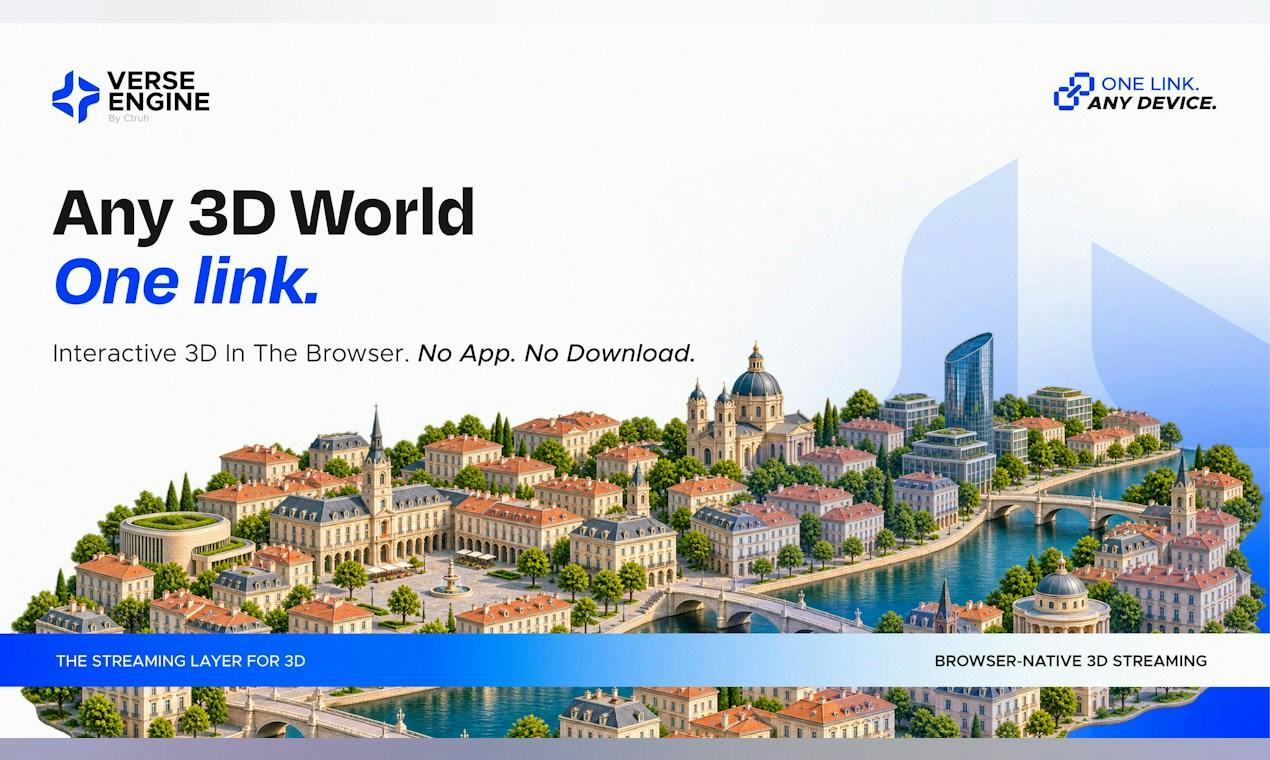
There has long been a gap between 3D content creation and distribution: when designers finish polishing a scene in Blender, Unity, or Unreal and need to deliver it to clients, colleagues, or end users, the recipients often have to install the corresponding software, configure their environment, or even download project files that can run several GB. Verse Engine by Ctruh attempts to close this gap with "a single link"—it's a browser-native 3D and XR engine that turns any 3D content into a link that opens directly in a browser, with no installation or download required.
One-Click Publishing: From Desktop Tools to Browser Links
The core interaction of Verse Engine is compressed into "one click": users can publish scenes directly from Blender, Unity, or Unreal, or upload existing 3D files, scan data, or floor plans. Once published, it generates a standard link that anyone can open and view in any browser, without installing plugins or clients.
This positioning lets it cover multiple roles at once: developers can use it for rapid prototype demos, 3D artists can use it as a distribution vehicle for their portfolios, game studios can use it for internal reviews, architects and real estate teams can use it to present spatial proposals to clients, and e-commerce brands can use it to showcase interactive product models. The official categorization on Product Hunt confirms this—Developer Tools, Augmented Reality, 3D Modeling.
How Streaming Supports Billion-Triangle Scenes
Browser-side 3D has long been constrained by local compute power and memory, and Verse Engine's key technology is "on-demand streaming": scenes only stream the parts visible within the viewer's current field of view, rather than downloading the entire model locally at once.
According to official descriptions, this mechanism allows a city-scale scene containing 1.03 billion triangles to be opened from a link on an ordinary laptop. This number itself illustrates the value of the streaming approach—under traditional methods, models of this magnitude would be nearly impossible to render smoothly in a browser. For scenarios like architectural visualization, digital twins, and large-scale scene previews—where "model size far exceeds the capacity of end devices"—view-based streaming loading is the more realistic path.
Triangles are the most basic geometric unit in 3D modeling: any complex curved surface is ultimately broken down into countless triangles, so triangle count has become a common metric for measuring model detail. Models for ordinary web display typically range from tens of thousands to hundreds of thousands of triangles, while scenes like film and city-scale digital twins can reach hundreds of millions or even billions. Traditional browser solutions need to load the entire model into memory first and then render it via GPU; constrained by end-device VRAM and bandwidth, billion-triangle scenes are nearly impossible to open. The view-based streaming approach pre-partitions the model into spatial chunks (such as octrees or 3D Tiles), requests only the chunks near the view frustum, and combines this with level of detail (LOD)—using low-precision chunks at a distance and swapping in high-precision chunks up close—thereby presenting extremely large scenes under limited bandwidth and VRAM.
On-demand streaming in the 3D field is often combined with techniques such as geometric LOD, spatial indexing, and progressive mesh compression: the server dynamically delivers data chunks based on camera position and orientation, and the client continuously requests new chunks and reclaims old ones as it moves or rotates the view. Such solutions are sensitive to network latency, typically require CDN edge node support, and must balance loading waits against visual continuity. The article's claim of "opening a billion-triangle scene on an ordinary laptop" relies on this entire mechanism, not merely on improving browser rendering performance.
Embeds, API, and SDK: More Than Just a Display Link
If it only did "generate a shareable 3D link," Verse Engine's potential would be limited. The product also offers Embeds, API, and SDK, meaning developers can integrate 3D viewing capabilities into their own websites, applications, or workflows, rather than just sending links for others to view.
This is especially critical for B2B scenarios. Real estate platforms can embed 3D floor plans into listing pages, e-commerce can embed product models into detail pages, and SaaS tools can integrate 3D previews as a feature module. The browser-native, no-download nature means such integrations require no user redirects or additional installations, lowering the barrier to use.
Embeds refer to placing a 3D viewer directly into an existing webpage via an iframe or script tag, similar to the share code provided by video sites, where the host page doesn't need to understand rendering details; API allows programmatic control over which scene to load, switching viewpoints, triggering hotspot annotations, or reading user interaction events; SDK typically encapsulates authentication, asset uploading, scene management, and front-end components for developers to call in their own code. Together, the three form a gradient from "zero-code sharing" to "deep integration": marketing or operations staff can handle distribution with links and embeds, while engineering teams can use API/SDK to turn 3D capabilities into product features. This layered design is also a common path for commercializing browser 3D engines, lowering the trial barrier while leaving room for customization and usage-based billing for B2B customers.
XR and the Imagination of Multi-Industry Adoption
Verse Engine is positioned as a 3D and XR engine, with links that open in any browser. Although the official documentation doesn't elaborate on the specific implementation details of XR, the combination of browser-native and no-download is naturally suited for lightweight distribution of AR/VR content—users can enter a three-dimensional space without first installing a standalone XR application.
Looking at target users, the product covers developers, 3D artists, game studios, architects, real estate teams, and e-commerce brands, spanning nearly all major consumers of 3D content. This "one engine serves multiple industries" strategy suits teams that have 3D needs but lack the capability to build their own rendering pipelines.
XR (Extended Reality) is an umbrella term for VR (Virtual Reality), AR (Augmented Reality), and MR (Mixed Reality). Browser-side XR capabilities mainly rely on the WebXR standard, which lets webpages directly access headset or phone cameras and sensors after user authorization to enter immersive three-dimensional views without installing standalone applications. WebXR's adoption still depends on device and browser support, but in lightweight scenarios like "scan a code to view an AR product" or "a link straight to VR property viewing," browser-native solutions can significantly shorten the user journey. Verse Engine emphasizes that links can open in any browser, and its XR value lies in compressing what used to require a dedicated app into a single click—though actual experience is still constrained by end-device hardware and network conditions.
Free Trial and Product Stage
Verse Engine offers a 14-day Pro trial. When it launched on Product Hunt, it received 131 upvotes and 32 comments, ranking #2 for the day. For a tool aimed at professional 3D workflows, this level of discussion suggests that "3D content distribution is hard" genuinely hits a pain point.
That said, it's worth taking a rational view: the browser 3D engine space already has multiple players, and Verse Engine's differentiation lies in "one-click publishing from mainstream creation tools" and "large-scale scene streaming." Whether it can reliably handle complex scenes in real projects and how mature its API and SDK are still need more real-world usage to verify. For teams that need to distribute 3D content to non-technical users, it's worth using the free trial period to run a test with real scenarios.
One-line Summary
Verse Engine turns Blender, Unity, and Unreal scenes into browser links in one click, with streaming loading supporting billion-triangle scenes.
Paragraph Summary
Verse Engine by Ctruh is a browser-native 3D and XR engine that aims to close the gap between 3D content creation and distribution with a single link. Users can publish scenes from Blender, Unity, or Unreal in one click, or upload 3D files, scan data, and floor plans, generating standard links that open in any browser without installation. Its core technology is view-based streaming, loading only the parts currently visible to the viewer, enabling a city-scale scene with 1.03 billion triangles to open on an ordinary laptop. The product also offers Embeds, API, and SDK, supporting integration of 3D viewing capabilities into websites and applications, covering developers, 3D artists, game studios, architecture, real estate, and e-commerce users. It offers a 14-day Pro trial and received 131 upvotes, 32 comments, and a #2 ranking on Product Hunt.
Related articles

Anthropic's IPO Eve: Five Risks Behind the Trillion-Dollar Valuation and the Truth About Its Governance
Breaking down Anthropic's IPO prospectus: $184M daily revenue at a trillion-dollar valuation, the truth behind $104B in paper losses, a five-class share governance structure, unusual disclosures in 94 pages of risk factors, and how the lock-up schedule may affect retail investors.

FBI Warns: Hackers Weaponize AI Agent ARTEX to Attack 200+ Organizations
FBI warns that AI penetration framework ARTEX is being used to attack 200+ organizations, with CrowdStrike tracking the VaporPanda group. We break down ARTEX's agent orchestration architecture, the real attack chain, loss data, and the FBI's five defense recommendations.

FBI Warns: Free AI Hacking Tool Artex Spirals Out of Control, Breaches Cloud Systems in Three Hours
FBI warns that the free open-source AI penetration tool Artex is being abused by criminals and state-backed hackers to breach cloud systems in as little as three hours. This article analyzes real attack cases, overlooked side-door risks, and defense measures enterprises and individuals can take immediately.