Can Deleting Weights Actually Improve LLM Post-Training?
Deleting some weights during post-training may yield unexpected gains via regularization and sparsification.
The article explores the counterintuitive idea of deleting some LLM weights during post-training. While post-training usually updates weights via full fine-tuning or LoRA, weight deletion belongs to pruning, distinguished by task-aware and dynamic rather than static removal. It proposes three mechanisms—regularization, sparsity-driven efficiency, and iterative loss/gradient-based removal—while noting limits: results depend on strategy, ratio, and task; over-deletion collapses performance; identifying deletable weights remains open; and the original lacks experimental data.
Introduction: A Counterintuitive Finding
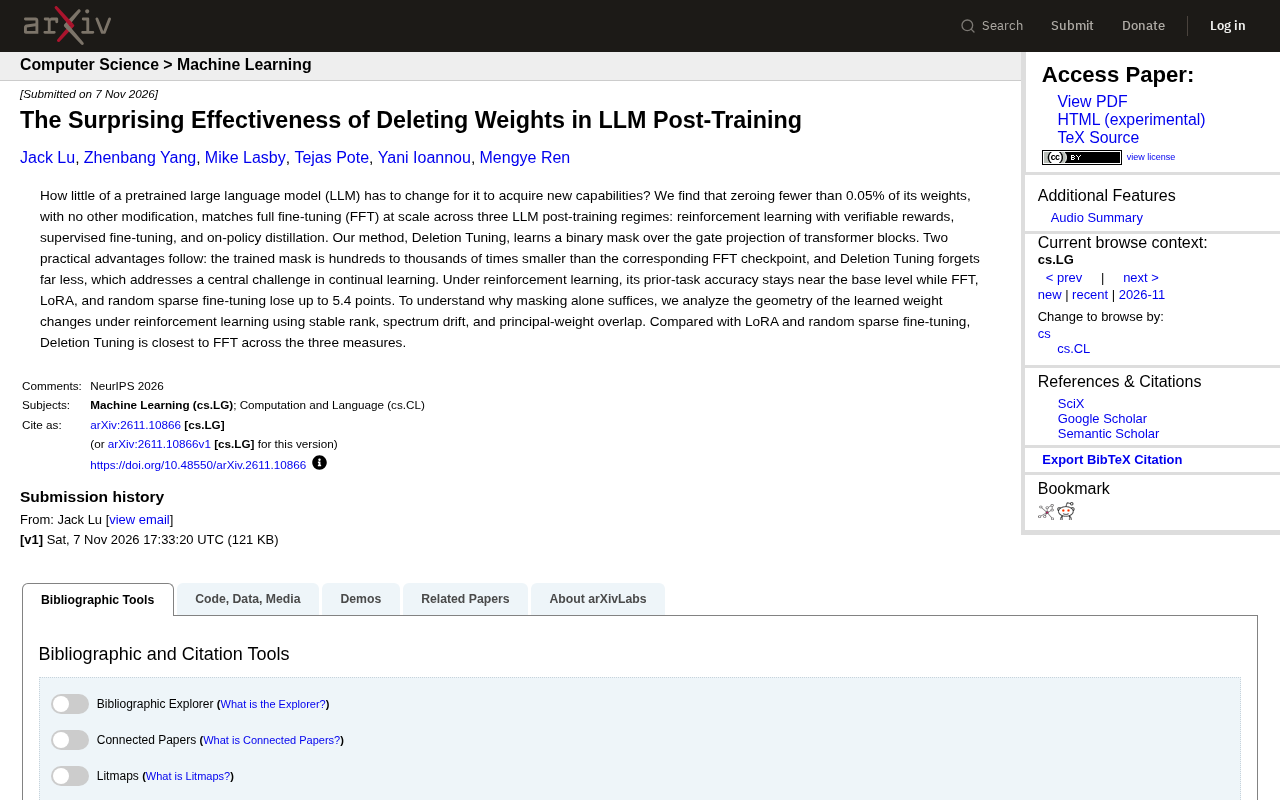
During the post-training phase of large language models (LLMs), we typically focus on adjusting or adding parameters to improve model performance. However, a recent article titled "The Surprising Effectiveness of Deleting Weights in LLM Post-Training" that sparked discussion on Hacker News proposes a counterintuitive idea: deleting some weights may yield unexpected benefits. Although the original article provides no detailed data, this line of thinking challenges conventional wisdom and merits deeper exploration.
Weight Deletion in Post-Training: Concept and Background
Post-training broadly refers to fine-tuning, alignment, and similar processes performed on top of a pretrained model. Traditional approaches such as full-parameter fine-tuning or parameter-efficient fine-tuning (e.g., LoRA) all adapt to downstream tasks by updating weights. Weight deletion, by contrast, falls under the umbrella of model pruning, which aims to remove redundant connections. But the emphasis on deletion "in post-training" suggests this may be a dynamic, task-aware pruning strategy rather than simple static compression.
Parameter-Efficient Fine-Tuning (PEFT) is a class of methods that freeze most of the pretrained model's parameters and train only a small number of newly added or selected parameters. LoRA (Low-Rank Adaptation) is a representative example: it attaches a pair of low-rank matrices alongside the original weights, updates only these small matrices during training, and can merge their product back into the original weights at inference time, adding no inference overhead. The significance of PEFT lies in dramatically reducing memory and storage costs and allowing multiple task adapters to be mounted on the same base model. Understanding PEFT helps situate the difference of "weight deletion": PEFT adds on top of weights, while pruning subtracts from them. Both attempt to complete post-training with far less change than full-parameter fine-tuning, but the former alters the set of trainable parameters while the latter alters the network's connection structure.
Why Might Deleting Weights Work?
Regularization Effect
Deleting weights can be viewed as a strong form of regularization, forcing the model to rely on more important features and reducing overfitting. Especially in post-training scenarios with limited data, moderate pruning may improve generalization.
Magnitude pruning is the most classic pruning criterion: connections are ranked by absolute weight value, and those with the smallest absolute values are removed, on the intuition that small-magnitude weights contribute less to the output. It is simple to implement and requires no additional gradient information, so it is often used as a baseline. In contrast, gradient pruning judges importance based on the loss's sensitivity to weights (e.g., gradient magnitude or second-order information), which is theoretically more task-relevant but incurs higher computation and storage costs. In practice, iterative pruning is often used: remove a small fraction of weights at a time, continue training for several steps, then re-evaluate, avoiding the irrecoverable damage of a single large deletion. It is important to distinguish unstructured pruning (removing individual weights, producing irregular sparsity that requires specialized hardware to realize speedups) from structured pruning (removing blocks such as channels or attention heads, which can directly accelerate general-purpose hardware).
Efficiency from Sparsity
Sparse models may be more efficient at inference time while reducing interference among parameters, making critical paths clearer. Some studies show that sparse networks can achieve performance comparable to or even better than dense networks on specific tasks.
Potential for Dynamic Adjustment
Weight deletion during post-training can be dynamic: iteratively removing unimportant connections based on task loss or gradient information to refine the model. This "prune-while-training" approach may discover better subnetworks.
The Lottery Ticket Hypothesis provides an important theoretical reference for "deleting weights during post-training": it suggests that a dense network may contain a sparse subnetwork that, if retrained with its original initialization values, can match the performance of the full network. This hypothesis elevates pruning from a mere compression technique to a problem of "finding trainable substructures," and also explains why continued training after pruning often performs better than direct inference after pruning. However, the Lottery Ticket Hypothesis relies on precise initialization and retraining, which is costly in LLM post-training scenarios; a more realistic approach is therefore task-aware iterative pruning. Note also that the actual speedup of sparse models depends heavily on low-level operators and hardware support—at low sparsity levels, irregular sparsity may even slow things down due to indexing overhead.
Potential Challenges and Open Questions
Although the idea is appealing, actual results depend on the deletion strategy (e.g., magnitude pruning, gradient pruning), the deletion ratio, and task characteristics. Excessive deletion can cause performance collapse. Moreover, efficiently identifying deletable weights remains an open problem. The original article provides no experimental details, so the precise degree of its "effectiveness" remains unclear.
Implications for AI Practitioners
- Re-examine the value of pruning: Pruning is not only a compression tool but may also serve as a regularization method during post-training.
- Explore task-aware sparsification: Dynamically deleting weights for downstream tasks may be more effective than static pruning.
- Pay attention to the training dynamics of sparse models: Understanding the impact of deletion on the optimization landscape can help design better post-training pipelines.
Conclusion
While the effectiveness of weight deletion in post-training requires more empirical evidence, it offers a new perspective on model optimization. As we pursue ever-larger models, how to "do subtraction" may be equally important.
Note: This article is based on the Hacker News discussion and title information; the original article provides no specific experimental data, and the views expressed are for reference only.
One-line Summary
Deleting some weights during post-training may yield unexpected gains through regularization and sparsification.
Paragraph Summary
The article centers on the counterintuitive idea of "deleting some LLM weights during post-training." Post-training typically updates weights via full-parameter fine-tuning or parameter-efficient methods like LoRA, whereas weight deletion falls under pruning; its distinctiveness lies in emphasizing task-aware, dynamically performed deletion rather than static compression. The article proposes three possible mechanisms: first, a regularization effect, where deletion forces the model to rely on key features and alleviates overfitting on small data; second, sparsity improving inference efficiency and reducing interference among parameters; third, iteratively deleting based on loss or gradient information, which may discover better subnetworks. It also notes limitations: results depend on deletion strategy, deletion ratio, and task characteristics; excessive deletion leads to performance collapse; efficiently identifying deletable weights remains an open problem; and the original article lacks experimental data, so the degree of effectiveness is unclear. Finally, it offers three implications for practitioners.
Related articles

Meta FAIR Releases e-means: A New k-means Alternative That Converges 10x Faster
Meta FAIR releases e-means in FAISS 1.16.0, replacing mini-batch k-means with ~10x fewer epochs, 10-45x GPU speedup, and no new hyperparameters.

AI Is Great at Writing Code, So Why Are Codebases Becoming More Fragile?
AI coding tools boost efficiency but may make codebases fragile. Based on a developer blog and Hacker News discussion, this article analyzes the hidden costs of AI-generated code, community divisions, and practical suggestions for reducing risks.

30 Million USD in Funding: The Ambition and Challenge of Redesigning the CPU
A startup has raised 30 million USD to redesign the CPU. This article analyzes its possible technical routes, funding challenges, and industry impact, exploring architectural innovation opportunities in the battle between specialization and generalization.