Can Generated Images Really Improve Visual Reasoning? 13 Model Pairs Show Accuracy Actually Drops

Empirical study: having multimodal models generate auxiliary images before answering reduces average accuracy by 3.7 points.
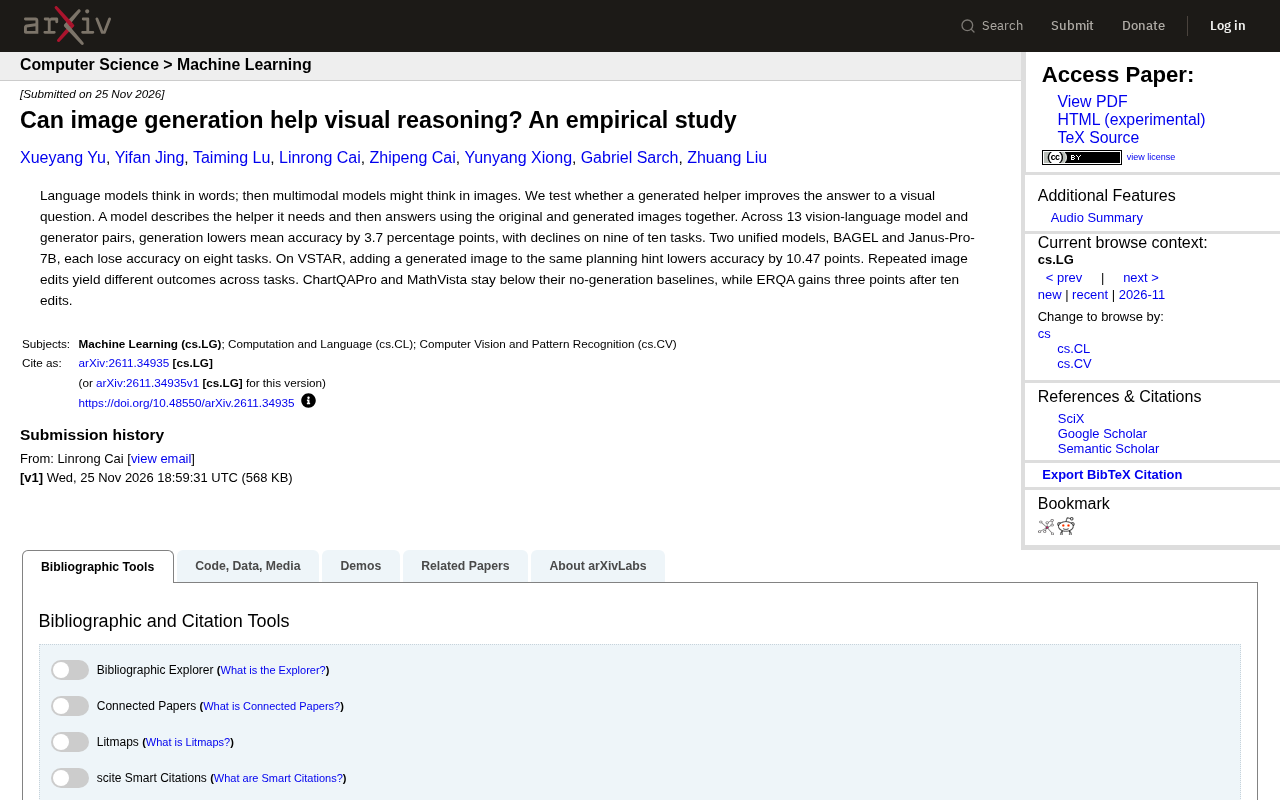
An empirical study covering 13 vision-language model and image generator pairings across 10 tasks tested the "generation as reasoning" hypothesis. Using a two-stage pipeline where models describe a needed auxiliary image and then answer with both the original and generated image, average accuracy fell by 3.7 percentage points, with 9 of 10 tasks declining; unified models BAGEL and Janus-Pro-7B each lost accuracy on 8 tasks, and the VSTAR planning task dropped by 10.47 points. Repeated editing helped only some tasks. The study suggests generation noise and bias outweigh information gains, challenging optimistic views of "thinking with images."
Can multimodal large models aid their thinking by "drawing pictures"? An empirical study offers a cautious answer: when models first generate an auxiliary image before answering visual questions, average accuracy drops by 3.7 percentage points. This experiment, covering 13 combinations of vision-language models and image generators, systematically tests the intuitive hypothesis of "generation as reasoning."
Experimental Design: Letting Models "Draw" the Clues They Need
The researchers' approach is straightforward: language models reason with text, so perhaps multimodal models can reason with images. They designed a two-stage pipeline—the model first describes what kind of auxiliary image it needs, then answers using both the original image and the generated image. This "self-supplied clue" approach could theoretically supplement visual information and let the model make judgments on clearer representations.
The test covered 13 pairings of vision-language models with generators and compared accuracy with and without generation across 10 tasks. This means the experiment examines not only the capability of a single model but also the generalizability of different generator-reasoning model pairings.
Vision-language models (VLMs) are multimodal models that accept both image and text inputs and output text, typically represented by LLaVA, Qwen-VL, and others; image generators refer to text-to-image models such as Stable Diffusion and DALL·E. Unified models (such as BAGEL and Janus-Pro) are models that possess both image understanding and image generation capabilities within the same set of parameters or architecture, distinct from "VLM + external generator" stitching solutions. The paired experiments in this study are organized around these two architecture types: one is the combination of an understanding model with an independent generator, and the other is native unified models, used to test whether generation capability serves reasoning more effectively when integrated into the architecture.
Core Finding: Generation Actually Hurts Accuracy
The overall results contradict expectations. Across the 13 pairings, generating auxiliary images reduced average accuracy by 3.7 percentage points, with 9 of 10 tasks showing declines. Even BAGEL and Janus-Pro-7B, the two unified models (with native support for both image generation and understanding), each lost accuracy on 8 tasks.
This result suggests that the noise or bias introduced by generated images may exceed the information gain they provide. The auxiliary images the model "draws" may not faithfully reflect the original visual content and may instead interfere with subsequent reasoning.
Significant Loss on Planning Tasks
The situation is especially pronounced on the VSTAR task: even when the model is given the same planning prompt, adding generated images still reduces accuracy by 10.47 percentage points. Planning tasks depend on precise grasp of space and steps, and the blurriness or erroneous details of generated images may directly mislead judgments.
The mechanism behind the accuracy drop can be understood from the perspective of "generation fidelity": the images output by text-to-image models are sampled approximations of the model's internal intent rather than faithful reconstructions of the original image, and they easily lose key information such as fine-grained text, counts, and spatial relationships. When the downstream reasoning model treats this approximate image as evidence, errors are amplified rather than offset. In addition, generated images have a domain gap from real images, and the visual priors VLMs acquire from training on real images may not adapt well to self-generated images—which also explains why unified models were not spared: native generation capability does not automatically guarantee that generated content is useful for reasoning.
VSTAR (Visual Spatial Reasoning with Textual Annotations and Rationales) is a benchmark for visual-spatial reasoning, where tasks require the model to determine relative positions, directions, and reachability between objects based on images and to provide step-by-step reasoning. Such tasks are extremely sensitive to the precision of spatial coordinates and geometric relationships; any perspective distortion, object misalignment, or detail hallucination in generated images directly changes the correct answer. Planning tasks therefore become the most stringent scenario for testing the "generation as reasoning" hypothesis, and the 10.47 percentage point drop also suggests that the more a task relies on precise spatial representations, the higher the risk of self-generated intermediate images.
Repeated Editing: Effects Vary by Task
The study also examined the impact of repeatedly editing generated images. Results after multiple edits were inconsistent: ChartQAPro and MathVista remained consistently below the no-generation baseline, indicating that editing did not recover the disadvantage; while ERQA improved accuracy by three percentage points after ten edits.
This divergence suggests that the value of generated images is highly task-dependent—tasks requiring precise numerical or chart understanding are unlikely to benefit from generation, while certain spatial reasoning tasks may gain limited improvements through iterative correction.
Implications for Multimodal Reasoning
This study provides empirical grounds to question the optimistic narrative of "thinking with images." As an intermediate step, image generation currently looks like a double-edged sword: it adds computational overhead while reducing answer reliability in most scenarios. Unified models also failed to show the expected advantage, indicating that native generation capability does not equal effective visual reasoning ability.
If generation is to truly serve reasoning in the future, stricter generation quality constraints may be needed, or models may need to learn when not to rely on self-generated images. Until then, the default practice of treating generated images as reasoning aids deserves caution.
One-line Summary
Empirical study: having multimodal models first generate auxiliary images before answering reduces average accuracy by 3.7 percentage points.
Paragraph Summary
An empirical study covering 13 vision-language model and image generator pairings across 10 tasks tested the hypothesis of "generation as reasoning." The experiment used a two-stage pipeline: the model first describes the auxiliary image it needs, then answers using both the original and generated images. Results show that generating auxiliary images reduced average accuracy by 3.7 percentage points, with declines on 9 of 10 tasks; the unified models BAGEL and Janus-Pro-7B also each lost accuracy on 8 tasks. The VSTAR planning task saw a drop of 10.47 percentage points. The effect of repeatedly editing generated images varied by task: ChartQAPro and MathVista remained consistently below baseline, while ERQA improved by three percentage points after ten edits. The study concludes that the noise and bias introduced by generated images exceed the information gain, raising questions about the optimistic narrative of "thinking with images."
Related articles

A 19-Year-Old's Rental Horror Story: Ceiling Collapse, Bug Infestation, and the Lessons It Taught Me
At 19, my first off-campus rental brought bug infestations, no heat, a collapsed ceiling, and a ruined laptop with no renter's insurance. Here are the hard-won lessons for first-time student renters.

Veda Nurse's Cranial Nerve Exam: Why ASMR Role-Play Is Going Viral
Bilibili creator Veda's cranial nerve exam ASMR video goes viral, blending humor and sensory triggers through nurse role-play. This article analyzes its unique appeal and the audience psychology behind ASMR role-play.

LG Cinebeam AI Review: 120-Inch Giant Screen + 3000 Lumens, a New Choice for the Living Room Theater
LG Cinebeam AI projector review: 3000 ANSI lumens, 4K, 100 inches from about 8 cm and 120 inches from about 18 cm. Built-in webOS, AI Concierge voice recommendations, AI Sound Pro 11.1.2 virtual surround, and Game Optimizer—positioned for fixed living room installation, complementing the portable Cinebeam S.